
The blue wildebeest (Connochaetes taurinus) is a large, muscular antelope found across the grasslands and savannas of southern and eastern Africa. It’s the star of the Great Migration, the animal most people picture when they think of a million hooves crossing the Serengeti. It’s also one of two wildebeest species, and it’s often confused with its cousin, the black wildebeest.
Here’s the quick answer to what sets them apart: the blue wildebeest has a bluish-gray coat with dark vertical stripes, lives across a much wider range, and migrates in huge numbers. The black wildebeest has a dark brown to black coat, sticks to South Africa, and stays mostly in one place. The rest of this guide covers both in detail, along with the facts about blue wildebeest behavior, speed, and migration that most articles get slightly wrong.
Why Are Blue Wildebeest Blue?
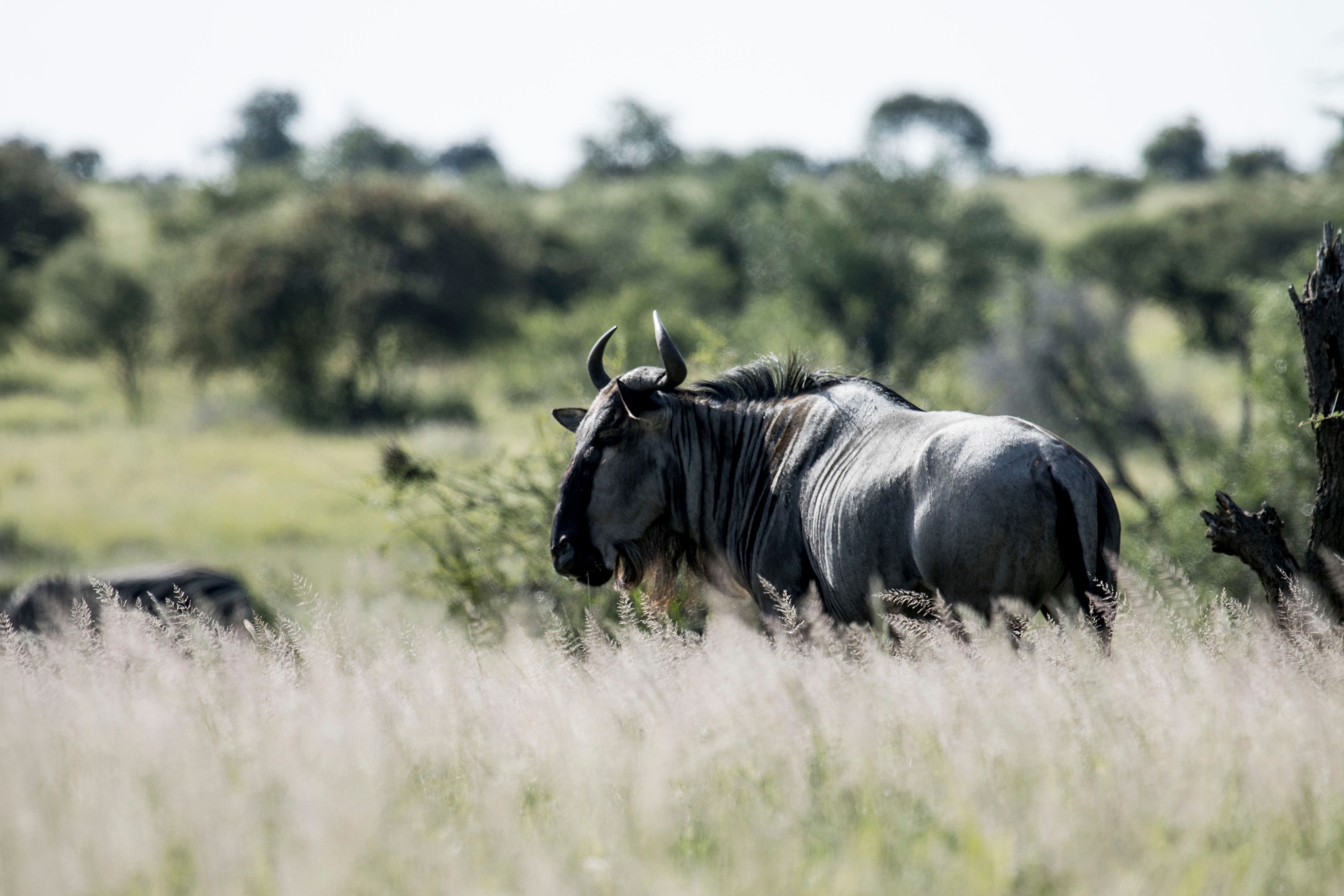
Wildebeest calves are actually born tawny brown, not blue. The bluish-gray coloring develops around two months of age as pigment builds up in the coat. Along with the dark vertical stripes, this coloring helps break up a wildebeest’s outline against the shimmering heat haze of the savanna, making it harder for lions, hyenas, and other predators to pick out a single animal from a moving herd.
Blue Wildebeest at a Glance
| Feature | Detail |
|---|---|
| Scientific name | Connochaetes taurinus |
| Also known as | Common wildebeest, white-bearded wildebeest, brindled gnu |
| Weight | 330 to 660 lb (150 to 300 kg), males larger than females |
| Height at shoulder | 4 to 5 feet (1.2 to 1.5 m) |
| Coat | Bluish-gray to brownish-gray, with dark vertical stripes |
| Top speed | Around 50 mph (80 km/h) on land |
| Lifespan | Up to 20 years in the wild |
| Habitat | Short-grass plains and acacia savanna |
| Diet | Short grasses |
| Predators | Lions, hyenas, cheetahs, leopards, wild dogs, crocodiles |
| Conservation status | Least Concern (IUCN) |
| Global population | Around 1.5 million |
Blue Wildebeest vs Black Wildebeest

These are the two things people search for most, and the confusion is understandable since both animals share a genus and a general shape. Here’s how they actually differ.
| Feature | Blue Wildebeest | Black Wildebeest |
|---|---|---|
| Scientific name | Connochaetes taurinus | Connochaetes gnou |
| Coat color | Bluish-gray to brownish-gray with dark stripes | Dark brown to black |
| Build | More robust and heavily built | More slender |
| Range | Southern and East Africa, widespread | South Africa only, more localized |
| Migration | Migrates in massive herds, up to 1.5 million animals | Largely non-migratory, holds smaller territories |
| Horns | Curve outward and up in both sexes | Curve forward and up in both sexes |
| Gallop | Standard running gait | Distinctive stiff-legged gallop |
| Conservation status | Least Concern | Least Concern, recovered from near-extinction in the 1900s |
The black wildebeest actually had a much closer call with extinction than the blue wildebeest. Hunting nearly wiped it out in the early 20th century, and the entire species came from a small number of surviving animals on private land. Conservation efforts since then have brought numbers back to a stable, healthy population, almost entirely on private and provincial reserves in South Africa today.
Five Subspecies of Blue Wildebeest
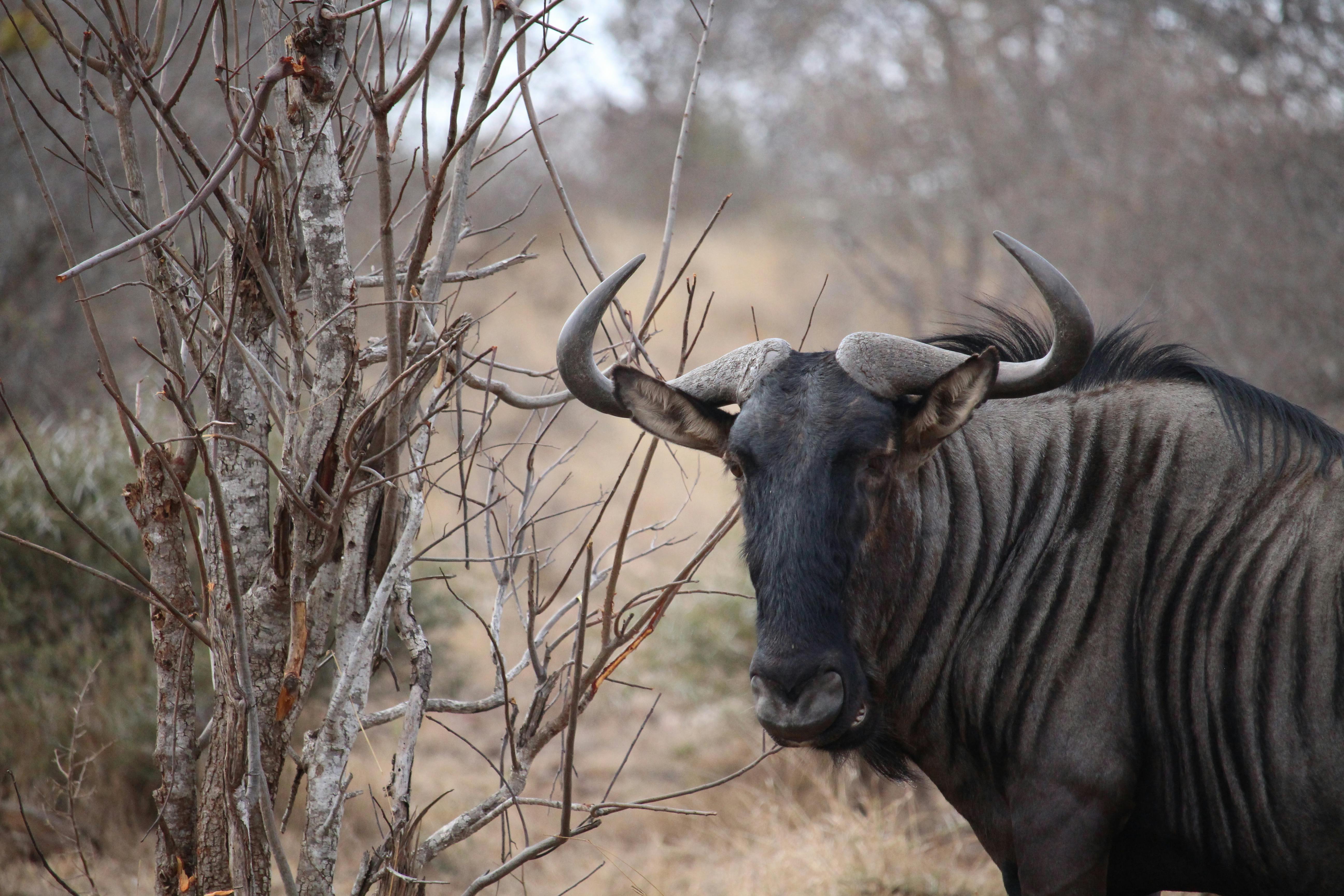
This is the part most guides to the blue wildebeest skip entirely: it isn’t one uniform population. There are five recognized subspecies, spread across different parts of the continent.
| Subspecies | Where Found | Notes |
|---|---|---|
| Common wildebeest (C. t. taurinus) | South Africa, Namibia, Mozambique, southwestern Zambia, southern Angola | The widest-ranging subspecies |
| Western white-bearded wildebeest (C. t. mearnsi) | Serengeti, Tanzania | Most numerous, with over 1 million individuals; smallest and lightest subspecies |
| Eastern white-bearded wildebeest (C. t. albojubatus) | Northeastern Tanzania to central Kenya | Least numerous, around 6,000 to 8,000 individuals |
| Nyassaland wildebeest (C. t. johnstoni) | Mozambique, southern Tanzania | Has the largest beard of any subspecies |
| Cookson’s wildebeest (C. t. cooksoni) | Luangwa Valley, Zambia | Largest subspecies by body and horn size |
The wildebeest most safari-goers picture during the Great Migration is the western white-bearded wildebeest, since it’s the subspecies that dominates the Serengeti-Mara ecosystem.
Where Blue Wildebeest Are Found in Africa
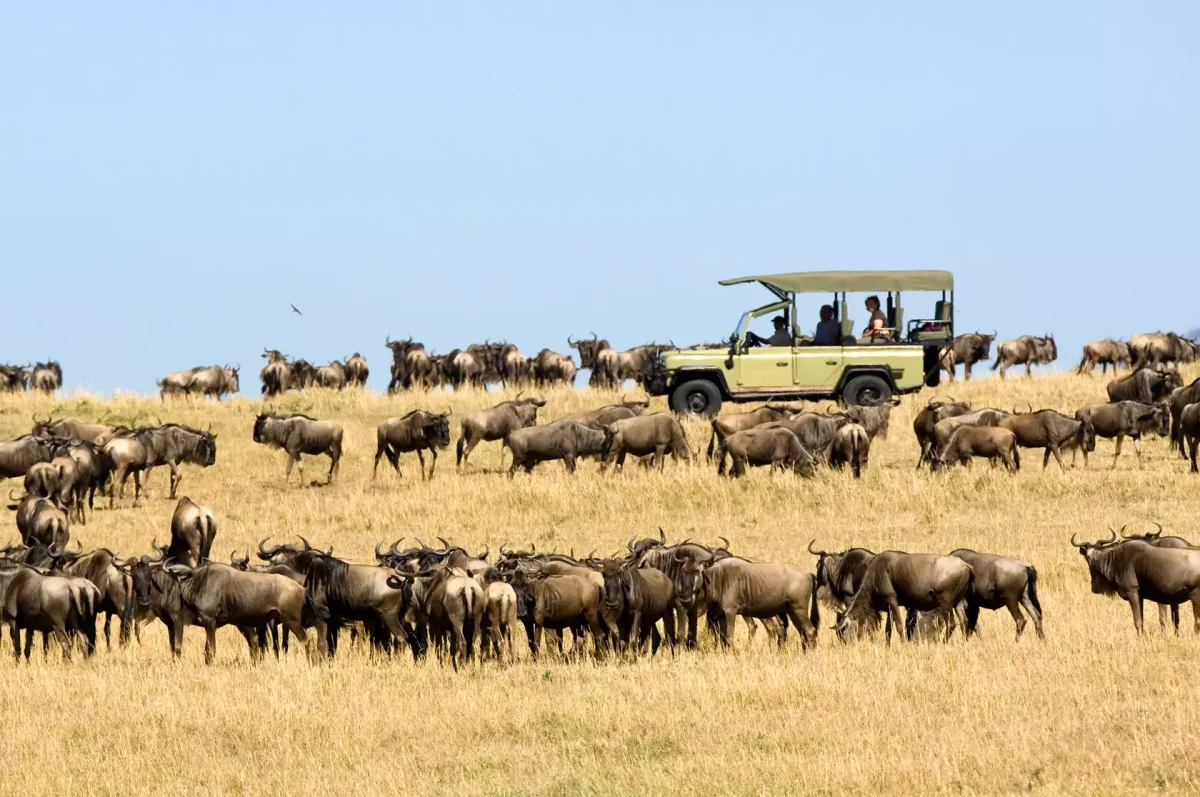
Blue wildebeest range across a wide stretch of southern and eastern Africa. The best-known populations, and the ones most safari itineraries are built around, include:
- Serengeti National Park, Tanzania: home to the western white-bearded subspecies and the core of the Great Migration herd.
- Masai Mara National Reserve, Kenya: the migration’s northern range, famous for the Mara River crossings.
- Ngorongoro Crater, Tanzania: a resident, non-migratory population living within the crater year-round.
- Kruger National Park, South Africa: home to the common wildebeest subspecies, alongside other Big Five wildlife.
- Okavango Delta and Chobe, Botswana: wildebeest are present, though in smaller numbers than the Serengeti-Mara ecosystem.
- Etosha National Park, Namibia: a stable population centered around the park’s waterholes.
- South Luangwa and Luangwa Valley, Zambia: home to the Cookson’s wildebeest subspecies, found nowhere else.
Blue Wildebeest Behavior and Communication
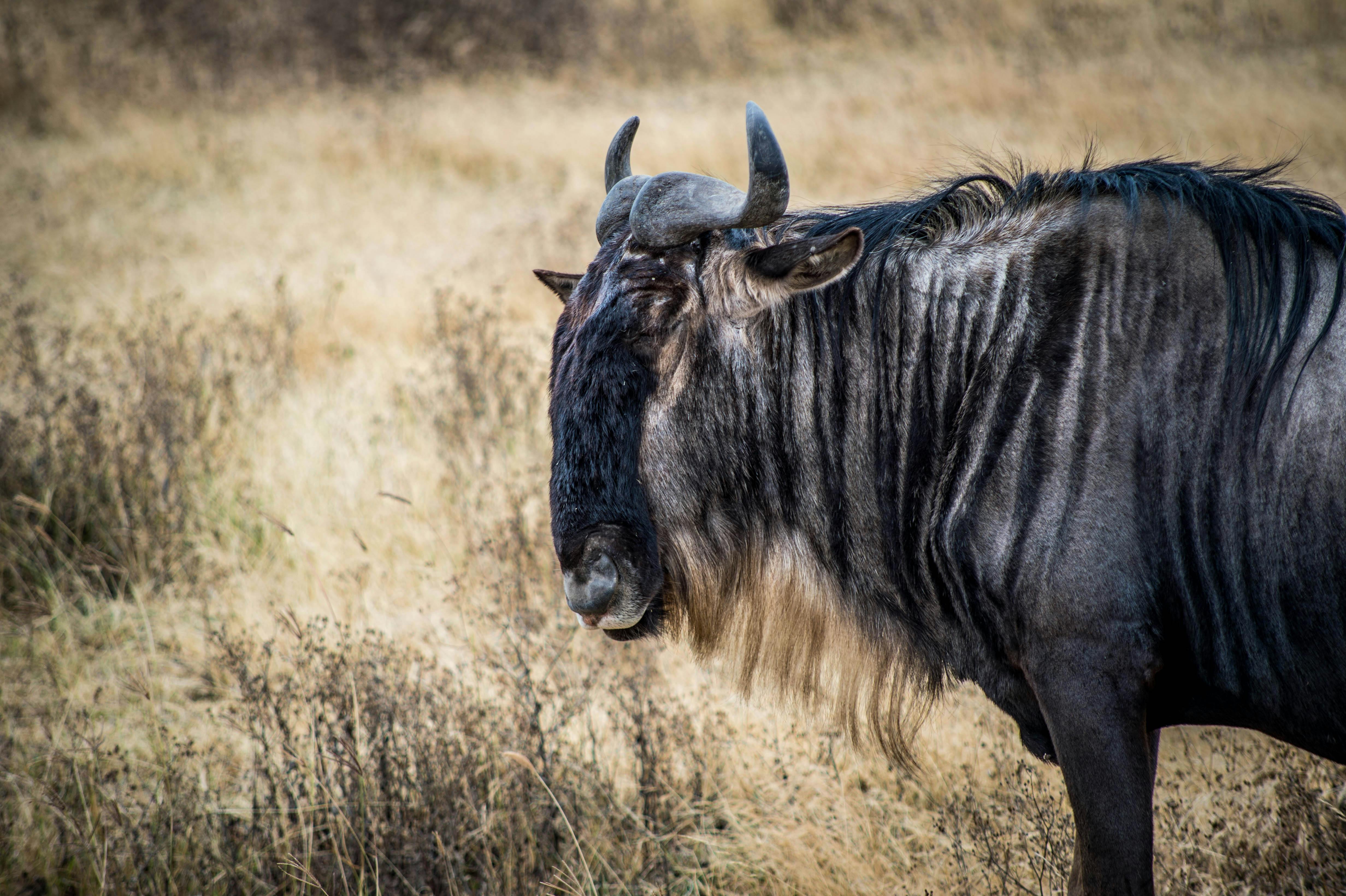
Blue wildebeest are highly social and almost never seen alone. A few behaviors stand out:
- Scent-based communication. Wildebeest use preorbital glands near the eyes, pedal glands on their feet, plus urine and feces, to mark territory, stay bonded with the herd, and leave trails other wildebeest can follow across open plains.
- Social bonding. Herd members rub their faces and glands against each other’s hindquarters, and often nuzzle or sniff one another, which helps reduce tension and reinforce group cohesion.
- Early warning system. Wildebeest are usually the first animals in a mixed herd to snort and alert everyone to a predator, since their survival depends on collective vigilance.
- Mixed herding. They often graze alongside zebras, since the two species have different grazing preferences and don’t compete directly for the same grass, while both benefit from extra eyes watching for predators.
Do Wildebeest Really Smell Rain From Miles Away?
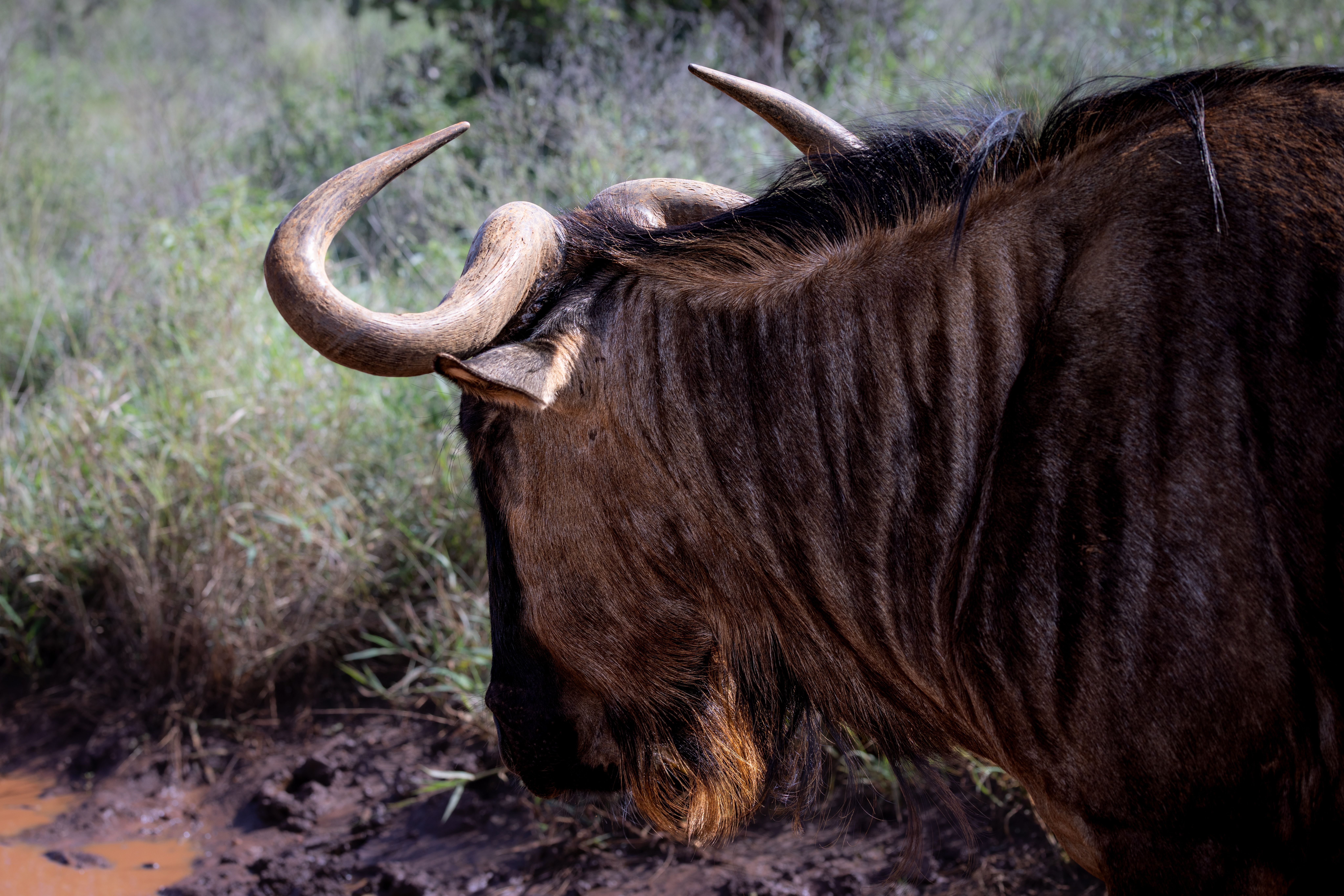
You’ll see this claim everywhere, usually with a number attached, anywhere from 30 to over 50 kilometers. The truth is more layered than a single sense. Researchers studying the migration generally agree that wildebeest respond to distant rainfall, but the mechanism is likely a combination of cues rather than smell alone: scent carried on the wind, the low-frequency rumble of distant thunder, and visual cues like storm clouds building on the horizon. No study has pinned an exact detection range, so treat any specific number you see, including ours, as a rough estimate rather than a measured fact.
Wildebeest Calves: Birth, Survival, and Real Numbers
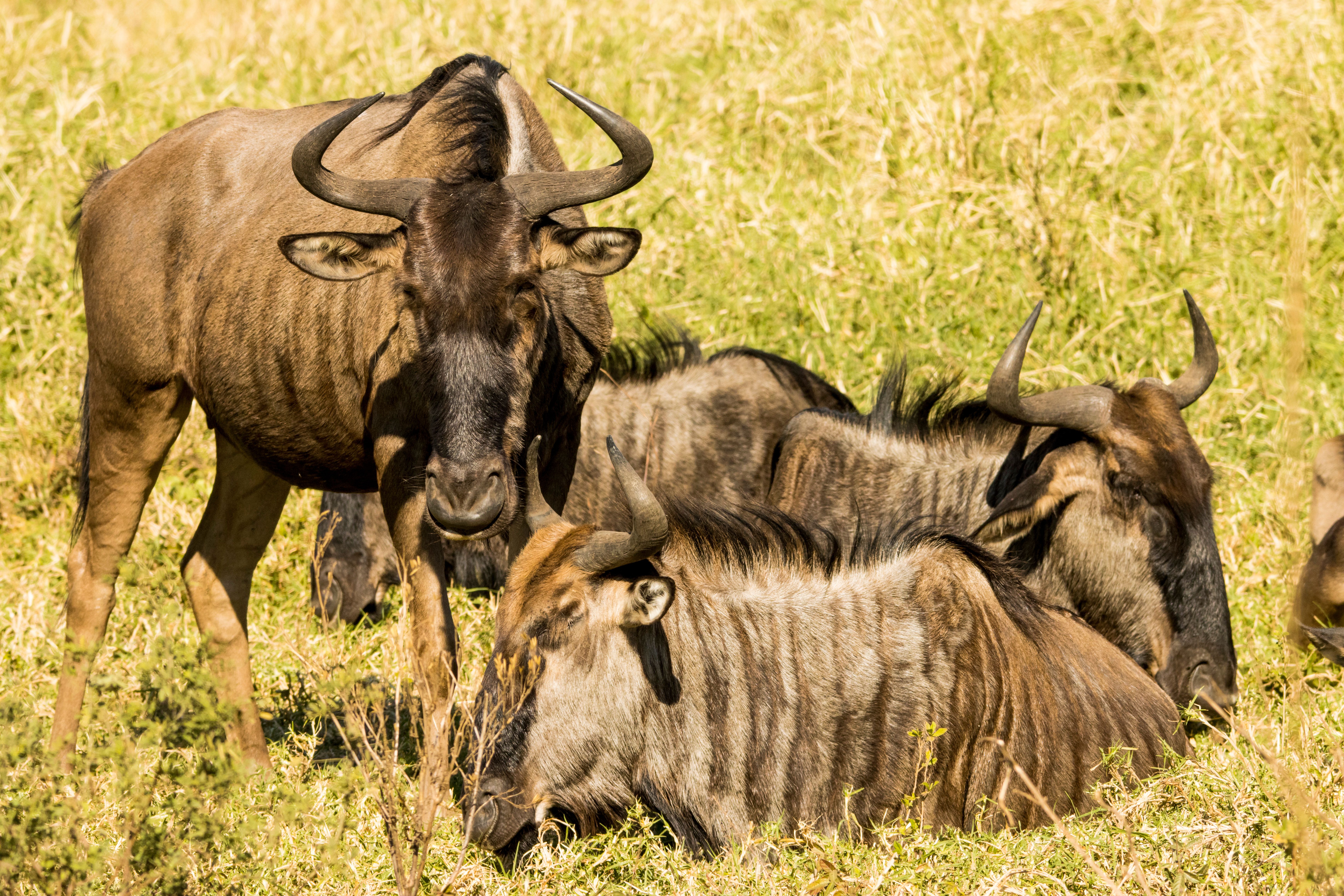
Wildebeest time their births carefully, and the numbers involved are genuinely striking:
- Gestation lasts 250 to 260 days, roughly 8.5 months.
- Calves are born during the wet season, when food is most plentiful, and many females in a herd synchronize births within the same few weeks.
- A newborn calf can stand within minutes and is typically running with the herd inside 10 minutes, one of the fastest transitions to mobility of any large mammal.
- Around 500,000 calves are born within a two-to-three-week window each year in the southern Serengeti, one of the most concentrated birth events of any land animal.
- Calves nurse for around 4 months, drawing essential nutrients like calcium and phosphorus from their mother’s milk.
On calf survival, it’s worth correcting a number that gets repeated a lot online. Long-term field research on wild wildebeest populations puts first-year calf survival at roughly 50 to 56 percent, not the 90 percent figure sometimes quoted. Predation, mainly from hyenas and lions, is the leading cause of death, and mortality is highest during the migration itself, when herds cross predator-dense, unfamiliar territory. The herd’s synchronized calving and its habit of keeping calves toward the center of the group are exactly what keep that survival rate as high as it is, given the sheer scale of predation pressure they face.
Can Blue Wildebeest Swim?
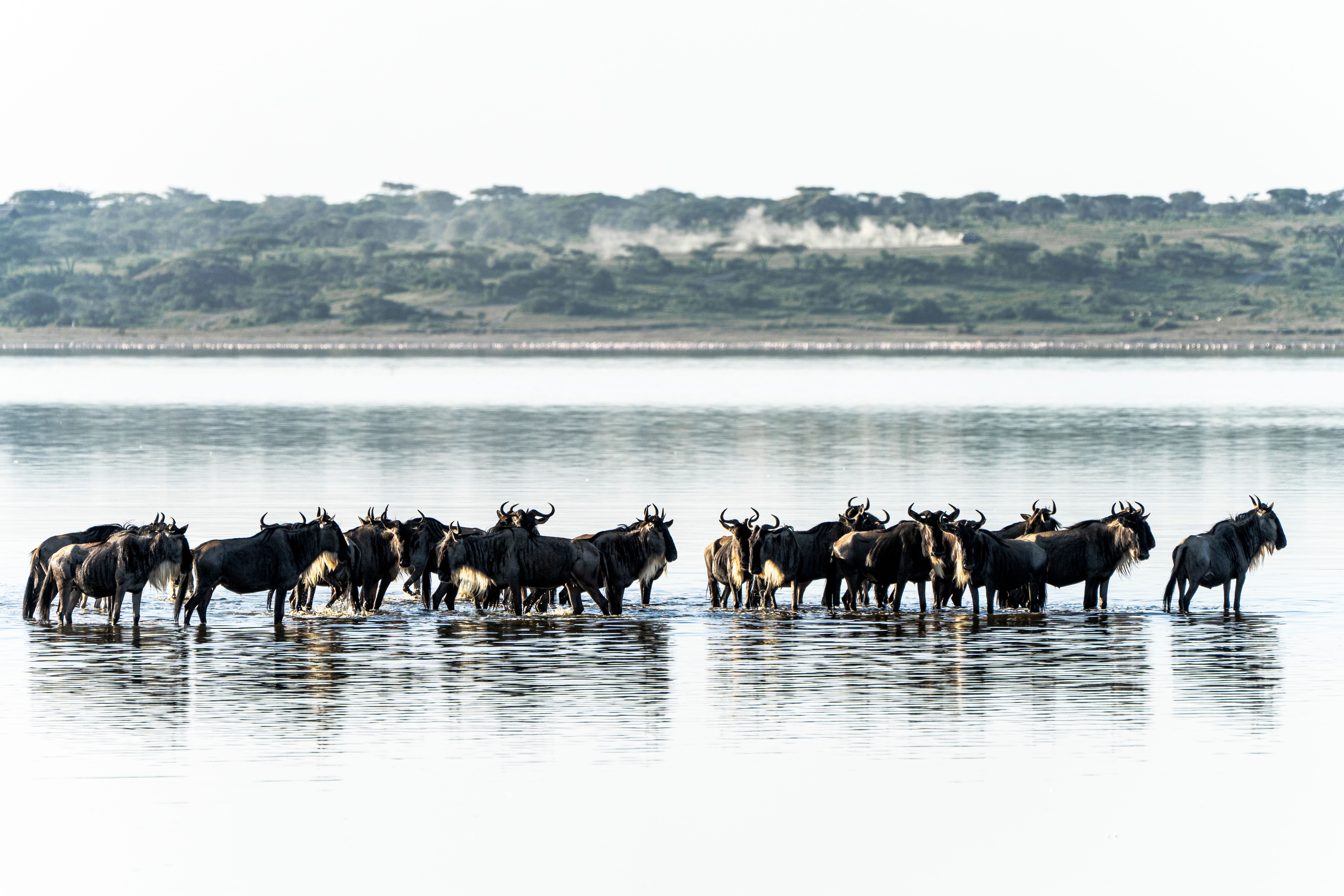
Yes, and they have to. The Great Migration includes several major river crossings, most famously the Mara River, where herds have no choice but to swim through fast currents and past waiting crocodiles. Their body shape helps: a large, muscular frame combined with relatively light limb bones gives them decent buoyancy. They’re strong runners on land, reaching speeds up to 50 mph (80 km/h), but swimming is slower and far more dangerous, since strong currents and crocodile ambushes make river crossings one of the deadliest parts of the entire migration.
See the Blue Wildebeest Migration in Person

The best way to understand a blue wildebeest is to watch one in the wild, ideally as part of the Great Migration. A few planning basics:
- River crossings: typically July through October, as herds move from the Serengeti into Kenya’s Masai Mara.
- Calving season: January through March, concentrated in the southern Serengeti’s Ndutu region, when the plains fill with newborn calves and the predators that follow them.
- Best combined trip: many travelers pair a Kenya and Tanzania itinerary to catch both the Mara crossings and the Serengeti’s resident herds.
TourwithPipi runs dedicated safaris built around both of these windows:
- 10-Day Luxury Tanzania Great Migration Safari, timed for peak Mara River crossings
- 10-Day Luxury Tanzania Calving Season Safari, built around the February calving peak in Ndutu
- 7-Day Northern Tanzania Safari, a value-focused option across Tanzania’s top parks
Contact the team on WhatsApp to plan a Kenya or Tanzania safari timed around the Great Migration’s river crossings or calving season.
Frequently Asked Questions
What is a blue wildebeest?
The blue wildebeest (Connochaetes taurinus) is a large African antelope with a bluish-gray to brownish-gray coat, dark vertical stripes, and curved horns in both sexes. It’s best known for its role in the Great Migration across the Serengeti and Masai Mara.
What is the difference between a blue wildebeest and a black wildebeest?
Blue wildebeest have a bluish-gray coat, a more robust build, and migrate in huge herds across a wide range in southern and eastern Africa. Black wildebeest have a dark brown to black coat, a more slender build, and stay mostly in localized territories in South Africa.
How fast can a blue wildebeest run?
Blue wildebeest can reach speeds of around 50 mph (80 km/h) on land, making them one of the faster large antelope species, and fast enough to outrun most predators over open ground.
How many blue wildebeest are there?
The global population is estimated at around 1.5 million, most of which are the western white-bearded subspecies found in the Serengeti-Mara ecosystem.
What do the terms “blue wildebeest mount” or “shoulder mount” mean?
These refer to taxidermy trophies: a preserved head and shoulders of a wildebeest mounted for wall display, typically from regulated hunting areas in South Africa. TourwithPipi focuses on photographic safaris, not hunting.
Do wildebeest calves survive the migration?
Most do, though not at the rate often claimed online. Field research on wild populations puts first-year survival at roughly 50 to 56 percent, with predation as the leading cause of death, concentrated during river crossings and the early weeks after birth.
Blog Summary
- The blue wildebeest (Connochaetes taurinus) has a bluish-gray coat with dark stripes, while the black wildebeest (Connochaetes gnou) has a dark brown to black coat and a more localized range.
- Blue wildebeest are widespread across southern and eastern Africa and are the species behind the Great Migration, with a global population of around 1.5 million.
- There are five subspecies of blue wildebeest, spread from South Africa to Zambia to Kenya, each with its own range and appearance.
- Blue wildebeest can run up to 50 mph (80 km/h) and are strong swimmers, which they need to be for river crossings like the Mara.
- Calving season runs January to March, with around 500,000 calves born in a two-to-three-week window, though only about half survive their first year due to predation.
- “Blue wildebeest mount” and “shoulder mount” refer to hunting taxidermy, not something offered on a TourwithPipi photographic safari.


