
The term Big Five safari animals appears everywhere in African wildlife travel, and for good reason. The Big Five animals refer to the lion, leopard, elephant, rhinoceros, and Cape buffalo. These are the animals most travelers hope to see on a safari because they represent power, rarity, and the feeling of being close to true wilderness. The term originated in the late 1800s and early 1900s during colonial hunting expeditions, when these five species were considered the most difficult and dangerous to hunt on foot. Today, the meaning has evolved. The Big Five now represent conservation, wildlife tourism, and photographic safaris, especially in East Africa. Countries like Tanzania (Serengeti, Ngorongoro), Kenya (Maasai Mara), South Africa (Kruger), Botswana (Okavango Delta), and Zimbabwe (Hwange) are leading destinations where sightings are most common, and sightings have increased in several regions thanks to conservation areas and anti-poaching programs.
History of the Big Five Safari Animals
1. Lions (Panthera leo)
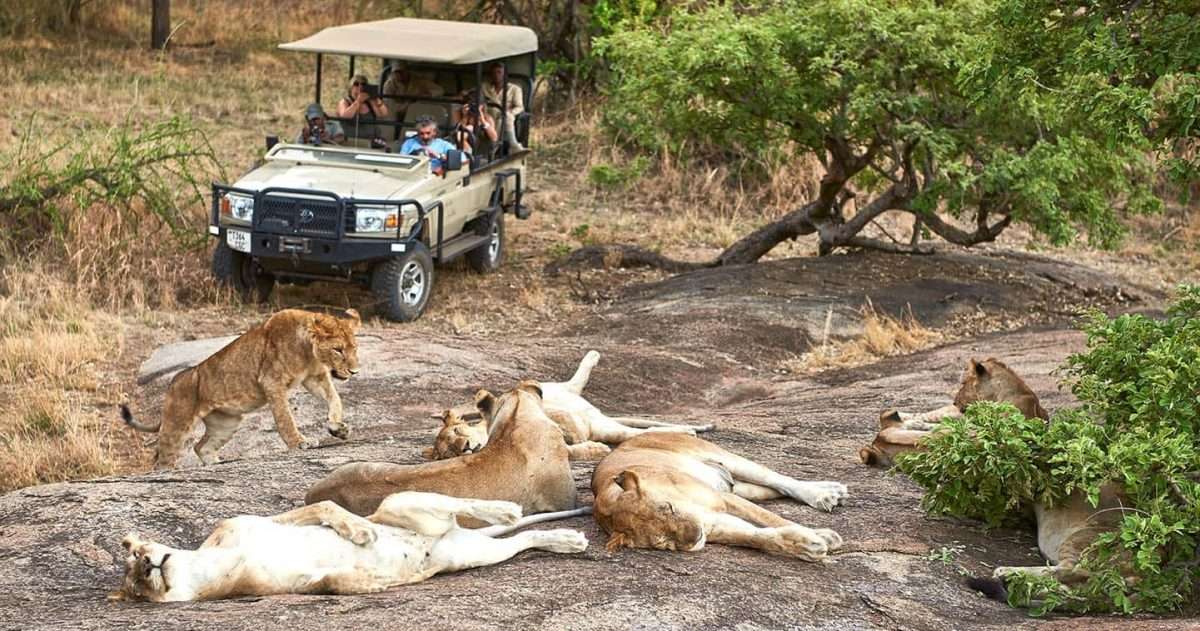
Lions are the first and most iconic of the Big Five safari animals. They are classified as Vulnerable on the IUCN Red List as of 2024. A 2023 Oxford University study estimates Africa’s wild lion population at 20,000 to 25,000 individuals across 25 African countries. Historical records show that in the early 1900s there were more than 200,000 lions in the wild, meaning the population has declined by nearly 90% in 120 years, largely due to habitat loss and poaching.
Population of Lions by region (approx.):
- Tanzania: 14,000 (largest population in Africa)
- Botswana & South Africa: ~3,000 each
- Kenya & Zambia: ~2,500 each
- Countries with fewer than 250 lions: 12 nations
- Countries with only one surviving pride: 8 nations
A typical pride averages 13 lions, but prides up to 40 individuals have been recorded in the Serengeti. Lion cubs are forced out between 2 to 3 years old and may wander as nomads for up to 4 years before challenging a dominant male.
Fun but true lion facts:
- A lion’s roar carries 5 miles (8km) across the plains.
- They sleep up to 20 hours per day, making them the laziest hunters of the Big Five.
- They hunt mostly in daylight, and females perform about 80 to 90% of the hunts.
- Lions can sprint up to 50 mph (80 kph) but only in short bursts.
Despite being called “King of the Jungle,” lions rarely live in forests. Instead, they dominate savannahs, grasslands, and open woodlands like the Serengeti, Maasai Mara, Tarangire, and Kruger. This open terrain is why Tanzania consistently delivers some of the highest lion sighting success rates in the world, estimated at 85 to 92% on multi-day safaris.
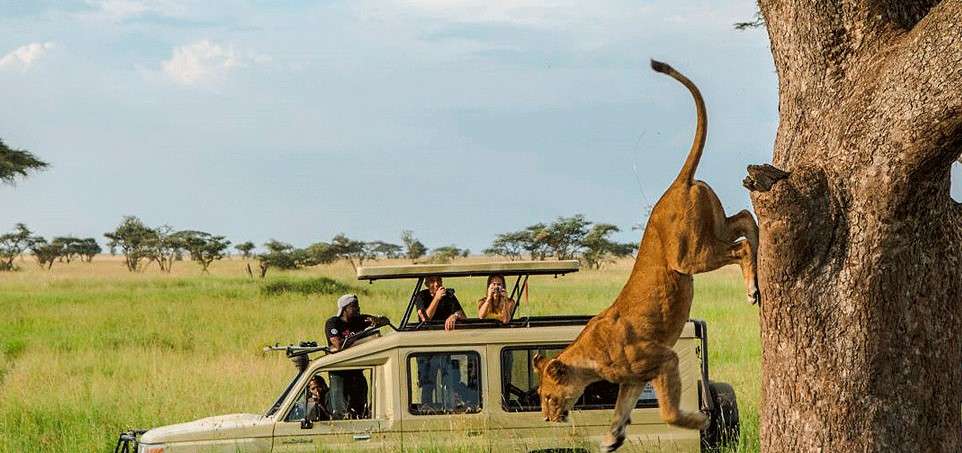
Tree-climbing lions are rare but real. They are seen regularly in:
- Serengeti National Park, Tanzania
- Lake Manyara National Park, Tanzania
- Lake Nakuru National Park, Kenya
This unusual behavior may be a response to insects, wet grass, heat avoidance, or just elevated vantage points to scout prey.
2. Rhinoceros
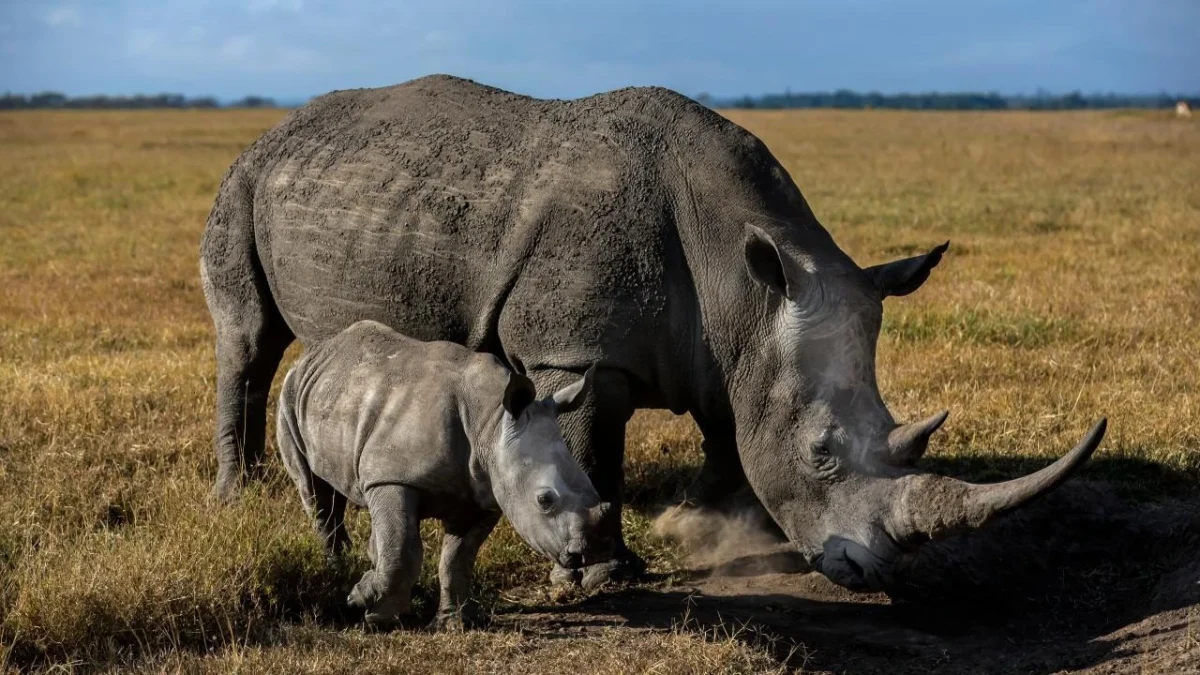
Rhinoceros are the second of the Big Five safari animals, and they are among the most threatened mammals on earth. Africa is home to two native species, the black rhino (Diceros bicornis) and the white rhino (Ceratotherium simum), divided into several subspecies. Their populations collapsed dramatically between 1960 and 1995, when widespread poaching caused a 98% population decline across the continent. By the end of 2023, Africa’s total rhino population stood at approximately 23,290 individuals, according to the African Rhino Specialist Group.
More than 70% of Africa’s rhinos are southern white rhinos, most classified as Near Threatened by the IUCN. South Africa holds the largest population, with an estimated 12,968 rhinos, followed by Namibia (1,416), Kenya (873), Zimbabwe (417), and Botswana (242). In over 15 other African countries, rhino populations number fewer than 100 individuals, and in several regions they have already vanished entirely.
Despite their names, black and white rhinos are not named for their color. The term “white” rhino likely comes from the Afrikaans word “wyd,” meaning “wide,” referring to the rhino’s square grazing lips. Black rhinos have pointed, prehensile lips designed for browsing leaves and shrubs. In general, white rhinos are larger, standing up to 6.5 feet tall and weighing as much as 5,000 pounds (2,300 kg), around the size of a small SUV, while black rhinos weigh 3,000 to 4,000 pounds and stand around 5.5 feet tall.
Rhinos are herbivores and feed mostly at night or dawn, resting in the heat of the day. Their horns are made of keratin, the same material as human nails and horse hooves, and can regrow if broken.
Conservation Status and Population Facts
- Southern White Rhino: Near Threatened since 1994. Once reduced to only 20 individuals, now rebounded to nearly 20,000+ thanks to strict conservation policies.
- Black Rhino: Critically Endangered with roughly 6,487 individuals left as of 2024; listed on CITES Appendix I.
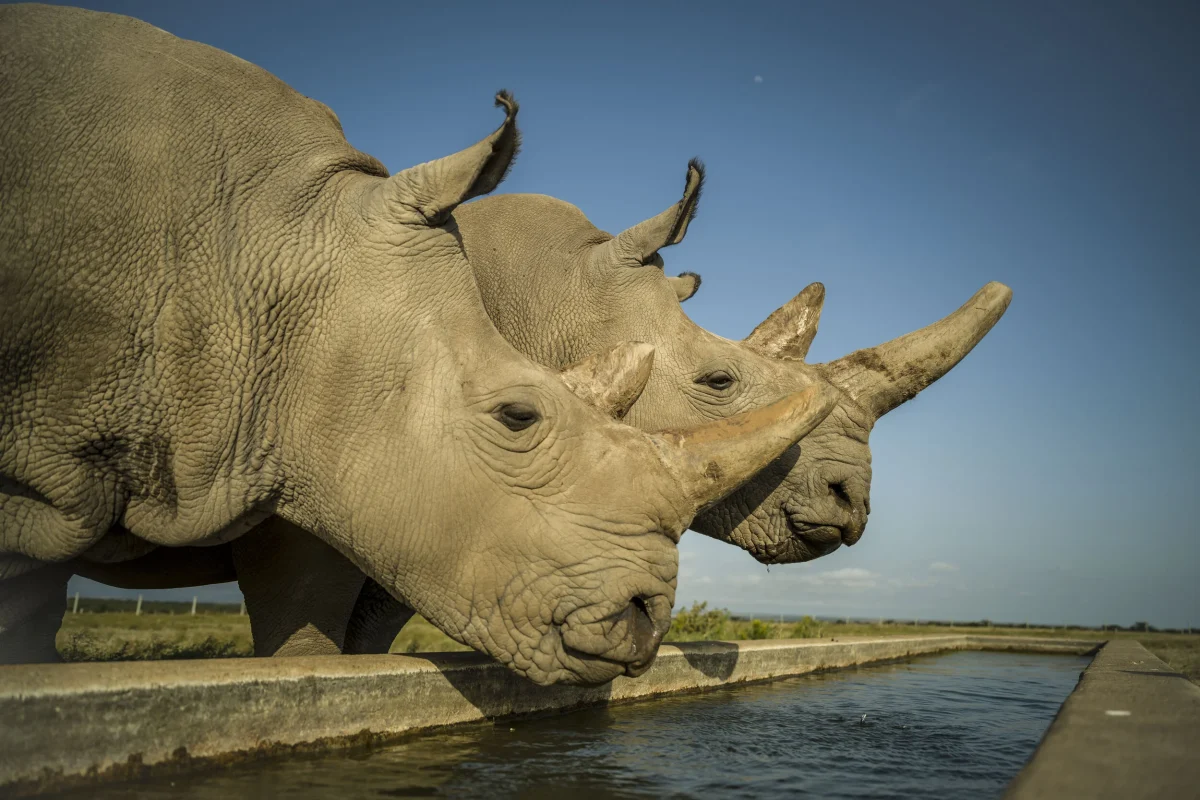
- Northern White Rhino: Functionally extinct in the wild. Only two females remain, protected under 24/7 armed security in Ol Pejeta Conservancy, Kenya. Scientific programs like the BioRescue Consortium are attempting IVF and stem cell methods to save the subspecies.
- Poaching Peak Year: 2014, when 1,215 rhinos were killed in South Africa alone.
A group of rhinos is called a crash, and their gestation period lasts 16 months, one of the longest of any land mammal. Calves stay with their mothers for up to three years, learning how to navigate the landscape and avoid predators.
Where to See Rhinos on Safari
- Ol Pejeta Conservancy, Kenya: leading center for black rhino conservation and the last northern white rhinos
- Hluhluwe–iMfolozi Park, South Africa: Africa’s oldest reserve and a rhino recovery success story
- Khama Rhino Sanctuary, Botswana: ideal for photography and walking safaris
- Ngorongoro Crater, Tanzania: one of the best places to see black rhino within the Big Five
Despite their size, rhinos run surprisingly fast, up to 34 mph (55 kph), and are more agile than most animals of their weight class. They run on their toes, which is why they are classified among three-toed ungulates, closely related to horses, zebras, and tapirs.
3. Leopard
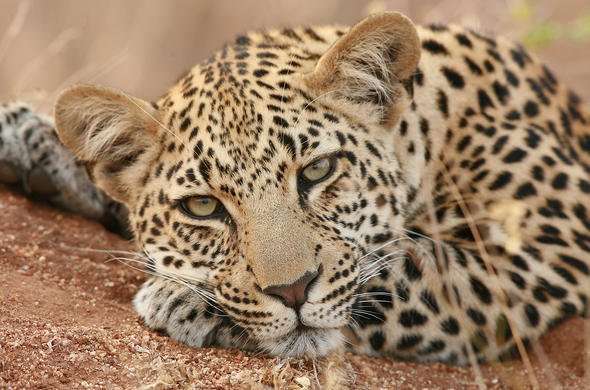
Leopards are the third of the Big Five safari animals and one of the most elusive predators in Africa. Although claims once suggested there were more than 700,000 leopards across the continent, modern studies show that figure was incorrect. Current research indicates leopard numbers have declined by 48 to 67 percent over the past 100 years, placing them in the Vulnerable category on the IUCN Red List. Their decline is driven by habitat loss, poaching, shrinking prey populations, and human expansion into traditional leopard territory.
South Africa holds the strongest remaining population, with core territories split across the Western Cape and Eastern Cape coastal ranges, the KwaZulu Natal interior, Greater Kruger National Park, Limpopo, Mpumalanga, and into the Kgalagadi Transfrontier region bordering Botswana. Kenya, Tanzania, Botswana, Zambia, and Zimbabwe also hold viable leopard populations, but in more than a dozen African countries leopard numbers now stand below 200 individuals. In North Africa, only a tiny remnant exists in Egypt’s Elba National Park, making sightings extremely rare.
Unlike lions, leopards are solitary. They hunt alone, live alone, and only interact for mating or cub rearing. Their adaptability is the reason they remain the widest ranging of the Big Five animals. They survive in mountains, rainforests, riverside forests, deserts, and savannahs. They have one of the broadest diets of any large cat, with confirmed kills of over 100 species including monkeys, warthog, antelope, impala, young giraffes, rodents, and birds. Their most remarkable trait is strength. A leopard can drag prey three times its own body weight up a tree more than 20 feet high to avoid scavengers like hyenas and lions. They are the only big cat known for consistently hunting, feeding, and sleeping in trees.
Black leopards or black panthers occur due to melanism. Confirmed sightings have come from Mount Kenya, the Aberdare Mountains, Laikipia, Samburu, and Tsavo in Kenya, as well as recent verified photographic evidence in South Africa. Tanzania’s Serengeti ecosystem also records occasional melanistic sightings, although they remain extremely rare.
Conservation Status and Population Facts
- Global leopard status: Vulnerable since 2016 after declining from Near Threatened in 2008 and Least Concern in 2002
- Estimated continental decline: 48 to 67 percent since the early 1900s
- Countries with the largest remaining populations: South Africa, Tanzania, Kenya, Botswana, Zambia, Zimbabwe
- Strongest protected zones: Greater Kruger in South Africa and the Serengeti ecosystem in Tanzania
- Hunting style: solitary, ambush predator, prefers nocturnal hunting with rare daytime hunts reported in Tsavo and Central Serengeti
- Tree carrying ability: up to three times body weight lifted vertically to avoid competition
Where to See Leopards on Safari
- Sabi Sands Game Reserve, Greater Kruger, South Africa
- Serengeti National Park, Tanzania, especially Central Seronera region
- South Luangwa National Park, Zambia, known for night drive sightings
- Moremi Game Reserve, Botswana, within the Okavango Delta ecosystem
- Laikipia and Samburu, Kenya, with occasional melanistic individuals
Leopards represent the mystery and drama of the African bush. They are the animal many seasoned travelers consider the hardest of the Big Five safari animals to find.
4. Buffalo
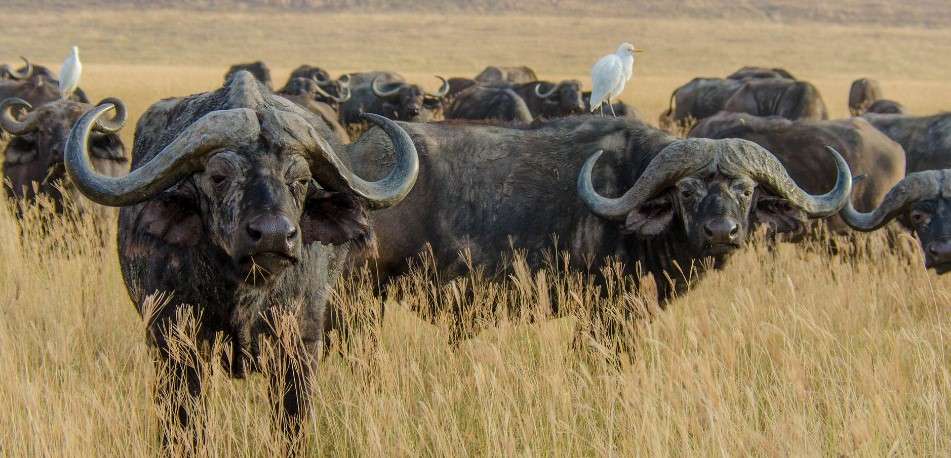
Buffalo are the fourth of the Big Five safari animals and are considered one of the most dangerous mammals in Africa. Often mistaken for domestic cattle at a distance, the African buffalo is a completely wild species with no history of domestication due to its unpredictable and aggressive temperament. According to the African Wildlife Foundation, Africa hosts four buffalo subspecies, and approximately 75 percent of their remaining population now lives inside protected reserves. Current research estimates that there are about 400,000 African buffalo left in the wild, a number that continues to decrease due to habitat loss, disease, and poaching, which is why the species is listed as Near Threatened on the IUCN Red List of Threatened Species.
The African buffalo’s size and temperament make it a formidable member of the Big Five animals. Weighing up to 2,000 pounds and capable of running 35 miles per hour, they are powerful enough to injure or kill lions and crocodiles that attempt to prey on them. Buffalo are widely described as responsible for more human deaths in the African bush than any other large animal, with commonly cited estimates around 200 fatalities per year, though exact figures vary by source, which earned them the historic nicknames Black Death and Widow Maker. They are the only species of wild cattle in Africa and have never been domesticated due to their explosive and defensive behavior.
Buffalo survival strategy is built on group protection. Females and juveniles remain in large herds year round, while males may form bachelor herds or stay alone during the dry season. When attacked, buffalo herds unite to defend the injured member. There are documented cases of buffalo killing lions, overturning safari vehicles during confrontations, and rescuing calves from crocodiles during river crossings. Buffalo prefer wetlands, river systems, and savanna grasslands, and they typically drink 40 liters of water a day, so sightings are extremely common near lakes and waterholes.
Buffalo Subspecies and Where They Live
- Savanna or Cape Buffalo (Syncerus caffer caffer): the largest and most common subspecies. Found across Tanzania, Kenya, Uganda, South Africa, Zimbabwe, Botswana, Mozambique, and Zambia. Seen in most major safari parks including the Serengeti and Kruger.
- West African Savanna Buffalo (Syncerus caffer brachyceros): distributed through Benin, Senegal, Niger, Burkina Faso, and Ivory Coast. Populations vary, with several regions experiencing declines.
- Central African Savanna Buffalo (Syncerus caffer aequinoctialis): found in South Sudan, Democratic Republic of the Congo, and the Central African Republic. Declines linked to civil conflict, poaching, and habitat pressure.
- Forest Buffalo (Syncerus caffer nanus): smaller and reddish in color, found in the rainforests of Cameroon, Gabon, and the Republic of Congo. Population numbers are harder to confirm due to dense habitat.
Conservation Status and Population Facts
- Continental population: approximately 400,000 individuals remaining
- IUCN Status: Near Threatened since 2008 with steady decline
- Drinking needs: 40 liters per day, which keeps them close to water sources
- Running speed: 35 miles per hour during charge behavior
- Herd structure: mixed family herds with solitary or bachelor bulls in dry months
Where to See Buffalo on Safari
- Kruger National Park, South Africa
- Hwange National Park, Zimbabwe
- Kafue National Park and South Luangwa, Zambia
- Serengeti National Park and Ngorongoro Crater, Tanzania
- Okavango Delta and Chobe River, Botswana
The African buffalo might appear cattle-like at first glance, but their intelligence, strength, and collective herd strategy make them one of Africa’s most respected animals. When buffalo arrive at a waterhole, most other wildlife steps aside.
5. Elephant
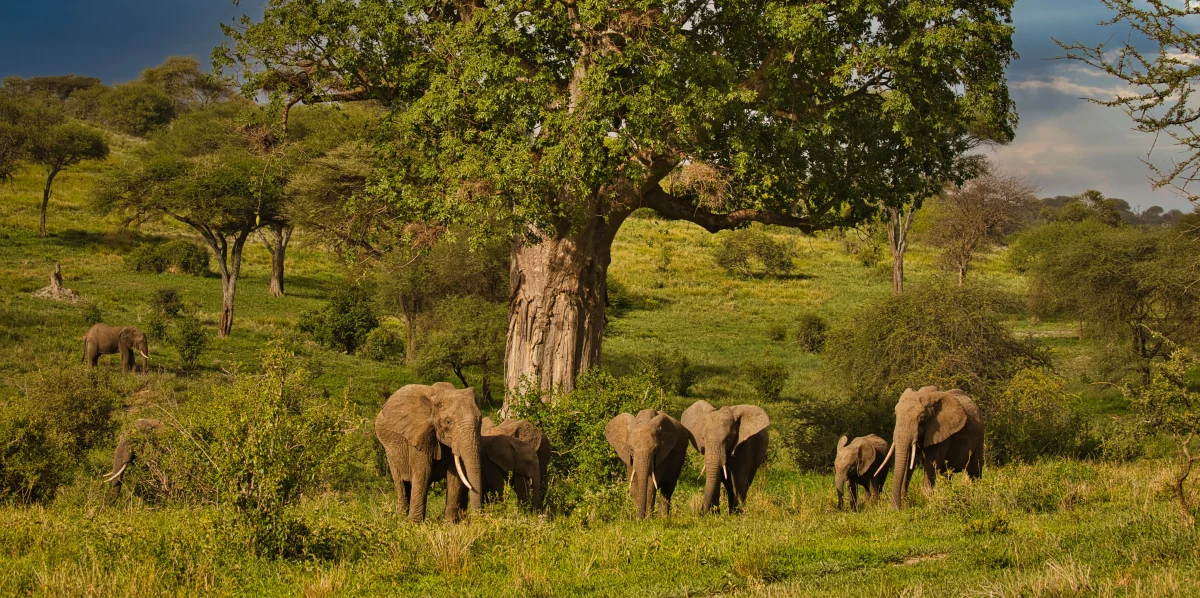
Elephants are the fifth and final member of the Big Five safari animals and are the largest land mammals on Earth. Africa is home to two species: the African Savanna Elephant (Loxodonta africana) and the African Forest Elephant (Loxodonta cyclotis), formally recognized as separate species since 2021.
The most current data comes from IUCN’s African Forest Elephant Status Report 2024, published in November 2025, the first assessment to count forest elephants independently using DNA-based methods. It puts the forest elephant population at 135,690 individuals, a 16% increase over the 2016 estimate. IUCN has been clear that this reflects better counting methods, not a real population rebound, and forest elephants remain Critically Endangered. Two-thirds of the global forest elephant population lives in Gabon, with another 20% in the Republic of Congo.
The African Savanna Elephant’s own updated status report is still pending, expected by the end of 2026. Until then, the most commonly cited estimate remains around 350,000 individuals, continuing a roughly 70% continent-wide decline recorded between the mid-1960s and 2016, with southern Africa holding the largest and most stable populations.
More than 50 percent of all African Savanna Elephants live inside the Kavango Zambezi Transfrontier Conservation Area (KAZA), the largest peace-park conservation region in the world spanning Angola, Botswana, Namibia, Zambia, and Zimbabwe. In 2022, the first-ever aerial survey conducted by KAZA recorded 227,900 elephants, a 7 percent increase compared to 2016 data, suggesting that long-term anti-poaching investments and protected land corridors are helping herds stabilize.
South Africa supports a population of 44,326 elephants, with 31,527 living in Kruger National Park alone, making it one of the most reliable places for Big Five sightings.
African Savanna Elephants are the world’s largest land animals, reaching 13 feet in height and weighing 6 to 11 tons. African Forest Elephants are smaller by comparison, standing roughly one yard shorter and weighing about half as much, but they play a crucial role in forest ecosystems by dispersing seeds and shaping vegetation. Elephants have the longest gestation period of any land mammal at 22 months, and newborn calves weigh around 120 kilograms, with the herd forming a protective circle during birth.
Elephant Population and Conservation Status
- African Forest Elephant (2024 IUCN status report, published Nov 2025): 135,690 individuals, up 16% from 2016 due to improved DNA-based survey methods, Critically Endangered
- African Savanna Elephant: approximately 350,000 individuals (updated status report pending, expected end of 2026), Endangered
- KAZA population (2022 survey): 227,900 elephants, up 7 percent since 2016
- South Africa national population: 44,326 elephants
- Kruger National Park: 31,527 elephants
- Annual illegal killings due to ivory trade: an estimated 20,000 to 30,000 elephants per year, though poaching rates have declined since 2018-2019
Where to See Elephants on Safari
- Chobe National Park, Botswana: believed to host the world’s largest elephant concentration, especially along the Chobe Riverfront
- Kruger National Park, South Africa: dense elephant numbers, excellent for sightings year-round
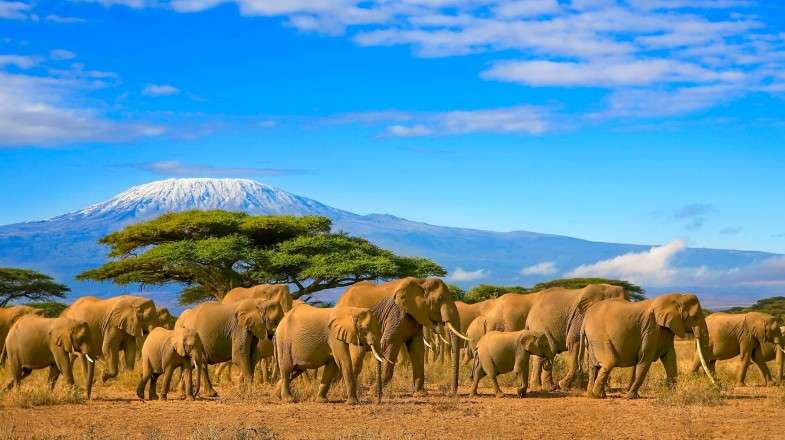
- Amboseli National Park, Kenya: famous for elephants with Mount Kilimanjaro as a backdrop
- Tarangire National Park, Tanzania: migratory herds and baobab-framed landscapes
- Hwange National Park, Zimbabwe: seasonal elephant corridors and waterhole congregation
Elephants are keystone species and ecosystem engineers, shaping the land they move through. They clear grasslands, carve new migration paths, and disperse seeds over long distances.
Is South Africa the Best Place to See the Africa Big Five?
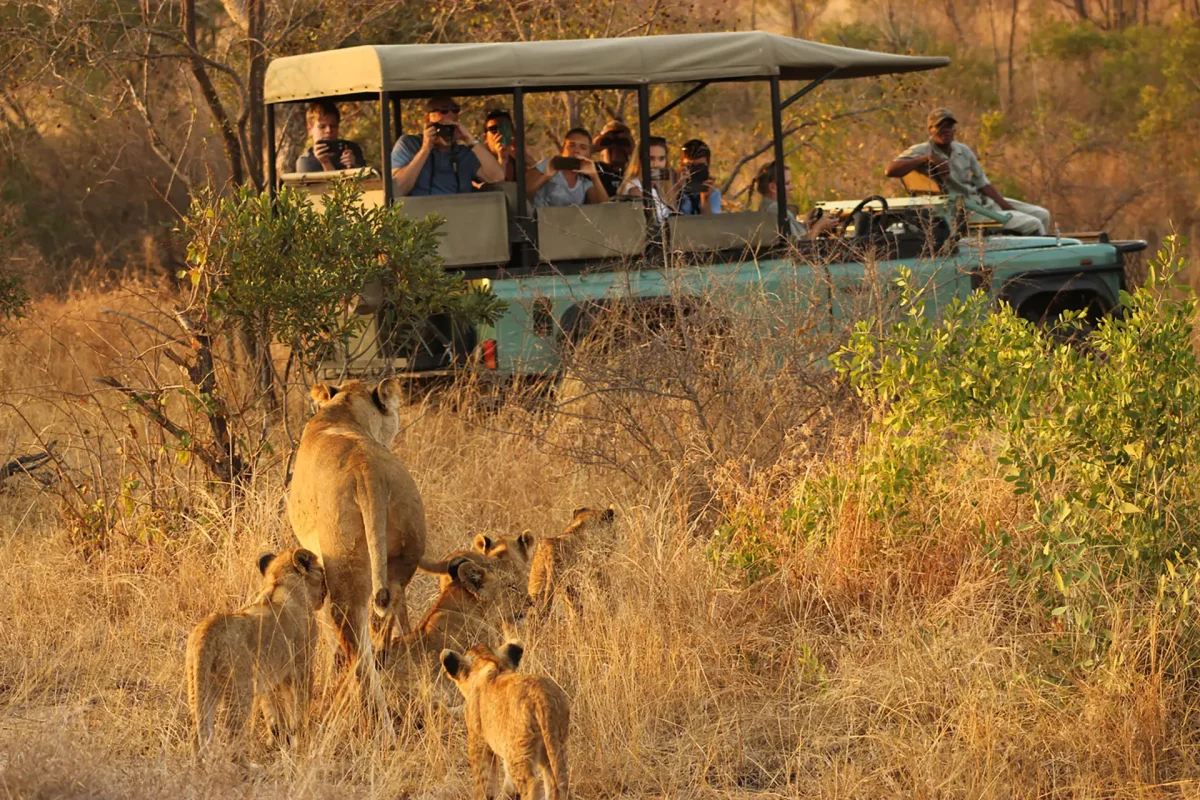
South Africa is widely considered one of the most reliable places on the continent to see the Big Five safari animals in a single trip. This is due to its strong wildlife management system, high animal densities in protected reserves, and well-developed tourism infrastructure that increases sighting success even for first-time safari travelers. South Africa is home to approximately 3,000 wild lions, mostly located in protected national parks and private game reserves. It also holds Africa’s largest leopard population, spread across habitats such as the Western and Eastern Cape Provinces, KwaZulu-Natal, Greater Kruger, Limpopo, Mpumalanga, and the Kgalagadi Transfrontier Park region. South Africa dominates rhino conservation, with over 70 percent of Africa’s rhinos found within its borders, including around 12,968 southern white rhinos and 2,056 black rhinos.
Buffalo populations remain strong, with approximately 30,000 Cape buffalo recorded across savanna systems like Kruger National Park, Hluhluwe-Imfolozi, and Addo Elephant National Park. The country also supports an estimated 44,326 wild elephants, with 31,527 located in Kruger National Park. Because of these concentrations, South Africa offers a high Big Five success rate, especially in Greater Kruger, where sightings regularly exceed 80 percent or higher on a multi-day safari.
Is Tanzania the Best Place to See the Africa Big Five?
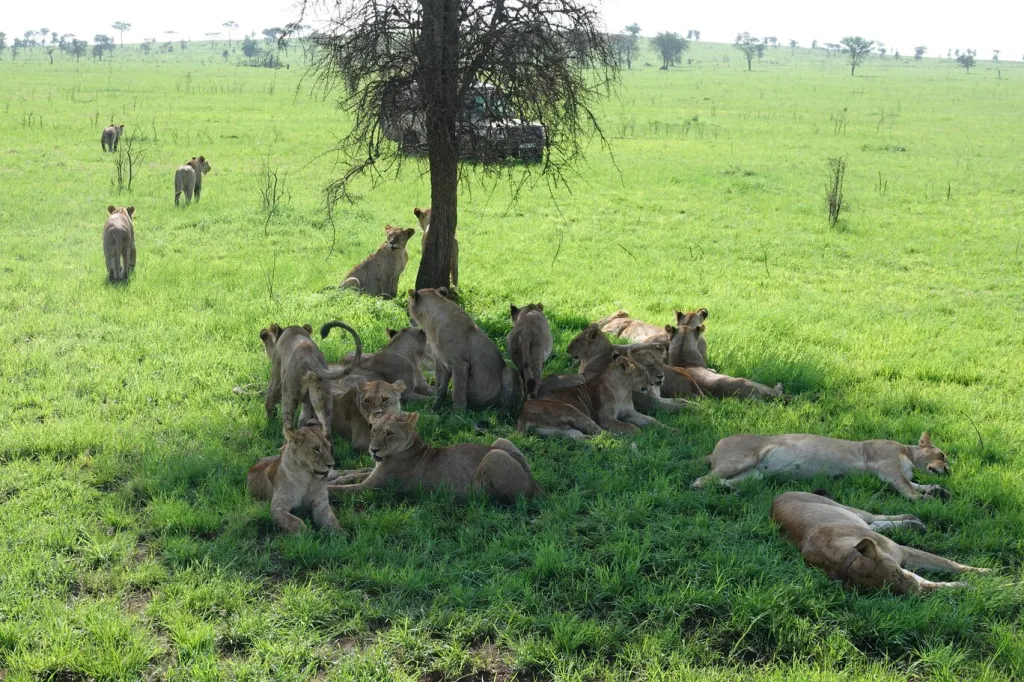
Yes. Tanzania is arguably one of the best countries in Africa to see the Big Five because of its unmatched wildlife density, natural migration systems, and concentration of key ecosystems that make sightings feel wild rather than staged. It is also the only place in East Africa where it is realistic to see all five members in one day inside a natural habitat, especially within the Ngorongoro Crater.
Tanzania’s Big Five Population Overview
| Animal | Tanzania Estimate | Key Notes | Best Places to See |
|---|---|---|---|
| Lion | 14,500 (largest population in Africa) | Serengeti holds the highest single concentration with around 3,000 | Serengeti, Ruaha, Ngorongoro |
| Leopard | Widespread but uncounted, stable in protected zones | Most sightings in woodlands and river systems | Serengeti, Ruaha, Nyerere |
| Elephant | Large and stable herds | Ruaha hosts an estimated 12,000 migrating elephants seasonally | Tarangire, Ruaha, Serengeti corridors |
| Buffalo | Very large and commonly sighted | Present across most northern and southern parks | Serengeti, Ngorongoro, Nyerere |
| Black Rhino | 212 individuals (critically endangered) | The most reliable sightings occur in a contained ecosystem | Ngorongoro Crater |
Why Tanzania Works So Well for Big Five Sightings
- The Northern Circuit offers the strongest chance, especially Ngorongoro Crater, where terrain and enclosed geography increase sighting reliability.
- The Serengeti provides daily predator encounters and migration activity, including lions, cheetahs, leopards, and buffalo herds.
- Tarangire is the migration corridor for elephants and hosts some of East Africa’s largest dry-season populations.
- The Southern Circuit in Ruaha and Nyerere offers remote, crowd-free viewing and holds some of the world’s most important lion and elephant populations, although rhino are not present.
How Tanzania Compares to Other Big Five Destinations
- South Africa is best for high-success sighting rates and infrastructure. Ideal for first-timers wanting comfort and guaranteed rhino visibility.
- Kenya is strongest during the Great Migration and river crossings in the Maasai Mara, but rhino sightings are less consistent than Tanzania or South Africa.
- Botswana excels for luxury wilderness and low-impact tourism, especially in the Okavango Delta, but it requires a higher travel budget.
Why Are They Called the Big 5 Animals?
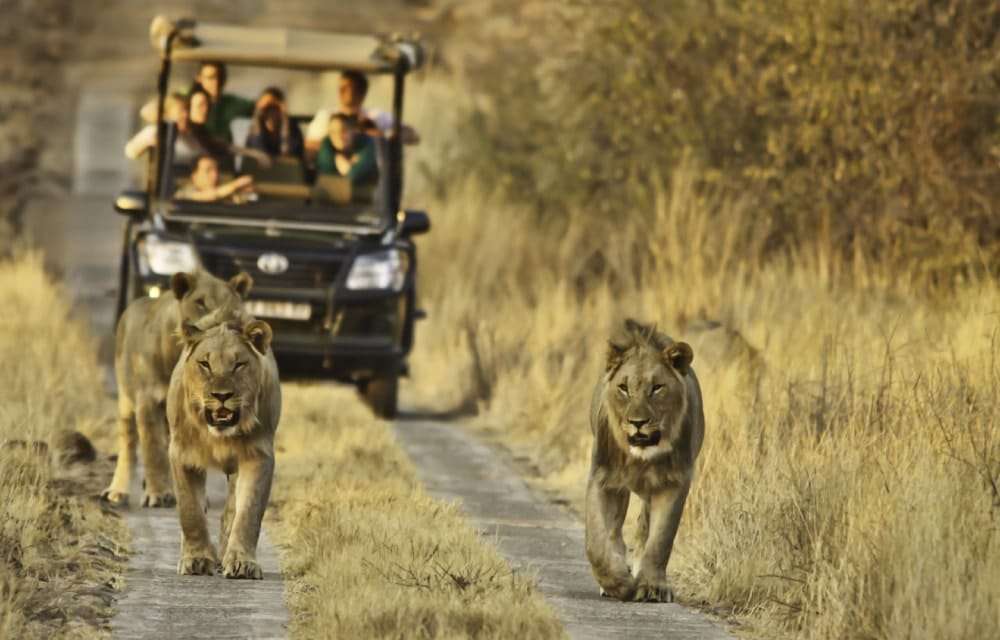
The term Big Five safari animals refers to the lion, leopard, elephant, rhinoceros, and Cape buffalo, and it originated in the late 1800s and early 1900s during the era of big-game hunting in Africa. They were labeled the Big Five not because they are the largest animals on the continent, but because they were considered the most dangerous, challenging, and deadly to hunt on foot.
Today, the meaning has shifted. Instead of being associated with trophies, the Big Five safari animals are now the most sought-after wildlife for viewing, photography, and conservation-based tourism.
Key Reasons Behind the Big Five Name
- Historically the most dangerous to approach on foot.
- Among the hardest animals to track, stalk, and hunt safely.
- Possess the strength, speed, or aggression to injure or kill predators and humans.
- Symbolic of the power and diversity of African wildlife ecosystems.
See the Big Five
Seeing all of Africa’s Big Five safari animals, the lion, leopard, elephant, rhinoceros, and Cape buffalo, is one of the most meaningful goals for many travelers planning their first safari. Their popularity has inspired other wildlife checklists like the Little Five of Africa and the Little Five of Namibia, but the Big Five still remain the ultimate benchmark for an unforgettable safari experience.
Top Destinations to See the Big Five
- Tsavo Conservation Area, Shaba National Reserve, Aberdare National Park: Kenya
- Kruger National Park: South Africa
- Okavango Delta & Chobe National Park: Botswana
- Ngorongoro Crater: Tanzania
- Murchison Falls: Uganda
- Akagera National Park: Rwanda
- Mana Pools National Park: Zimbabwe
- North Luangwa National Park: Zambia
Your Big Five Safari Experience
When you plan your safari with TourWithPipi, you get customized guidance on:
- The best parks for your travel dates
- The best season for sightings and migration routes
- Options for private vehicles, photography safaris, and balloon experiences
- Recommended itineraries for 7 to 11 day Tanzania safari routes focused on game density and value
On safari, your professional guide will help track animals using prints, calls, terrain changes, weather patterns, and known pride or herd territories.
Ready to plan your Big Five Safari? Contact TourWithPipi today to start planning your once-in-a-lifetime trip.
Big Five Safari Animals FAQs
Where is the largest lion population in Africa?
Tanzania holds the largest remaining lion population on the continent, with current estimates of around 14,000 lions spread across parks like Serengeti, Ruaha, Tarangire, and Ngorongoro. The Serengeti alone is believed to host nearly 3,000 lions. Kenya, Botswana, South Africa, and Zambia each hold much smaller populations ranging between 1,500 and 3,000.
Where is the largest leopard population in Africa?
South Africa has the highest concentration of leopards, especially in regions like the Greater Kruger ecosystem, KwaZulu-Natal, the Drakensberg foothills, and the Kgalagadi Transfrontier Park. Leopards remain elusive even where populations are healthy because they are primarily nocturnal, solitary, and territorial.
Where is the largest buffalo population in Africa?
The Cape or Savanna buffalo has its largest numbers in East and Southern Africa, with Tanzania, Botswana, South Africa, Zambia, and Zimbabwe being the most reliable countries for sightings. Herds can number in the hundreds and sometimes thousands, especially in places like the Serengeti, Chobe, and Kruger.
Where is the largest rhino population in Africa?
South Africa remains the stronghold for rhinos, particularly the southern white rhino, with more than 70% of Africa’s remaining rhinos found there. Parks like Hluhluwe-iMfolozi, Kruger, Pilanesberg, and private conservancies are central sanctuaries. Black rhinos, while critically endangered, are steadily recovering in Kenya, Namibia, and Tanzania due to anti-poaching units.
Where is the largest elephant population in Africa?
The Kavango Zambezi Transfrontier Conservation Area (KAZA), spanning Angola, Botswana, Namibia, Zambia, and Zimbabwe, hosts the world’s largest elephant range, with over half of Africa’s savanna elephants living in this cross-border reserve. Botswana alone contributes a large share of that population.
What are the Big 5 animals to see on safari?
The Big Five safari animals are the lion, leopard, elephant, rhinoceros, and Cape buffalo. They became known as the Big Five because early hunters considered them the most dangerous and difficult to hunt on foot. Today, the meaning has evolved, and the Big Five represent the most sought-after wildlife sightings for safari travelers.
Why is the hippo not one of the Big 5?
Hippos are dangerous and cause more human deaths in Africa than lions, but they are not part of the Big Five because the category was defined by difficulty and danger of hunting on foot, not by size or aggression. Hippos were easier to avoid or hunt from a distance near water, whereas buffalo, rhino, lion, leopard, and elephant required close-range tracking.
What is the hardest Big Five animal to see?
The black rhinoceros is typically the hardest to spot due to low population numbers, solitary behavior, and thick bush habitats. Leopards can also be challenging because they are nocturnal and prefer secluded, wooded areas.
Why can’t you wear black on a safari?
Black and dark blue clothing attract tsetse flies, which are found in several safari regions and can bite painfully. Neutral colors like beige, olive, brown, and light green help you blend into the environment and avoid disturbing wildlife. Bright white clothing is also discouraged because it stands out and alerts animals to movement.
Why is a giraffe not part of the Big Five?
Giraffes are iconic and impressive, but they were never one of the most dangerous animals to hunt on foot. They are prey animals rather than predators, generally non-aggressive unless threatened, and much easier to avoid or track. The Big Five list was based on the risk level for hunters, not the animal’s popularity or symbolism.
Are you guaranteed to see animals on safari?
No safari can guarantee sightings because wildlife moves freely and unpredictably. However, national parks like Ngorongoro Crater, Serengeti, Maasai Mara, Kruger, Chobe, and Etosha have some of the highest success rates, and experienced guides dramatically improve your chances.
How do you go to the bathroom on a safari?
Most safari vehicles stop at designated restroom spots in parks, lodges, or picnic areas. On long drives, guides find safe areas away from animal activity for a “bush break.” Luxury lodges and mobile camps also provide private bathroom facilities.
Is it safe to drink the water on safari?
In major lodges and camps, treated drinking water is usually safe, and filtered water is provided. In remote or mobile camps, bottled or purified water is recommended. Travelers with sensitive stomachs should avoid tap water and ice in local towns.
Is it the Big 5 or the Big 6?
The official term is Big Five, referring to lion, leopard, elephant, rhino, and buffalo. Some safaris informally use the term Big Six when including a cheetah, hippo, or giraffe depending on the area, but these additions are not official and vary by operator.
Can a grizzly bear beat a hippo?
There are no grizzlies in Africa, but hippos outweigh grizzlies, have more powerful jaws, and are aggressively territorial. In water, the hippopotamus would dominate. On land, the comparison remains hypothetical since the two never coexist in the wild.
What kills more in Africa, hippos or crocodiles?
Hippos are widely cited as causing more human deaths per year than crocodiles, with commonly referenced estimates around 500 for hippos versus 200 to 300 for crocodiles, though precise figures vary by source and are hard to verify continent-wide.
What is the rarest animal to see in Africa?
The northern white rhino is the rarest, functionally extinct with only two remaining females, both living under armed guard in Kenya’s Ol Pejeta Conservancy. Among species with breeding wild populations, the African wild dog is one of the rarest sightings due to low numbers and habitat loss.
What are the Big 7 on safari?
Some destinations promote a Big Seven list that adds the cheetah and African wild dog to the original Big Five. These lists highlight parks where all seven predators and large mammals can be seen, like South Africa’s Greater Kruger or Botswana’s Okavango Delta.
What is the top predator in Africa?
The lion is Africa’s apex land predator and sits at the top of the food chain. The Nile crocodile dominates waterways and holds the highest bite force among African predators, but in terms of terrestrial ecosystem impact, the lion holds the top spot.
Can you still hunt the Big Five in Africa?
Yes, in a limited and highly regulated capacity. Trophy hunting is legal in parts of Tanzania, Namibia, South Africa, and Zimbabwe through licensed concessions. It remains controversial due to ethical concerns and conservation debate, and many African countries are shifting toward photographic safaris instead.
Do giraffes eat meat?
Giraffes are herbivores and primarily eat leaves, acacia, and shoots. They do not hunt or scavenge, though there are rare reports of giraffes chewing bones for minerals during drought conditions.
Are giraffes friendly?
They are calm and gentle but not domesticated. Giraffes remain wild animals and can defend themselves with extremely powerful kicks capable of injuring or killing a predator. They should be viewed with respectful distance.
Why are they called Cape buffalo?
Early European settlers in South Africa first identified large buffalo herds near the Cape of Good Hope, and the name Cape Buffalo stuck, though the more accurate name is African buffalo.
What is the most popular safari in Africa?
The Serengeti-Maasai Mara ecosystem and the Great Migration are the most visited and photographed safari experiences in Africa. Kruger National Park in South Africa is the second most visited, thanks to its accessibility, infrastructure, and high sighting success.
Final Thought
A journey through Africa’s wilderness is more than a safari. It is a personal transformation. Standing before the Big Five safari animals, the lion, leopard, elephant, rhino, and buffalo, reminds you how ancient, powerful, and fragile the natural world truly is. Whether you witness lions on the Serengeti plains, elephants crossing Tarangire’s river valleys, or rhinos grazing in the shadow of Ngorongoro, the experience stays with you long after you leave.
Seeing the Big Five in their natural habitat is a privilege that depends on protected ecosystems, responsible tourism, and the communities who safeguard them.
Contact the team on WhatsApp to start planning your Big Five safari across Kenya or Tanzania.


