
The white rhino vs black rhino question is one that confuses almost every first-time safari visitor. Both are grey. Both are enormous. Both have two horns. And both live across the same African countries. So what actually makes them different and how do you tell them apart when you are sitting in a Land Cruiser watching one from thirty meters away?
The answer is simpler than you think once you know what to look for. This guide covers every difference between white rhinos and black rhinos in plain, clear language so you arrive on safari ready to identify them instantly.
Short Answer — White Rhino vs Black Rhino
Neither the white rhino nor the black rhino is actually white or black. Both are grey. The name white rhino most likely comes from the Afrikaans word meaning wide, referring to its wide square lip. The black rhino was probably named simply to distinguish it from the white. The easiest way to tell them apart is the lip. White rhinos have a wide flat square lip for grazing grass. Black rhinos have a pointed hooked lip for grabbing leaves from trees and bushes.
Why Are They Called White and Black Rhinos When Both Are Grey?
This is the first thing most people ask and it is a fair question.
Neither species is white or black in color. Walk up to both and you will find two animals that look the same shade of grey. The color difference between them is minimal and varies more with the soil they have been rolling in than anything else.
The most widely accepted explanation for the name white rhino is that it comes from the Afrikaans word wyd or weit, meaning wide, which referred to the animal’s distinctive wide square lip. When English speakers heard Afrikaans-speaking South Africans describe the animal, they heard white instead of wide and the name stuck.
The black rhino was then named simply to distinguish it from the white. Some people suggest the name also relates to the darker mud that black rhinos tend to coat themselves in due to their preference for denser, wetter bush habitat.
The honest answer is that the names are historical accidents. Do not try to tell them apart by color. Look at the lip instead.
White Rhino vs Black Rhino — Physical Differences
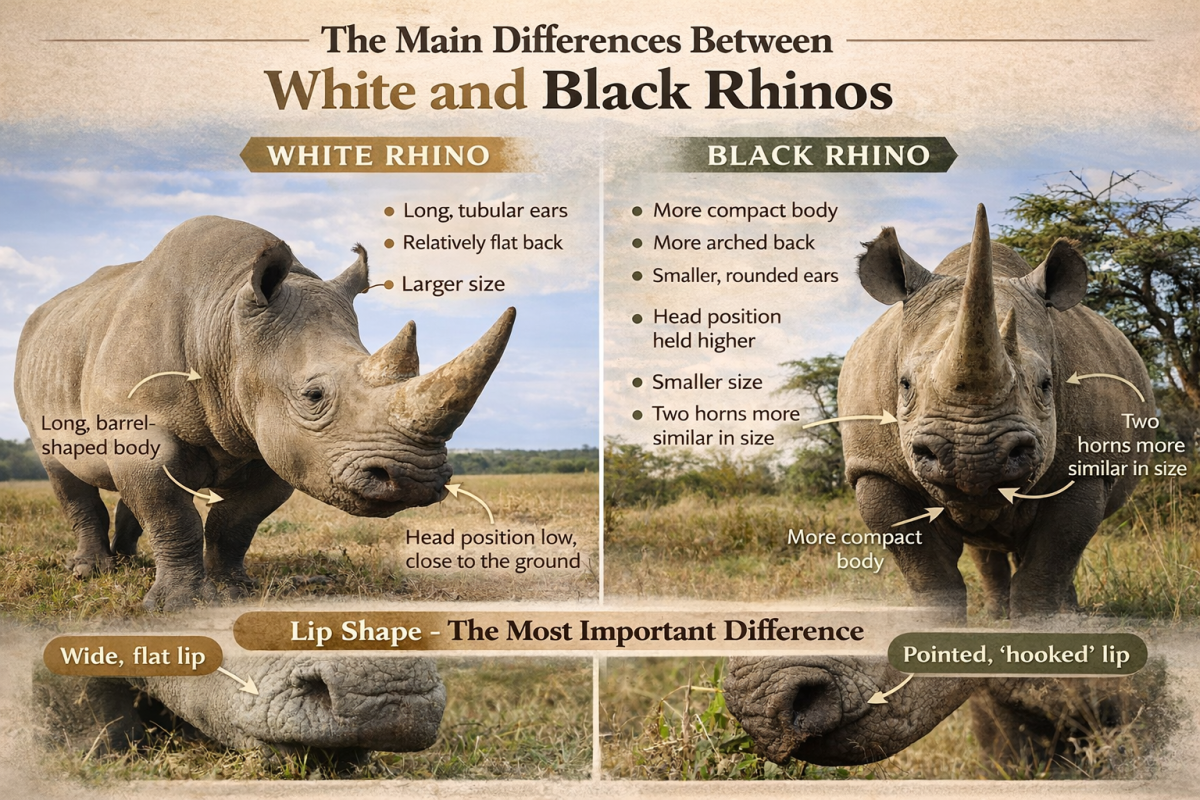
Size
This is the most immediately obvious physical difference between white rhinoceros vs black rhinoceros. White rhinos are among the largest land animals on Earth. A fully grown white rhino can weigh between 1,700 and 2,300 kilograms with some individuals reaching even higher. They stand 1.6 to 1.8 metres at the shoulder.
Black rhinos are significantly smaller, though still enormous animals. They weigh between 800 and 1,400 kilograms and stand 1.4 to 1.6 metres at the shoulder.
If you see two rhinos together and one looks noticeably larger and more barrel-shaped, it is almost certainly the white rhino.
Lip Shape — The Most Important Difference
The lip is the single clearest way to tell a white rhino and black rhino apart in the field.
White rhinos have a wide, flat, square-shaped lip. This lip acts like a lawnmower, gripping and tearing large amounts of short grass from the ground efficiently. The wide lip is perfectly designed for a grazer that spends most of its day with its head down eating grass.
Black rhinos have a narrow, pointed, hooked lip. This prehensile lip works like a finger, curling around individual leaves, twigs, and branches to pull them from trees and bushes. It is precise and selective, designed for a browser that picks food from vegetation above the ground.
Once you know this difference you can identify the species from a good distance just by watching how they feed and the shape of their mouth.
Head Position
The lip shape directly affects how each species carries its head.
White rhinos keep their heads low and close to the ground. They are grazing animals and their necks have adapted to this posture. The muscles that would lift the head high are relatively weaker because they are rarely needed.
Black rhinos carry their heads higher. They need to reach up into trees and bushes to feed so their neck muscles are stronger and their natural resting position is with the head elevated.
This head position difference is visible from a long distance and is one of the fastest ways to identify the species on a game drive.
Ear Shape
White rhinos have long, tubular ears that rotate independently to pick up sounds from different directions. Because white rhinos have poor eyesight and spend their time with their heads down grazing, their hearing is their primary sense for detecting danger. The long ears compensate for limited vision.
Black rhinos have smaller, more rounded ears. They have better eyesight than white rhinos and are less dependent on hearing alone, so their ears are less exaggerated in size.
Horn Length
Both species have two horns. The front horn is larger in both cases and is the one most targeted by poachers.
White rhinos tend to have a longer front horn and a much shorter second horn. The horns are proportionally large relative to the head.
Black rhinos have shorter front horns than white rhinos on average, but their two horns are more similar in length to each other compared to the white rhino’s dramatic front-to-rear difference.
Back Shape
White rhinos have a relatively flat back with a distinctive hump or raised bump over the lower back toward the hips. Their body is long and barrel-shaped.
Black rhinos have a more pronounced arch in the back, giving them a slightly rounder, more compact profile when viewed from the side.
| Physical Feature | White Rhino | Black Rhino |
|---|---|---|
| Weight | 1,700 to 2,300 kg | 800 to 1,400 kg |
| Shoulder height | 1.6 to 1.8 metres | 1.4 to 1.6 metres |
| Lip shape | Wide, flat, square | Narrow, pointed, hooked |
| Head position | Low, close to ground | Higher, more elevated |
| Ear shape | Long and tubular | Smaller and rounded |
| Front horn | Longer | Shorter than white rhino |
| Back shape | Flat with rear hump | More arched |
| Eyesight | Poorer | Better |
White Rhino vs Black Rhino — Habitat and Where to Find Them
Where White Rhinos Live
White rhinos prefer open grassland and savannah where their grazing diet is available. They are found in their largest numbers in South Africa, which holds the vast majority of the world’s white rhino population. Outside South Africa, white rhinos are present in Kenya, Zimbabwe, Namibia, Uganda, and Zambia.
In Kenya: Lake Nakuru National Park holds approximately 100 white rhinos in a fully fenced sanctuary. Ol Pejeta Conservancy on the Laikipia Plateau also has white rhinos, including the world’s last two northern white rhinos, Najin and Fatu.
Where Black Rhinos Live
Black rhinos prefer denser bush and are more adaptable to a wider range of vegetation types. Their populations are scattered across Kenya, Namibia, South Africa, Tanzania, Zimbabwe, Zambia, and Botswana.
In Kenya: The Maasai Mara National Reserve holds one of the few natural wild populations of eastern black rhino in Africa, with approximately 50 to 60 individuals. Lake Nakuru National Park has around 25 eastern black rhinos. Ol Pejeta Conservancy has over 140 black rhinos, making it one of the most important black rhino sanctuaries in East Africa. The Ngorongoro Crater in Tanzania also has a small but stable black rhino population.
| Where to See Them | White Rhino | Black Rhino |
|---|---|---|
| Kenya | Lake Nakuru, Ol Pejeta | Maasai Mara, Lake Nakuru, Ol Pejeta |
| Tanzania | Less common | Ngorongoro Crater |
| South Africa | Kruger, KwaZulu-Natal reserves | Kruger, Eastern Cape |
| Namibia | Etosha National Park | Damaraland, Etosha |
| Zimbabwe | Hwange, Matusadona | Hwange, Matobo Hills |
| Best single location in East Africa | Ol Pejeta Conservancy | Ol Pejeta Conservancy |
See rhinos on a Kenya safari with TourwithPipi →
How to Tell Them Apart on Safari — Quick Tips
Look at the lip. Wide and flat means white rhino. Narrow and hooked means black rhino.
Look at the head position. Head low near the ground means white rhino grazing. Head raised browsing vegetation means black rhino.
Look at the size. Massive and barrel-shaped is more likely a white rhino. More compact and shorter is a black rhino.
Look at the habitat. Open grassland is white rhino country. Dense bush and thicker vegetation is black rhino territory.
Watch the behavior. Calm and possibly in a group means white rhino. Alone and alert means black rhino.
Conclusion
The white rhino vs black rhino difference comes down to one thing above everything else. The lip. Wide and square means white. Narrow and hooked means black. Everything else, the head position, the habitat, the temperament, the size, follows directly from this one difference in diet.
Both are extraordinary animals facing serious threats. Seeing either one on a Kenya safari is a privilege. Ol Pejeta Conservancy gives you the best chance of seeing both species in a single visit while also witnessing one of the most important conservation projects in Africa.
TourwithPipi designs private Kenya and Tanzania safaris that include dedicated rhino experiences at Ol Pejeta, Lake Nakuru, and the Maasai Mara for travelers from the US and UK.
Plan a Kenya rhino safari with TourwithPipi →
Summary Table — White Rhino vs Black Rhino
| Feature | White Rhino | Black Rhino |
|---|---|---|
| Color | Grey | Grey |
| Weight | 1,700 to 2,300 kg | 800 to 1,400 kg |
| Lip shape | Wide, flat, square | Narrow, pointed, hooked |
| Diet | Grazer — grass | Browser — leaves and branches |
| Head position | Low | Higher |
| Ear shape | Long and tubular | Smaller and rounded |
| Temperament | Calm, social | Aggressive, solitary |
| Habitat | Open grassland | Dense bush |
| Social groups | Up to 7 or more | Usually alone or pairs |
| IUCN status | Near Threatened | Critically Endangered |
| Wild population | Approximately 20,000 | Fewer than 6,000 |
| Best place to see in Kenya | Lake Nakuru, Ol Pejeta | Maasai Mara, Ol Pejeta
|
Frequently Asked Questions — White Rhino vs Black Rhino
What is the main difference between a white rhino and a black rhino?
The clearest difference is the lip shape. White rhinos have a wide flat square lip designed for grazing grass. Black rhinos have a narrow pointed hooked lip designed for browsing leaves and branches from trees and bushes. Neither species is actually white or black in color. Both are grey.
Why are they called white and black rhinos if both are grey?
The name white rhino most likely comes from the Afrikaans word wyd or weit meaning wide, referring to the animal’s wide square lip. English speakers misheard this as white and the name stuck. The black rhino was then named simply to distinguish it from the white, not because of any color difference.
Which is bigger — a white rhino or a black rhino?
White rhinos are significantly larger. An adult white rhino weighs between 1,700 and 2,300 kilograms. An adult black rhino weighs between 800 and 1,400 kilograms. White rhinos are among the largest land animals on Earth.
Which rhino is more dangerous — white or black?
Black rhinos are considered more dangerous. They are more aggressive, more territorial, and more likely to charge when they feel threatened. White rhinos are calmer and more placid, though all wild rhinos are potentially dangerous and should always be treated with respect.
Which rhino is more endangered?
Black rhinos are more endangered. They are listed as Critically Endangered by the IUCN with fewer than 6,000 individuals remaining in the wild. White rhinos are listed as Near Threatened with approximately 20,000 southern white rhinos surviving. However the northern white rhino subspecies is functionally extinct with only two females remaining at Ol Pejeta in Kenya.
Where can I see both white and black rhinos in Kenya?
Ol Pejeta Conservancy on the Laikipia Plateau is the best single location in Kenya to see both species. It holds over 140 black rhinos and has white rhinos including the world’s last two northern white rhinos. Lake Nakuru National Park also holds both species in a fully fenced sanctuary. The Maasai Mara has a small population of wild eastern black rhinos.
What do white rhinos eat?
White rhinos are grazers. They eat almost exclusively short grass which they crop continuously with their wide flat square lip. They spend most of their day moving slowly across open grassland with their heads close to the ground.
What do black rhinos eat?
Black rhinos are browsers. They eat leaves, twigs, branches, bark, and fruit from trees and bushes. Their pointed hooked lip allows them to select individual leaves and pull them from branches. They can feed on over 200 different plant species.
What are rhino horns made of?
Rhino horns are made of keratin, the same protein that makes up human fingernails and hair. They have no scientifically proven medicinal properties despite being traded illegally for huge sums in parts of Asia. Both black and white rhinos are killed by poachers for their horns, which is the primary threat to both species.
Can you see rhinos on a Kenya safari?
Yes. Kenya has several excellent locations for rhino sightings. Ol Pejeta Conservancy gives you the best chance of seeing both black and white rhinos including the world’s last northern white rhinos. Lake Nakuru National Park is a fully fenced sanctuary with reliable rhino sightings. The Maasai Mara has a small but genuinely wild eastern black rhino population.


