
Acacia trees are a group of thorny trees and shrubs belonging to the subfamily Mimosoideae in the family Leguminosae. Africa has approximately 132 acacia species, with 62 species found in East Africa alone. They grow across savannahs, semi-deserts, riverbanks, and highland forests from South Africa to the Sahel. The genus Acacia has been legally reclassified for scientific purposes and African species now belong to two main genera, Vachellia and Senegalia. However they are still widely known and recognized as acacias.
What Makes Acacia Trees So Iconic in Africa?
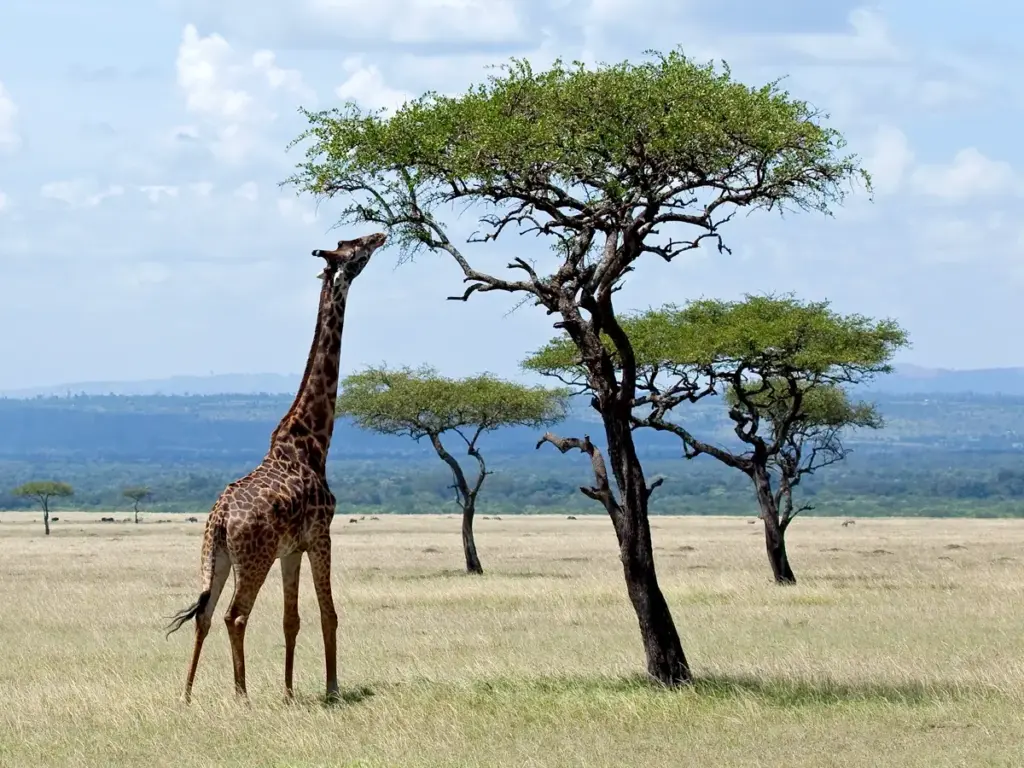
The acacia tree is the most recognizable tree in Africa and arguably the most photographed tree in the world. Its flat-topped umbrella canopy, thorny branches, and silhouette against an African sunrise have appeared in more wildlife documentaries, travel photographs, and safari brochures than any other plant.
But the acacia’s importance goes far beyond aesthetics. It is a keystone species across African savannahs, providing food, shelter, shade, and soil nutrients that support entire ecosystems. Remove the acacia from the African savannah and the landscape changes fundamentally.
The tree is also deeply connected to African culture, traditional medicine, and the economies of rural communities across the continent. From gum Arabic used in food production globally to bark medicines used in villages across Kenya, Tanzania, and southern Africa, the acacia tree touches human life at every level.
Acacia Tree Adaptations in the Savanna
The African savannah is a demanding environment. Long dry seasons, intense heat, poor soils, and constant pressure from large browsing animals have shaped acacia trees over millions of years into some of the most efficiently adapted plants on Earth.
Deep Taproots
One of the most important acacia tree adaptations in the savanna is the deep taproot system. Acacia trees develop long taproots that push far down through the soil to reach underground water sources that surface-level plants cannot access. Some species develop taproots that extend many meters below ground.
This adaptation allows acacias to survive prolonged drought periods that would kill most other trees. Even when the surface soil is bone dry and the savannah appears dead, acacia trees continue to draw water from deep reserves and maintain their canopy.
Tiny Leaves
Most acacia species have very small, feathery leaflets. This is a deliberate water conservation strategy. Smaller leaf surface area means less water lost through evaporation on hot, dry days. In some species the green stems and branches also contain chlorophyll, extending the surface area available for photosynthesis without needing to produce large water-expensive leaves.
Thorns as Defence
Acacia thorns are one of the tree’s most recognisable features and one of its primary adaptations against the constant pressure of large herbivores. Different species have evolved different thorn strategies.
Vachellia species produce straight thorns growing in V-shaped pairs. These can reach 8 centimetres in length in some species and are strong enough to puncture shoe soles and vehicle tyres on rough tracks.
Senegalia species produce hooked thorns that catch and hold anything that brushes against them. These thorns give species like the black-thorn acacia (Senegalia mellifera) its nickname, the wait-a-bit bush, because once caught in its thorns you wait a while before you can free yourself.
The umbrella thorn (Vachellia tortilis) uses both strategies simultaneously, producing both small hooked thorns and longer straight thorns to deter browsers of different sizes.
Chemical Communication
This is one of the most remarkable acacia tree adaptations and one that genuinely surprised scientists when it was first documented.
When an acacia tree is being heavily browsed by a large herbivore, it releases chemical signals into the air. These airborne chemicals are carried by the wind to neighboring acacia trees of the same species. Receiving trees detect these signals and respond by increasing the production of tannins in their leaves.
High tannin concentrations make the leaves bitter and unpalatable. The browsing animal finds the nearby trees increasingly unappealing and moves on. The tree being browsed and its neighbors have cooperated to reduce the attack without any physical connection between them.
Giraffes in areas with dense acacia populations appear to be aware of this phenomenon. They are often observed browsing into the wind rather than downwind, which reduces the effectiveness of the chemical signalling and keeps fresh leaves more palatable for longer.
Ant Partnerships
Some acacia species have evolved one of the most sophisticated defence systems in the plant kingdom. They form mutualistic relationships with specific ant species (primarily Crematogaster and Tetraponera) through a system called myrmecophily.
The acacia provides the ants with hollow swollen thorns as shelter and breeding space, plus sugary nectar from glands on the leaves and protein-rich food bodies called Beltian bodies. In exchange the ants become a permanent army defending the tree.
When a browsing animal begins feeding on the tree the ants swarm instantly, biting the animal’s face and mouth, spraying irritating compounds, and making feeding deeply unpleasant. Most browsers move away quickly. The relationship is mutually beneficial and genuinely effective.
The whistling thorn acacia (Vachellia drepanolobium) takes this further. Ants chew entry holes in the swollen galls they inhabit. When wind passes over these holes it produces a whistling sound that gives the tree its common name. You can hear it clearly on a windy day in the Maasai Mara or Serengeti.
Nitrogen Fixation
All acacia trees carry nitrogen-fixing bacteria in nodules on their roots. These bacteria take nitrogen from the air and convert it into a form that plants can use. This process enriches the soil around the tree, making it more fertile for surrounding vegetation.
Across African savannahs where soils are often poor and mineral-depleted, acacia trees function as natural fertilizers, quietly building soil health that benefits entire plant communities around them.
The Umbrella Thorn Acacia — Africa’s Most Iconic Tree
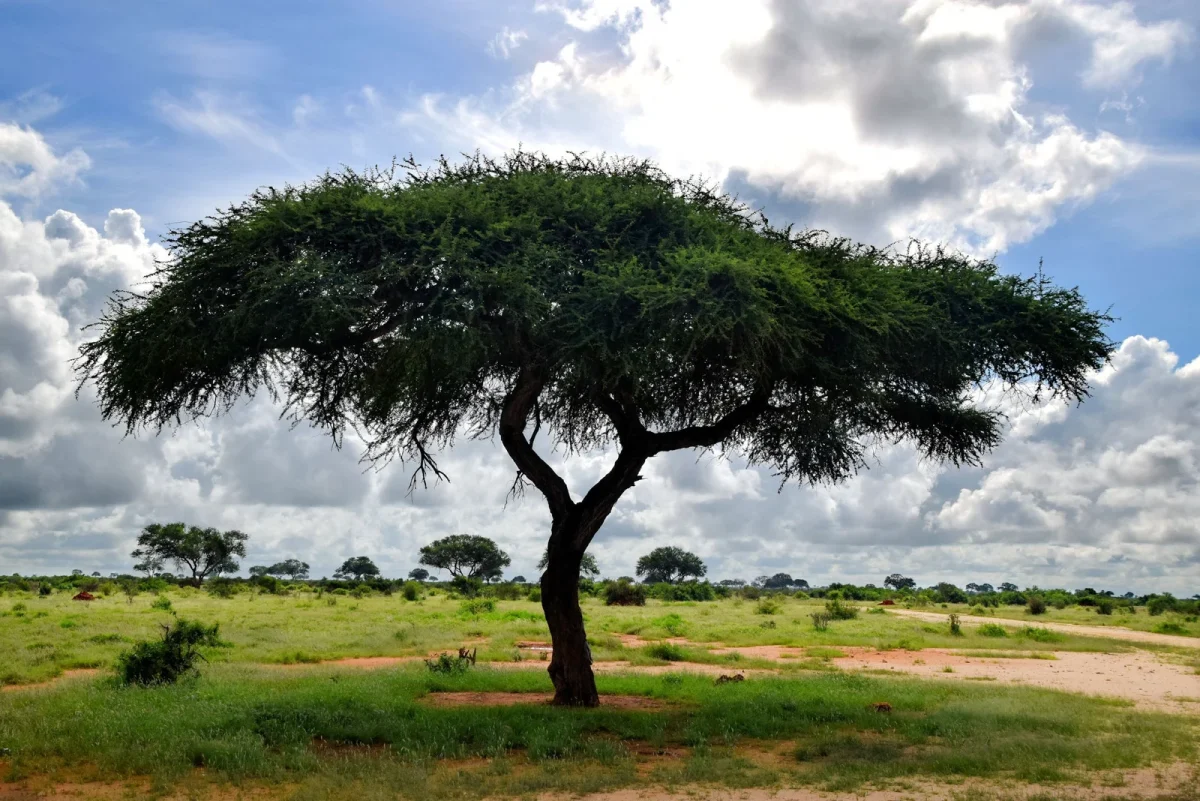
The umbrella thorn acacia is the classic African safari tree, known for its wide, flat canopy that creates the familiar umbrella shape across the savannah. It grows in dry regions and survives with very little rainfall. Its curled seed pods feed animals like elephants, zebras, and antelope, especially during the dry season. The tree has both long and hooked thorns, helping protect it from different types of animals.
The Fever Tree — Africa’s Most Beautiful Acacia
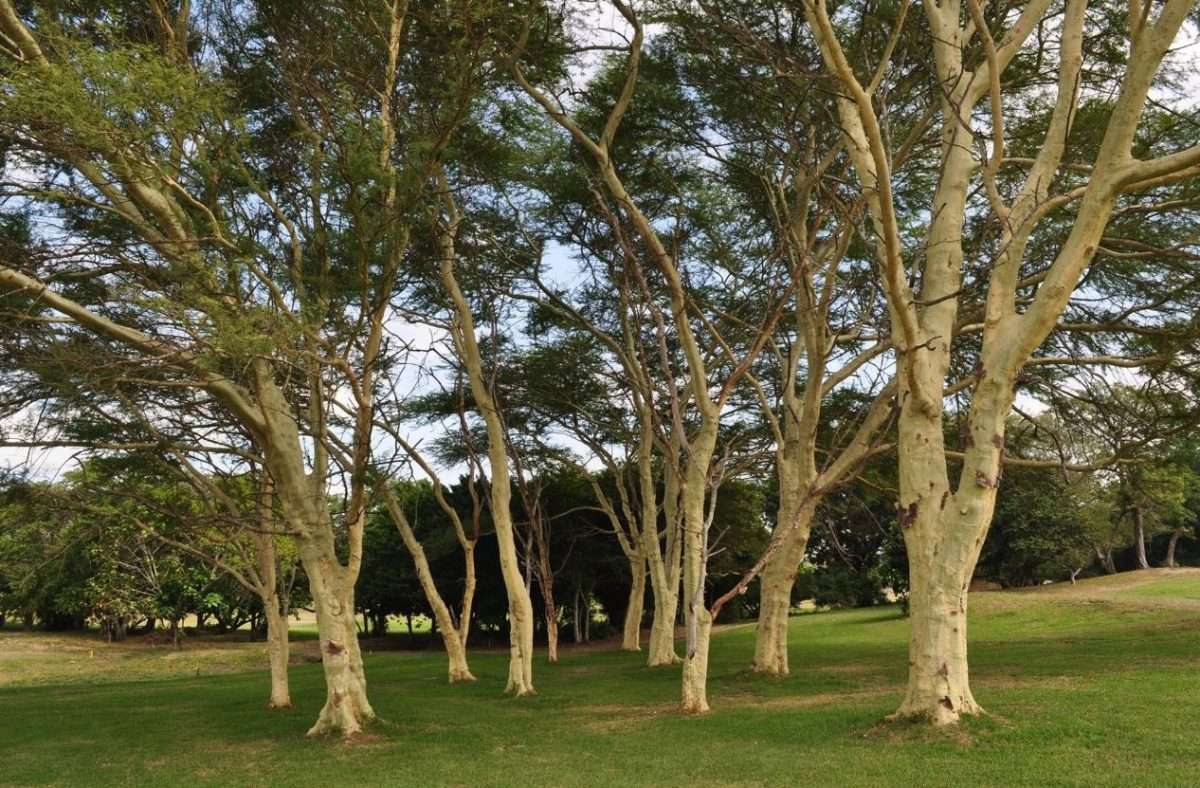
The fever tree stands out with its bright yellow-green bark, which can photosynthesise. It grows near water sources like lakes and swamps, especially in places like Lake Nakuru and Lake Naivasha. Its name came from early travelers who linked it to malaria, but the real cause was mosquitoes in nearby water, not the tree itself.
The Whistling Thorn — Africa’s Most Unique Acacia
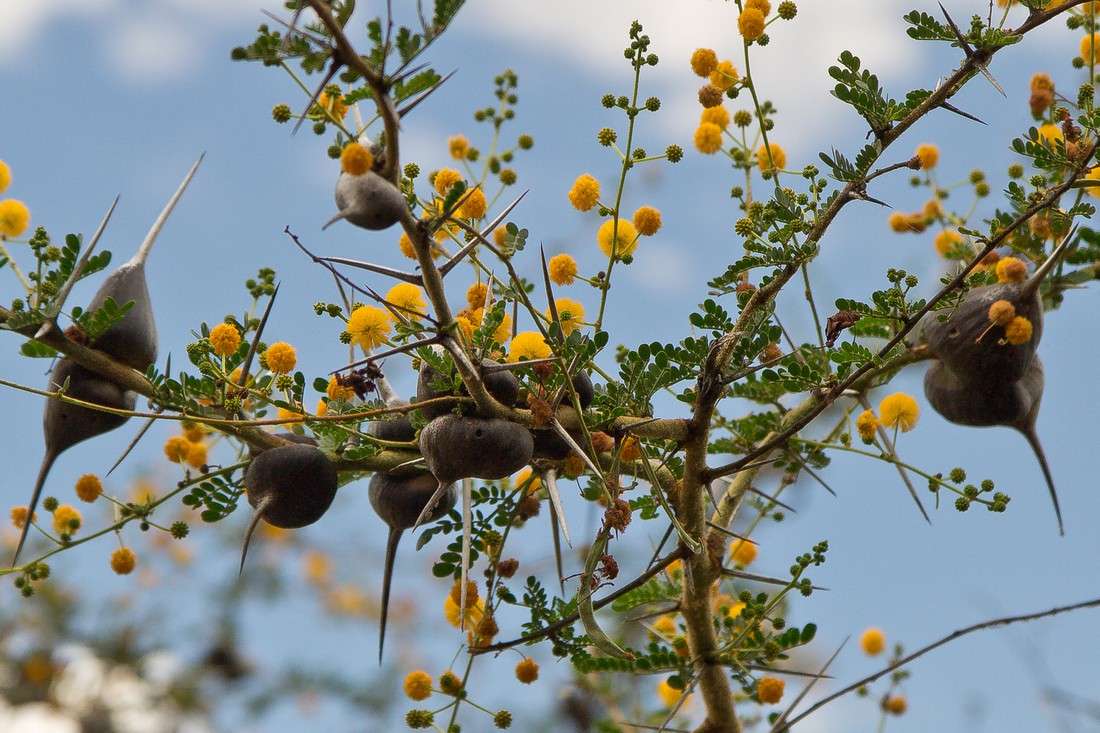
The whistling thorn acacia is common in the Maasai Mara and Serengeti. It has swollen thorns that house ants. When wind passes through small holes in these thorns, it creates a soft whistling sound. The ants protect the tree from animals, making this one of the most fascinating plant-animal partnerships in Africa.
Medicinal and Cultural Uses of Acacia Trees
For thousands of years, African communities have used acacia trees for medicine, food, construction, and cultural practices.
- Gum arabic from Vachellia senegal has been traded for over 4,000 years. Ancient Egyptians used it to make bandages for mummies, to glue paint onto tomb walls, and to create a contraceptive paste mixed with dates and honey. Today gum arabic is used globally as a food additive and stabiliser in confectionery, beverages, pharmaceuticals, and cosmetics.
- Medicinal bark and leaves: The bark and leaves of various acacia species are used across Africa to treat stomach ailments, respiratory infections, skin conditions, and wounds. The leaves of Vachellia nilotica have been used in treatments for cancer and tuberculosis. Leaves applied to wounds as a poultice have anti-inflammatory properties confirmed in modern research.
- Acacia honey: In Kenya and across East Africa the nectar-rich flowers of black-thorn acacia attract bees and produce honey with a distinctive flavor. Local communities hang hollow logs in acacia trees as traditional hives to harvest this honey.
- Charcoal and timber: Acacia wood is dense, hard, and long-burning. It is widely used for charcoal production and furniture making. The knob thorn acacia produces wood of sufficient quality for furniture and parquet flooring.
- Food for communities: Ground seeds of Vachellia karroo have traditionally been used as a coffee substitute. Acacia gum is eaten directly in North Africa and the Sahel as a food source. The protein-rich pods of many species are used as livestock fodder across dry-season rangeland.
Acacia Trees and African Wildlife
Acacia trees support an extraordinary range of wildlife across the African continent.
- Giraffes are perhaps the most iconic acacia browser. Their long tongues (up to 45 centimeters) and tough flexible lips allow them to navigate thorns and pull leaves from branches with precision. Giraffes are also thought to be the primary pollinators of the knob thorn acacia, collecting pollen on their faces as they feed and transferring it between trees.
- Elephants browse acacia branches, strip bark, and uproot entire trees in their pursuit of food. A single elephant can consume up to 150 kilograms of vegetation per day and acacia forms a significant part of their diet in many regions.
- Leopards use large acacia trees as resting spots and food storage, hauling prey carcasses into the branches to keep them away from lions and hyenas. A kill stored in an acacia tree can remain there for several days.
- Birds use acacias for nesting, hunting, and roosting. Secretary birds, bateleur eagles, and many raptor species nest in large acacias. Weaver birds construct their elaborate communal nests in the outer branches. Hornbills and starlings feed on insects, flowers, and seeds.
- Insects rely on acacia flowers for nectar and pollen. The flowers of Vachellia and Senegalia species are among the most important nectar sources in African savannahs, supporting bee populations that in turn support broader pollination across the ecosystem.
Where to See Acacia Trees on an African Safari
Acacia trees are found across almost every sub-Saharan African safari destination. Different species dominate different habitats and regions.
- East Africa — Kenya and Tanzania: The open plains of the Maasai Mara and Serengeti are dominated by whistling thorn and umbrella thorn acacias. Lake Nakuru and Lake Naivasha in Kenya’s Rift Valley have spectacular fever tree woodlands. Samburu National Reserve in northern Kenya has river acacias lining the Ewaso Ng’iro River. Amboseli’s plains are studded with umbrella thorn acacias against the Kilimanjaro backdrop.
- Southern Africa — South Africa, Zimbabwe, Zambia, Botswana, Namibia: The Kruger National Park has extraordinary acacia diversity including the knob thorn and sweet thorn. The Okavango Delta in Botswana has fever tree woodlands and river acacias along its channels. Etosha National Park in Namibia has dense umbrella thorn woodland across its plains. South Luangwa in Zambia has spectacular acacia riverine forest along the Luangwa River.
- West and Central Africa: Gum Arabic acacia (Vachellia senegal) dominates the Sahel zone across Senegal, Mali, Niger, and Chad. It is the primary source of the gum Arabic trade that supports millions of people across this region.
| Safari Destination | Best Acacia Species to See |
|---|---|
| Maasai Mara, Kenya | Whistling thorn, umbrella thorn, flat-top acacia |
| Serengeti, Tanzania | Umbrella thorn, whistling thorn, knob thorn |
| Lake Nakuru, Kenya | Fever tree, flat-top acacia, umbrella thorn |
| Samburu, Kenya | River acacia, black-thorn, scented pod acacia |
| Kruger, South Africa | Knob thorn, sweet thorn, umbrella thorn |
| Etosha, Namibia | Umbrella thorn, camel thorn |
| Okavango, Botswana | Fever tree, river acacia, camel thorn |
| South Luangwa, Zambia | Apple-ring acacia, river acacia |
Plan an African safari with TourwithPipi →
Conclusion
The acacia tree is far more than a backdrop for safari photographs. It is one of the most ecologically important, most biochemically sophisticated, and most culturally significant trees in Africa. Its acacia tree adaptations in the savanna — deep taproots, tiny leaves, thorn defences, chemical communication, and ant partnerships — represent millions of years of evolution in one of Earth’s most demanding environments.
Every safari across Africa, whether in the Maasai Mara, the Serengeti, Kruger, or the Okavango, takes place in a landscape shaped by these extraordinary trees. When you next watch a giraffe stretching its long neck into a flat-topped canopy, or hear a soft whistling in the morning breeze across the Serengeti, you will know exactly what you are looking at and why it matters.
TourwithPipi designs private guided safaris across Kenya, Tanzania, and wider Africa where guests experience these landscapes fully, with expert guides who know not just the animals but the trees, the plants, and the intricate relationships that hold African ecosystems together.
Start planning your African safari with TourwithPipi →
Frequently Asked Questions — Acacia Trees in Africa
What is an acacia tree?
An acacia tree is a thorny tree or shrub belonging to the subfamily Mimosoideae in the legume family. Africa has approximately 132 acacia species now classified under the genera Vachellia and Senegalia. They are among the most widespread and ecologically important trees across African savannahs, from the Sahel in the north to the Cape in the south.
What are the main adaptations of acacia trees in the savanna?
The main acacia tree adaptations in the savanna include deep taproots that access underground water during drought, small feathery leaflets that reduce water loss through evaporation, long sharp thorns that deter browsers, chemical signalling to neighboring trees when under attack, and mutualistic partnerships with ant colonies that actively defend the tree from herbivores.
Why do acacia trees have thorns?
Acacia thorns are a defence mechanism against the constant browsing pressure of large herbivores in African savannahs. Different species produce different thorn types. Vachellia species produce straight paired thorns. Senegalia species produce hooked thorns. Some species like the umbrella thorn produce both types simultaneously. The thorns make feeding difficult and uncomfortable for most animals.
How do acacia trees communicate with each other?
When an acacia tree is being heavily browsed it releases airborne chemical signals that travel on the wind to neighboring acacia trees. These trees detect the chemicals and respond by increasing tannin production in their leaves making them bitter and unpalatable. This is a documented form of interplant communication that reduces browsing pressure across a wider area.
What is the relationship between acacia trees and ants?
Several acacia species form mutualistic relationships with ant species including Crematogaster and Tetraponera. The acacia provides hollow swollen thorns as shelter, sugary nectar as food, and protein-rich Beltian bodies. In return the ants defend the tree by swarming and biting any animal that begins browsing the leaves. The relationship is mutually beneficial and highly effective.
What is acacia gum used for?
Acacia gum is produced from the sap of Vachellia senegal and related species. It has been used for thousands of years in food, medicine, and industrial applications. Ancient Egyptians used it in mummification and as a contraceptive paste. Today it is used globally as a food additive and stabiliser in confectionery, soft drinks, pharmaceutical tablets, and cosmetics. In North Africa and the Sahel it is eaten directly as a food source.
Which is the most iconic acacia tree in Africa?
The umbrella thorn acacia (Vachellia tortilis) is the most recognisable acacia species in Africa. Its wide flat-topped canopy creates the classic African savannah silhouette seen in wildlife photography and documentaries worldwide. It is widespread across semi-arid and arid regions from South Africa through East Africa and across the Sahel.
Why is the fever tree called a fever tree?
The fever tree (Vachellia xanthophloea) got its name from early European travelers who noticed that camps built near these trees often resulted in malaria. The tree was mistakenly blamed. The actual connection is water. Fever trees grow in areas with high water tables and near lakes and rivers. Malaria-carrying mosquitoes also breed near water. The tree was innocent but the name stuck.
Do giraffes eat acacia trees?
Yes. Giraffes are among the most important browsers of acacia trees across African savannahs. Their long tongues of up to 45 centimeters and tough flexible lips allow them to navigate thorns and pull leaves from branches. Giraffes are also thought to be the primary pollinators of the knob thorn acacia, collecting pollen on their faces as they feed and transferring it to the next tree they browse.
Where can I see acacia trees on safari?
Acacia trees are found across virtually every African safari destination. The Maasai Mara and Serengeti have iconic umbrella thorn and whistling thorn landscapes. Lake Nakuru and Lake Naivasha have spectacular fever tree woodlands. Kruger National Park in South Africa has exceptional acacia diversity. The Okavango Delta, Etosha National Park, and South Luangwa in Zambia all offer outstanding acacia landscapes as part of a broader safari experience.
Blog Summary About Acacia Trees in Africa
- Africa has approximately 132 acacia species spread across diverse habitats from coastal forest to desert edge.
- The word acacia comes from the Greek word akis, meaning thorns, which perfectly describes Africa’s thorny varieties.
- The umbrella thorn acacia (Vachellia tortilis) is the most iconic species and the image most associated with the African savannah.
- Acacia trees have two types of thorns — straight paired thorns in Vachellia species and hooked thorns in Senegalia species.
- Some acacia species communicate chemically, releasing airborne signals to neighboring trees when being heavily browsed, triggering tannin production to make leaves unpalatable.
- Acacia trees form mutualistic relationships with ants, providing hollow thorns as shelter and sugary sap as food in exchange for protection from herbivores.
- Giraffes are the primary browsers of many acacia species and are thought to be key pollinators of the knob thorn acacia.
- Acacia gum, produced from the sap of several species, has been used in food, medicine, and even ancient Egyptian mummification for thousands of years.
- All acacia trees have nitrogen-fixing bacteria in root nodules, which maintain soil fertility across vast African landscapes.
- The yellow-barked acacia (Vachellia xanthophloea) is also called the fever tree because it grows in moist areas where mosquitoes breed, giving early travelers the mistaken impression the tree itself caused malaria.


