
Quick Answer:
If your goal is to experience the greatest diversity of wildlife, expert-guided game drives, luxury safari lodges, and unforgettable encounters with iconic animals, an African safari offers a far richer experience than an American wildlife trip. While the United States has outstanding national parks and wildlife, Africa provides unmatched species diversity, higher wildlife densities, the Big Five, the Great Migration, and immersive safari experiences that cannot be replicated anywhere else.
African Safari vs American Wildlife Trip
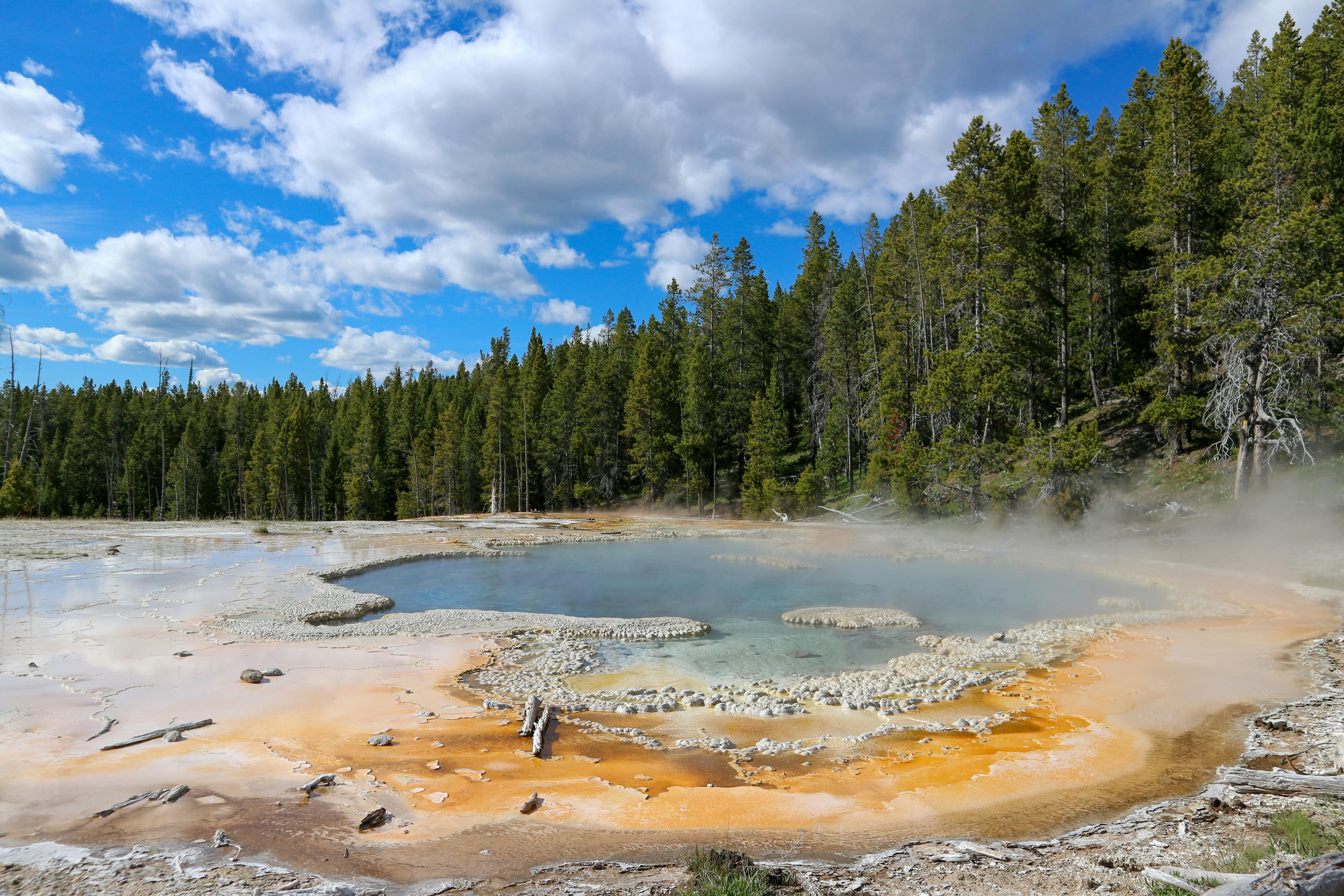
When American travelers consider a wildlife trip at home, the real contenders are Yellowstone National Park, the Okefenokee Swamp in Georgia, the Everglades, Point Reyes National Seashore in California, and the American Prairie in Montana. These are genuinely impressive places with real, wild animals.
Yellowstone covers 3,500 square miles and has wolves, bison, grizzlies, and geothermal features found nowhere else on earth. The Everglades has alligators, manatees, and Florida panthers. Point Reyes has one of the best bobcat sighting rates in the world. Nobody is pretending these are ordinary places.
But here is what they are not: they are not safari destinations in the classic sense. Wildlife in American national parks is mostly viewed from roads, at distance, through binoculars or a zoom lens. The animals are habituated to vehicles in some places (Yellowstone’s wolves are often watched from a quarter-mile away with spotting scopes) but genuinely close wildlife encounters of the kind you get in Kenya or Tanzania are rare and unpredictable rather than a daily expectation.
An African safari is built around that encounter. The private guide, the 4×4 with a pop-up roof, the positioning of the vehicle at the right angle to the light before the lion wakes up, the ability to stay at a sighting for two hours if you want to. That is structurally different from American wildlife tourism, not better in every way, but different enough that they are not really competing for the same experience.
Wildlife Diversity: Africa vs America Side by Side
| Category | East Africa (Kenya + Tanzania) | Best of the USA |
|---|---|---|
| Large predators | Lion, leopard, cheetah, spotted hyena, wild dog | Gray wolf, grizzly bear, mountain lion |
| Mega-herbivores | African elephant, hippo, giraffe, rhino, zebra, wildebeest | American bison, moose, elk |
| Primate species | Chimpanzee, olive baboon, colobus monkey, vervet | None (outside Florida’s escaped rhesus population) |
| Bird species | 1,000+ (Kenya alone has 1,100+ recorded species) | 900+ across all of North America |
| Annual wildlife migration | 1.5 million wildebeest + 200,000 zebra across the Serengeti | None comparable |
| Rhino species | Black and white rhino | No native rhino species |
| Big Five | All five (lion, leopard, elephant, buffalo, rhino) | None |
Kenya alone has more bird species than the entire continental United States. Tanzania’s Ngorongoro Crater holds over 25,000 large animals within a 260 square kilometer natural boundary. Yellowstone, which covers 3,500 square miles, has a wolf population of roughly 100 animals.
This is not a knock on America’s wildlife. A gray wolf or a grizzly bear is a genuinely extraordinary thing to see. But diversity and density are the words that keep coming up when people who have done both compare the experiences. In East Africa, the question on a game drive is not whether you will see wildlife. It is which wildlife, how many, and doing what.
The Cost Comparison: What You Actually Pay
This is where the American safari narrative gets its strongest foothold. Flying to Kenya or Tanzania from the US East Coast costs $1,200 to $2,500 return depending on routing and season. That is real money before the safari itself starts.
| Trip Type | Typical Cost Per Person | Duration | What’s Included |
|---|---|---|---|
| Yellowstone guided wolf tour | $250 to $800 | 2 to 4 days | Day guiding, no accommodation |
| American Prairie self-guided | $50 to $200 | 3 to 5 days | Entry fees, camping |
| Point Reyes wildlife tour | $150 to $400 | 1 to 2 days | Guided walk or drive |
| 7-Day Kenya safari (TourwithPipi) | from $2,519 per person | 7 days | Private vehicle, guide, full board lodges, park fees, all transfers |
| 7-Day Tanzania safari (TourwithPipi) | from $3,109 per person | 7 days | Private vehicle, guide, full board lodges, park fees, all transfers |
| 10-Day Great Migration safari | from $5,479 per person | 10 days | Private vehicle, guide, full board, Mara River crossing access |
The American options look cheaper until you factor in what they include. A Yellowstone wolf tour is a half-day with a guide who points at a distant pack through a spotting scope. A 7-day Kenya safari includes full board accommodation at personally vetted lodges, a private 4×4 Land Cruiser and certified guide every day, all park fees across multiple parks, airport transfers, and emergency medical evacuation cover. Those are not comparable products at any price.
When you build a genuine American “safari-style” experience, with a private naturalist guide, accommodation near the wildlife, and multiple full days in the field, the cost closes considerably. Three nights near Yellowstone in a good lodge with a private guide runs $2,000 to $4,000 per person. At that price point, an African safari starts to look significantly more compelling on a value basis.
The Luxury Experience: Where Africa Has No Competition
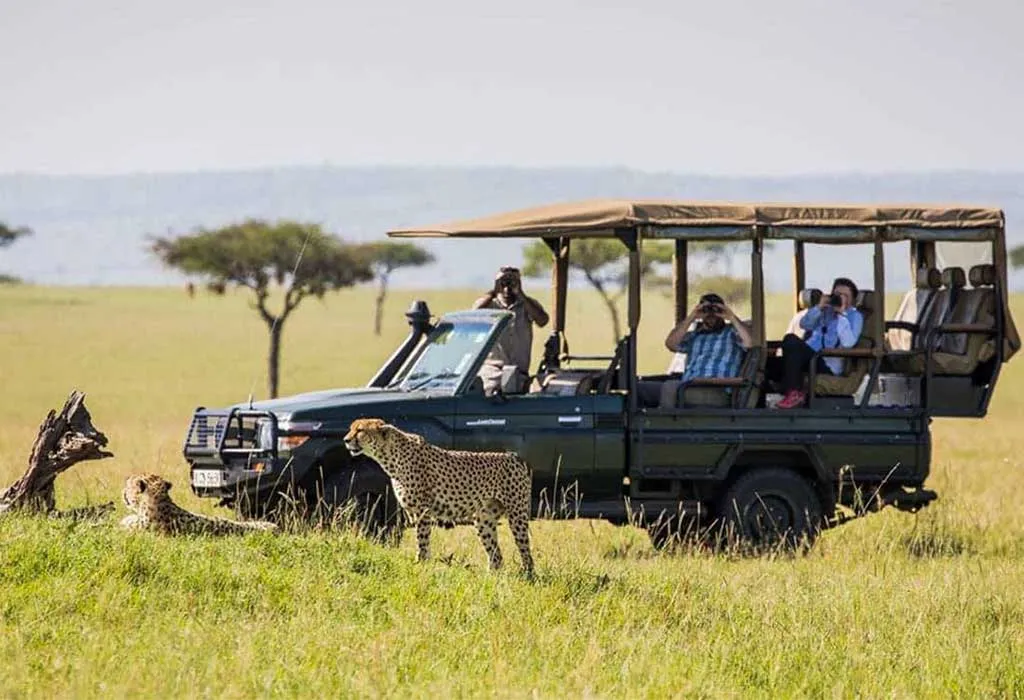
American wildlife lodges have improved dramatically over the past decade. There are genuinely beautiful properties in Yellowstone country, Montana, and coastal California. But the concept of luxury safari accommodation as it exists in East Africa has no real equivalent in North America.
| Feature | East Africa Safari | American Wildlife Lodge |
|---|---|---|
| Location | Inside national park or private conservancy, surrounded by wildlife | Usually outside park boundaries due to US park regulations |
| Accommodation style | Tented camps with en-suite bathrooms, plunge pools, bush decks | Hotel-style rooms, cabins, or glamping tents |
| Game drive access | Your vehicle, your guide, your schedule, no time limits | Often shared group tours with fixed departure times |
| Bush dining | Private bush lunches, sundowners in the wild, lantern-lit dinners | Restaurant dining, no equivalent bush experience |
| Wildlife proximity at lodge | Elephants, lions, hippos can walk through camp | Wildlife generally at a distance, fenced properties |
| Guide quality | TANAPA or KWS certified, dedicated naturalist for your group | Varies widely, often rotating staff |
| Night drives | Available in private conservancies outside national parks | Not permitted in most US national parks |
The experience of waking up at a tented camp in the Serengeti and having a giraffe walk past while you drink coffee on your deck before sunrise has no American equivalent. Not because American lodges are bad, but because US national park regulations prohibit the kind of in-park accommodation and free movement that make African safari camps what they are.
The Activities Comparison
| Activity | East Africa | USA |
|---|---|---|
| Private game drives (your vehicle, your schedule) | Yes, standard | Rare and expensive, not in national parks |
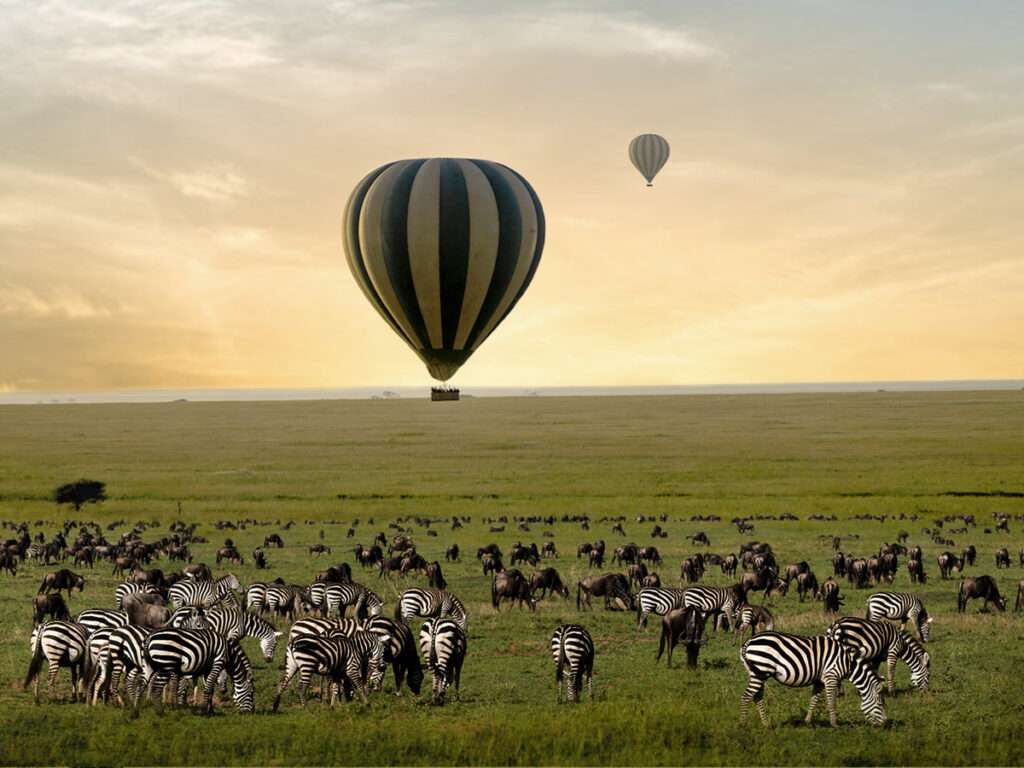
| Hot air balloon safari | Yes, over Serengeti and Masai Mara from $500 | Not wildlife-focused, no comparable operator |
| Walking safari with armed guide | Yes, available in Kenya conservancies | Limited (some Yellowstone tours, backcountry hiking) |
| Night drives | Yes, in private conservancies | Not permitted in US national parks |
| Guided bush walks in wildlife area | Yes | No, for safety reasons in most predator areas |
| Cultural village visits | Yes, Maasai communities, local partnerships | Limited, some indigenous partnerships in Montana |
| Great Migration viewing | Yes, July to October in Northern Serengeti | No equivalent event anywhere in North America |
| Mountain climbing add-on | Kilimanjaro (5,895m), Mount Kenya (5,199m) | Yellowstone has no summitable peaks nearby |
| Beach extension | Zanzibar, Lamu, Diani (same trip) | Separate trip entirely |
The Great Migration is the single most dramatic argument for Africa over America. Between July and October, 1.5 million wildebeest and 200,000 zebra move across the Serengeti and cross the Mara River in crossings that last minutes, during which hundreds of animals plunge into crocodile-filled water simultaneously. Nothing in the natural world in North America comes close to this in scale or drama.
Which Destination Is Better for Wildlife Photography?
Both Africa and North America attract wildlife photographers, but they offer very different shooting opportunities.
African Safari
African safaris are designed around photography.
Advantages include:
- Open 4×4 safari vehicles.
- Professional guides who understand animal behaviour.
- Excellent golden-hour game drives.
- Large mammals in open landscapes.
- Opportunities to photograph predators and prey together.
- Close wildlife encounters while following park regulations.
American Wildlife Trips
American parks are excellent for landscape and wildlife photography, particularly for:
- Wolves.
- Grizzly bears.
- Bald eagles.
- Moose.
- Bison.
- Elk.
- Mountain scenery.
However, wildlife is often viewed from longer distances, making telephoto lenses almost essential.
| Photography Feature | African Safari | American Wildlife Trip |
| Predator photography | Excellent | Good |
| Big mammals | Excellent | Good |
| Bird photography | Excellent | Excellent |
| Landscape photography | Excellent | Excellent |
| Close wildlife opportunities | More frequent | Less frequent |
| Guided photographic tours | Widely available | Available at selected parks |
Which Trip Is Better for Families?
Both destinations can create unforgettable family vacations, but they suit different travel styles.
African Safari
Ideal for families looking for:
- Bucket-list wildlife experiences.
- Private guides.
- Luxury family lodges.
- Educational wildlife learning.
- Cultural experiences.
- Personalized itineraries.
Many safari lodges also offer children’s programs, junior ranger activities, bush walks, and wildlife education tailored for younger guests.
American Wildlife Trips
Well suited for:
- Weekend getaways.
- Short holidays.
- Self-drive vacations.
- Hiking and camping.
- Families travelling on tighter budgets.
If time and budget allow, an African safari often becomes a once-in-a-lifetime educational experience that children remember for years.
Which Wildlife Trip Is Right for You?
There is no wrong choice.
The best destination depends on the type of experience you want.
| If You Want… | Choose an African Safari | Choose an American Wildlife Trip |
| Big Five wildlife | ✓ | |
| Great Migration | ✓ | |
| Private luxury safari | ✓ | |
| Multiple large mammals every day | ✓ | |
| Wildlife-focused vacation | ✓ | |
| Gorilla or chimpanzee trekking | ✓ | |
| Safari with Indian Ocean beaches | ✓ | |
| Weekend wildlife escape | ✓ | |
| Easier domestic travel | ✓ | |
| Wolves and grizzly bears | ✓ | |
| National park road trips | ✓ | |
| Hiking and camping | ✓ |
For travelers seeking the world’s most immersive wildlife experience, Africa remains unmatched.
Frequently Asked Questions
Is an African safari better than an American wildlife trip?
For wildlife diversity, luxury experiences, and guided animal encounters, yes. African safaris offer the Big Five, the Great Migration, private game drives, and exceptional biodiversity that cannot be replicated in North America.
Which has more wildlife, Africa or America?
Africa has greater concentrations of large mammals and more opportunities to see multiple iconic species during a single day. America offers outstanding wildlife but generally with lower animal density and fewer large mammal species in one location.
Is an African safari worth the cost?
For many travelers, yes. Although the initial investment is higher, most safaris include accommodation, guides, transportation, park fees, and daily game drives, providing excellent overall value.
Can I see the Big Five in America?
No. The Big Five—lion, leopard, elephant, rhinoceros, and African buffalo—are native to Africa.
Is Africa safer than people think for safari travel?
Yes. Safaris with experienced operators are highly organized and follow strict wildlife safety procedures. Guests travel with trained guides, stay in reputable lodges, and follow established park regulations.
Experience Africa with TourwithPipi
At TourwithPipi, we believe a safari should be more than simply checking animals off a list. It should be a carefully planned journey that combines extraordinary wildlife, authentic cultural connections, exceptional hospitality, and meaningful conservation experiences.
Founded in North America with deep East African roots, TourwithPipi specializes in tailor-made luxury safaris across Kenya and Tanzania. Every itinerary is designed around your travel style, whether you’re hoping to witness the Great Migration, photograph the Big Five, celebrate a honeymoon, enjoy a family adventure, or combine your safari with the white-sand beaches of Zanzibar or Lamu Island.
Our guests enjoy:
- Private 4×4 safari vehicles.
- Expert local guides.
- Handpicked luxury lodges and tented camps.
- Flexible itineraries.
- Seamless North American trip planning and support.
- Trusted partnerships with experienced teams on the ground.
From your first conversation to your final game drive, every detail is carefully arranged so you can focus on experiencing Africa’s remarkable wildlife.
Key Takeaways
- African safaris offer greater wildlife diversity than any single American wildlife destination.
- Africa is home to the Big Five, the Great Migration, and some of the world’s highest concentrations of large mammals.
- American national parks excel in landscapes, wolves, bears, and birdwatching but offer fewer large wildlife species.
- African safaris combine luxury lodges, private guides, game drives, cultural experiences, and wildlife viewing in one journey.
- Although African safaris require a larger travel budget, they often provide significantly greater value through all-inclusive experiences.


