
A Kilimanjaro trek usually takes 5 to 9 days to complete, covering a hiking range of 53 to 72 kilometers or 32 to 45 miles. The more days you spend on the mountain, the more time your body gets to acclimatize, which is a major advantage during a Kilimanjaro hiking tour. Since your body works harder to breathe at higher altitudes, longer routes give you the space to adjust slowly to lower oxygen levels. This is why extended itineraries on Mount Kilimanjaro consistently show a much higher Kilimanjaro success rate than the shorter trails.
Managing your daily elevation gain is one of the most effective ways to prevent altitude sickness on Kilimanjaro. A longer route naturally supports this because elevation is gained more gradually. One thing many climbers only learn afterward is that longer routes also reduce overall fatigue. The distance is divided into short, manageable hiking intervals, allowing your body enough time to recover each day. When the same distance is squeezed into fewer days, your chances of exhaustion and injury increase unless you are already very fit.
Overview: How Long Does It Take to Climb Mount Kilimanjaro?
Northern Circuit Route: The Northern Circuit route takes 9 days and covers about 82km (50 mi). It is the longest and easiest route on the mountain and consistently performs the best because of its excellent acclimatization opportunities. It is remote, quiet, and known for very few accident reports. When comparing Kilimanjaro vs Everest Base Camp, both the Northern Circuit and the Lemosho routes offer trekking experiences that stand strong beside the famous Everest Base Camp trail.
Lemosho Route: The Lemosho route, also known as the new Shira Route, takes 7 to 8 days and is the second longest and second easiest option after the Northern Circuit. The two routes are nearly identical until the final two days of hiking. One highlight of Lemosho is the optional overnight stay at Crater Camp, which allows you to sleep in the shadow of the summit.
Rongai Route: The Rongai route is the third easiest trail on Mount Kilimanjaro and takes 7 days to complete. Although it is gentle, the acclimatization landscapes are not as strong as those found on Lemosho or the Northern Circuit, so performance rates are lower. The trail is known for its stunning views of Mawenzi Peak from Mawenzi Tarn.
Machame Route: The Machame route, often referred to as the Whiskey Route, takes 6 to 7 days and follows a clear, well-structured trail. It begins at Machame Gate, moves through Lava Tower, and finishes at Mweka Gate. This is the most popular route on Kilimanjaro and covers 62km (37 mi).
Marangu Route: The Marangu route is the shortest of the main trails, covering 72km (45 mi). It can be completed in 5 to 6 days, but it performs poorly overall because the shorter duration reduces acclimatization time. This is the only route with hut accommodation rather than tents.
Umbwe Route: The Umbwe route covers 53km (32 mi) and takes 6 days. It is the hardest route on Mount Kilimanjaro because of its steep, unmaintained paths and rough terrain. It is recommended only for highly experienced climbers.
Mount Kilimanjaro Hiking Distances by Route
Below is a quick guide showing the total hiking distance for each route and itinerary:
| Route Variation | Distance |
|---|---|
| 5-Day Marangu Route | 72 kilometers (45 miles) |
| 6-Day Marangu Route | 72 kilometers (45 miles) |
| 6-Day Umbwe Route | 53 kilometers (32 miles) |
| 7-Day Rongai Route | 81 kilometers (50 miles) |
| 7-Day Machame Route | 62 kilometers (37 miles) |
| 7-Day Lemosho Route | 71 kilometers (43 miles) |
| 8-Day Lemosho Route | 71 kilometers (43 miles) |
| 9-Day Northern Circuit Route | 82 kilometers (50 miles) |
1. Northern Circuit Trail: The 9-Day, 82 km Ultimate Route
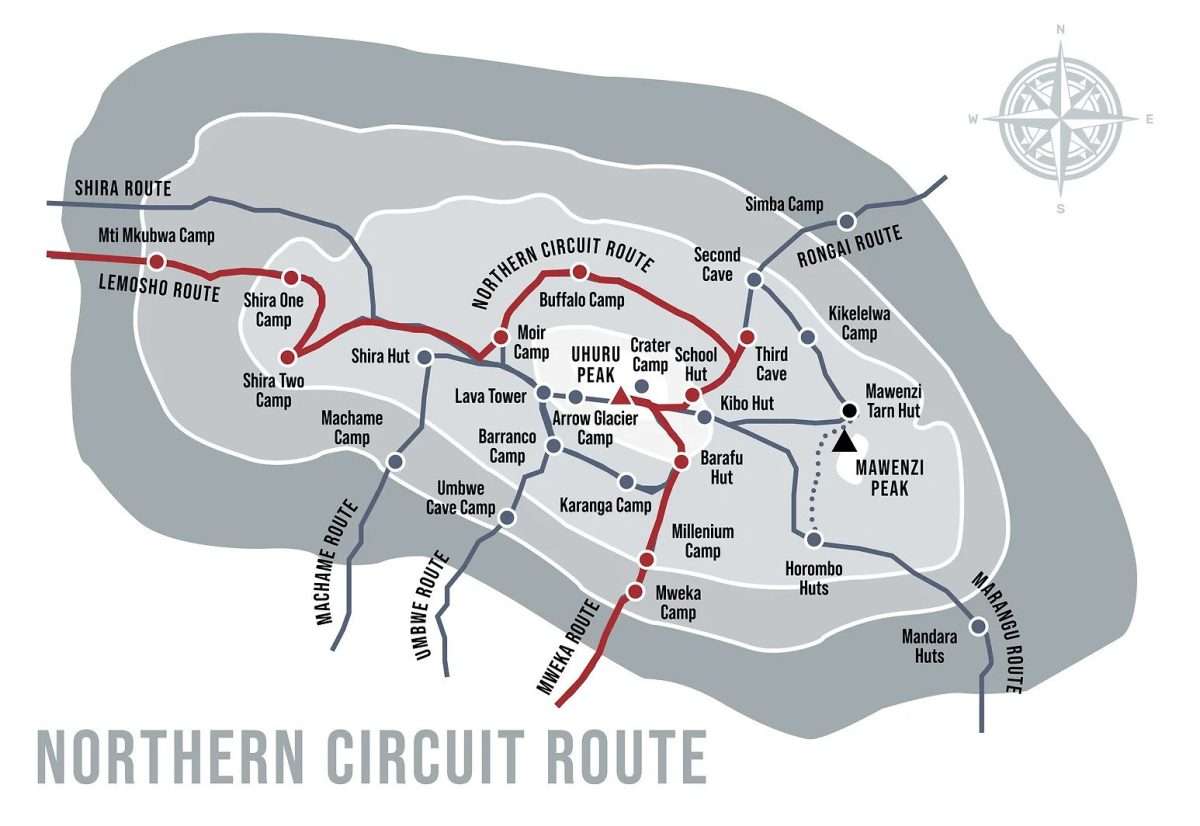
The Northern Circuit is the longest and most successful route on Kilimanjaro, requiring a minimum of 9 days to complete its full 82-kilometer (50-mile) journey from start to finish. This extended timeline is its greatest strength.
Here’s how it works: the ascent to Uhuru Peak takes 8 full days, followed by a 2-day descent down the Mweka trail. The route begins on the same path as the Lemosho Route but then makes a strategic and scenic detour. Instead of heading straight for the summit, it loops around the remote northern slopes of Kibo Peak. This “northern circuit” adds crucial acclimatization days at a high elevation before you finally turn east to make your summit push.
This design is why it performs so well. The trail consists of short daily hiking intervals on gradual slopes, which places the least physical strain on your body while maximizing your acclimatization time. The combination of extra days, a smart “climb high, sleep low” profile, and incredible solitude makes the Northern Circuit the undisputed best choice for summit success.
2. Lemosho Route: The 8-Day, 71 km Best All-Around Choice
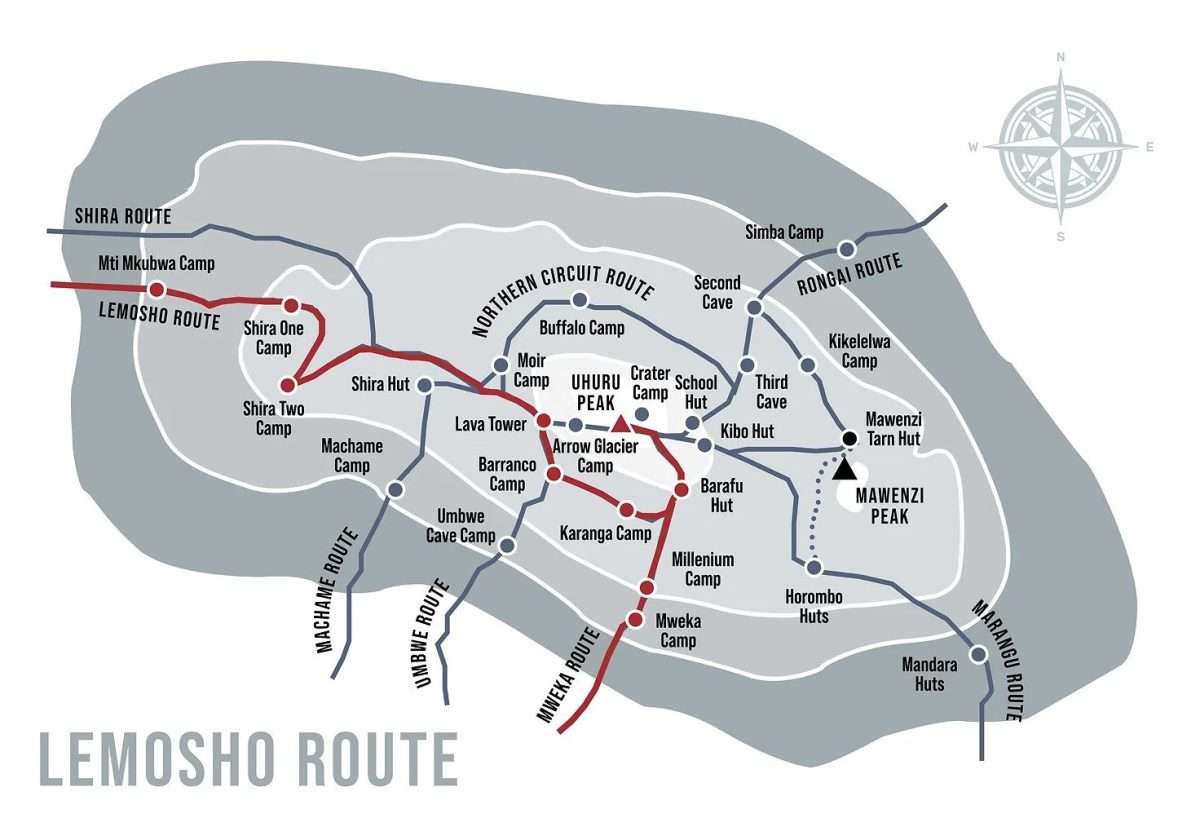
The Lemosho Route is our top-recommended path for most climbers, spanning 71 kilometers (43 miles) over a superior 7 or 8-day itinerary. We strongly advise choosing the 8-day option for the best experience.
Starting at the Londorossi Gate, Lemosho is renowned for its stunning beauty and gradual ascent. Its slopes are gentle underfoot, and the daily distances are well-paced, making it easier for your body to adjust to the altitude. The route crosses the expansive Shira Plateau, offering breathtaking views and excellent walking terrain that is perfect for group hiking.
Like the Northern Circuit, the Lemosho Route’s success lies in its smart pacing and built-in recovery time. The itinerary provides numerous opportunities to rest and acclimatize, which drastically reduces the risk of fatigue and related injuries. This careful balance of challenge and recovery, combined with lower traffic than the Machame route, makes the 8-day Lemosho a close second to the Northern Circuit in overall performance and a premier choice for an unforgettable climb. Check Dates.
3. Rongai Route: 81 Kilometers (50 Miles)
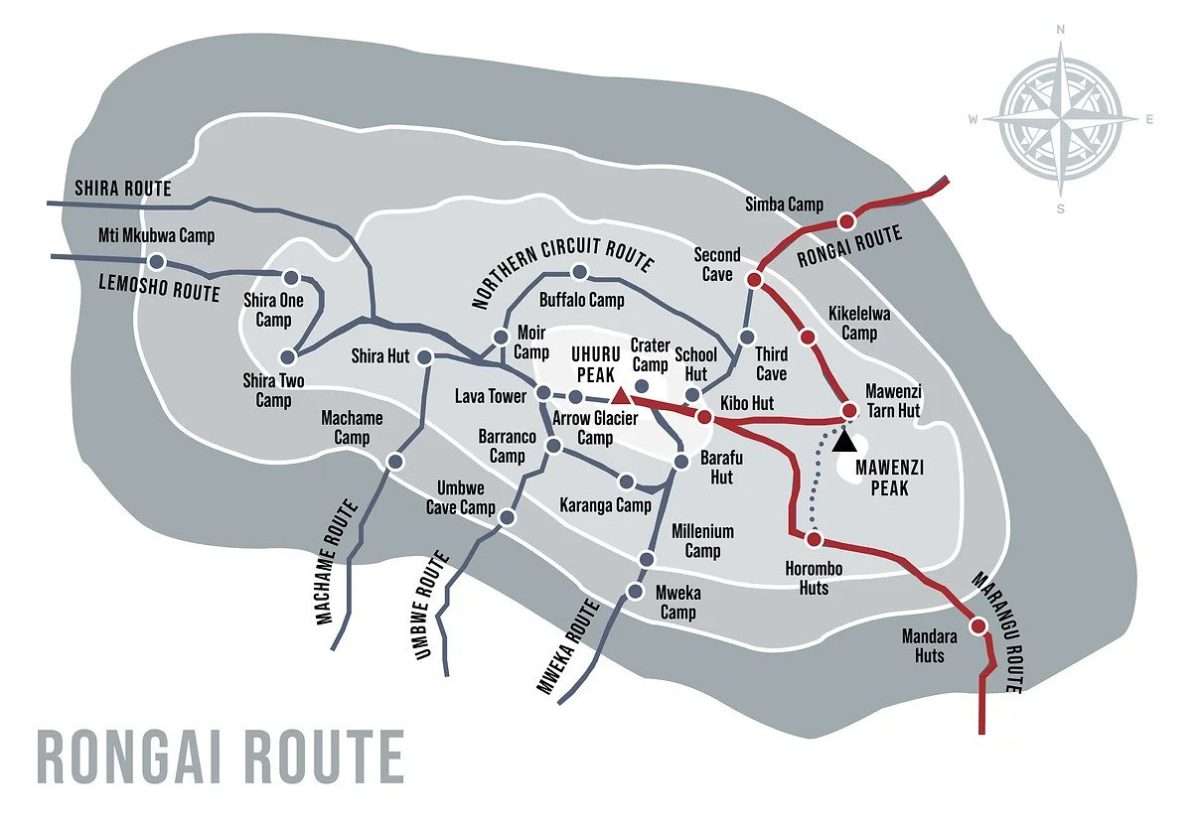
The Rongai Route covers approximately 81 kilometers (50 miles) and is designed as a 6 or 7-day trek, with the 7-day option providing a much better acclimatization profile. This route holds a unique position as the only main ascent path approaching Kilimanjaro from the north, near the Kenyan border.
This northern approach gives Rongai a distinct advantage during the rainy seasons (April-May and November), as it lies in a rain shadow and receives significantly less precipitation than the southern routes. The trail offers a sense of true wilderness with remote, unkempt paths and more gradual initial ascents. Climbers also have an above-average chance of spotting larger wildlife, such as antelope or monkeys, in the lower sections.
While scenic and less crowded, the Rongai Route’s acclimatization profile is generally considered less ideal than the Lemosho or Northern Circuit. Its ascent is more direct, offering fewer natural “climb high, sleep low” opportunities. Therefore, for beginners or those prioritizing summit success, the 7-day itinerary is the minimum recommended choice on this path.
4. Machame Route: 62 Kilometers (37 Miles)
The Machame Route, often called the “Whiskey Route,” spans about 62 kilometers (37 miles). It is typically completed in 6 or 7 days, with the 7-day program being the strong recommendation for proper acclimatization.
This is the most popular route on Kilimanjaro. Despite not having hut accommodations (it’s a camping-only route), its popularity stems from its beautiful, varied scenery and a solid ascent profile on the 7-day schedule. The route includes some challenging sections, like the Barranco Wall, but overall provides a scenic and manageable climb.
The 7-day Machame itinerary allows good acclimatization opportunities with well-placed recovery time. However, when comparing Lemosho vs. Machame, the 8-day Lemosho program is superior for acclimatization due to its extra day and more gradual pacing. While Machame is more straightforward and often slightly less expensive, its trails can be busier. For climbers with limited time who are in good shape, the 7-day Machame is a solid and proven choice. For those seeking the highest chance of success with lower crowds, the 8-day Lemosho remains the premier option. Check dates.
5. Marangu Route: 72 Kilometers (45 Miles)
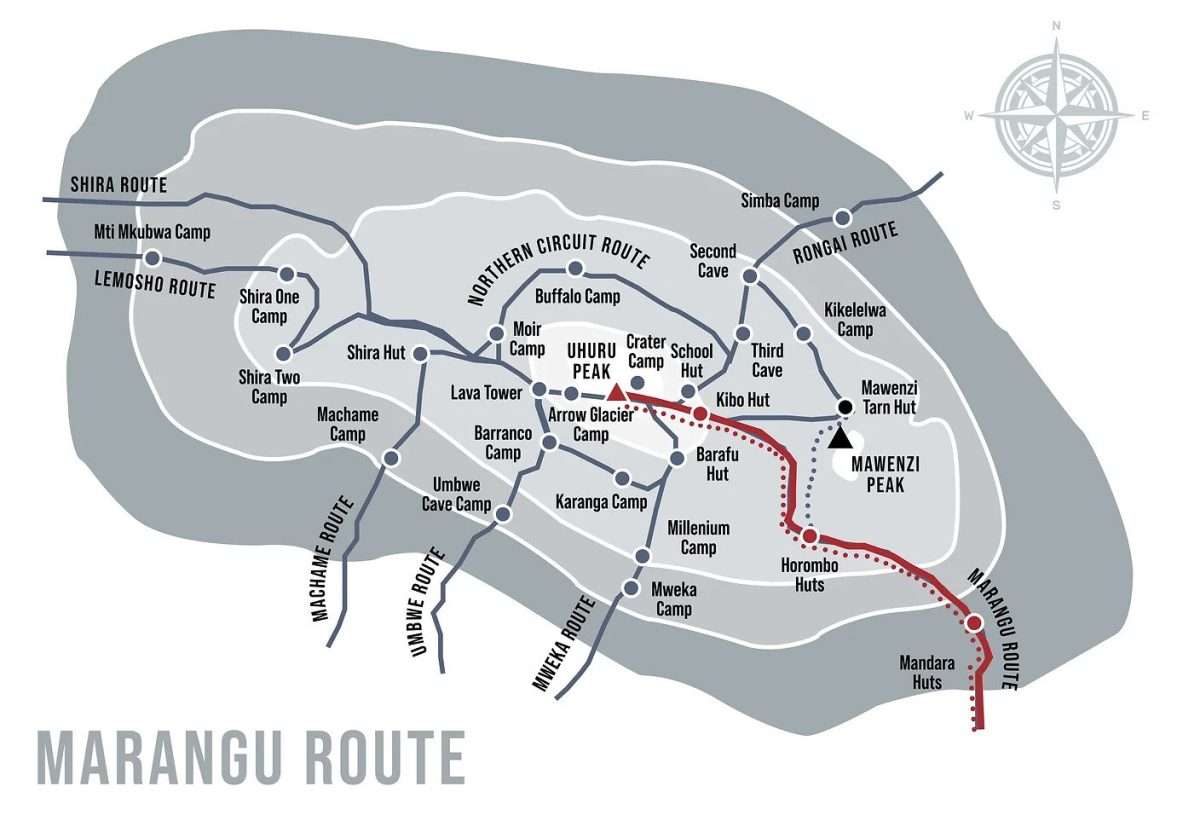
The Marangu Route, often called the “Coca-Cola” route, covers 72 kilometers (45 miles) and offers 5-day and 6-day itineraries. It is the shortest and only route on Kilimanjaro that uses mountain huts instead of tents for accommodation.
However, this shorter duration is its critical flaw. The Marangu Route has the lowest success rate on the mountain, typically between 40-60%. This is due to a very poor acclimatization profile. The rapid ascent leaves your body insufficient time to adapt, leading to a high incidence of altitude sickness and severe fatigue near the summit.
While the hut system and lower cost can be attractive, especially for those on a tight budget, the dramatically reduced chance of success makes it a risky choice. We do not recommend the Marangu Route for beginners or for any climber whose primary goal is to reach the summit safely. Check dates.
6. Umbwe Route: 53 Kilometers (32 Miles)
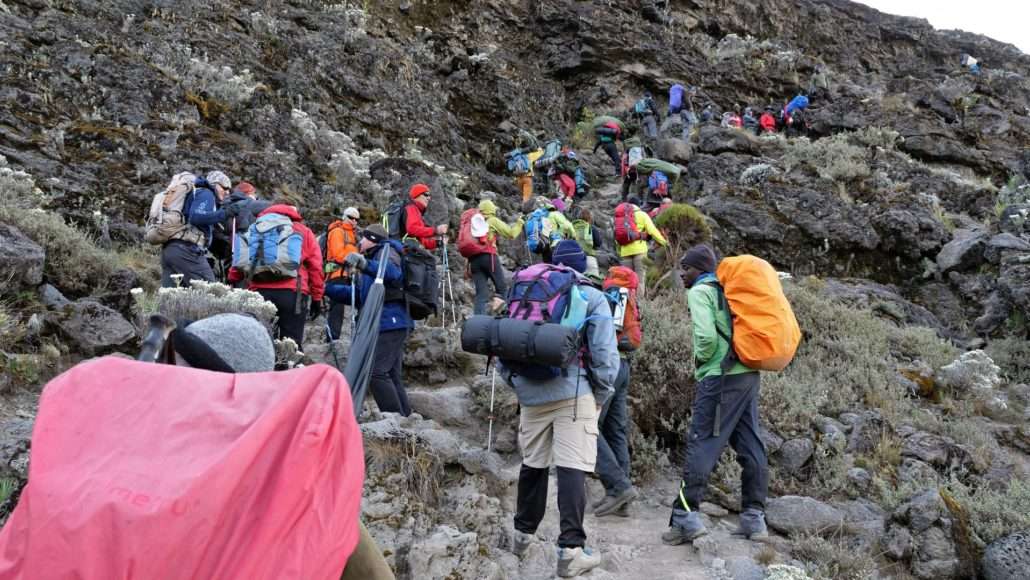
The Umbwe Route is the shortest and most direct path, covering just 53 kilometers (32 miles) and typically completed in 6 days. It is widely considered the most difficult route on Kilimanjaro.
This route offers complete solitude and a challenging adventure for expert trekkers. However, it features a very steep, relentless ascent with rough, unkempt trails. This “fast and hard” approach provides almost no opportunity for proper acclimatization, making the risk of altitude sickness extremely high.
The Umbwe Route should only be attempted by experienced, well-acclimatized mountaineers comfortable with rapid elevation gain. It is not suitable for beginners or even intermediate hikers. For context, the recorded fastest ascent time on this route is under 6 hours, which highlights its intense, uncompromising nature. For over 99% of climbers, a longer, more gradual route is the only safe and sensible choice.
How Many Miles Do You Hike per Day on Mount Kilimanjaro?
You hike 3 to 7 miles (5 to 12 km) per day on Kilimanjaro. The distance is less important than the elevation gain and altitude. Every route follows a slow “pole pole” pace for safe acclimatization.
Northern Circuit (9-Day)
Daily Distance: 5-7 miles (8-11 km)
Pace & Terrain: Very steady, gradual slopes. Long, scenic “acclimatization hike” days across the northern saddle.
Best For: Maximum acclimatization, solitude, and the highest success rate.
Lemosho Route (8-Day)
Daily Distance: 4-7 miles (6-11 km)
Pace & Terrain: Balanced, manageable days. Includes a key “climb high, sleep low” day to Lava Tower.
Best For: Excellent acclimatization, beautiful scenery, and high success for beginners.
Machame Route (7-Day)
Daily Distance: 4-6 miles (6-10 km)
Pace & Terrain: More strenuous pace due to shorter itinerary. Includes steep sections like the Barranco Wall.
Best For: Fit climbers wanting a classic, challenging route in 7 days.
Marangu Route (5-Day – Not Recommended)
Daily Distance: 5-7 miles (8-12 km)
Pace & Terrain: Deceptively long days with rapid elevation gain. Very poor acclimatization profile.
Best For: Those on a tight budget who accept a much lower summit success rate.
Rongai Route (6-7 Days)
Daily Distance: 4-8 miles (6-13 km)
Pace & Terrain: Gentle, steady ascent from the north. Less natural “climb high, sleep low” opportunity than western routes.
Best For: Trekkers seeking a remote, wilderness feel and a drier trail during rainy seasons.
Umbwe Route (5-6 Days)
Daily Distance: 3-6 miles (5-10 km)
Pace & Terrain: Short, very steep, and direct. A fast, challenging ascent with minimal acclimatization.
Best For: Experienced mountaineers only, seeking the most difficult and direct challenge.
FAQs for Your Kilimanjaro Climb with TourwithPipi
1. Why is the Western Breach a shorter approach to the summit?
The Western Breach is a steeper, more direct climbing route that requires basic technical skills and specific gear, such as a helmet. This allows for a faster ascent compared to the longer, winding hiking trails like the Barafu or Kibo Hut paths to Stella Point. Due to its exposed nature and objective hazards like rockfall, we only consider this route in stable, dry conditions, typically from June to October or December to March, and with experienced climbers.
2. How far in advance should I start training for Kilimanjaro?
We recommend a minimum of 3 months of dedicated physical training before your climb. This allows enough time to safely build the specific endurance and leg strength needed without risk of injury. If you already maintain a very active lifestyle, a focused 6 to 8-week training plan may be sufficient. The key is consistency in cardio, strength workouts, and, most importantly, practice hikes with a loaded daypack.
3. How far is Kilimanjaro from the major airports?
Kilimanjaro is very accessible. Kilimanjaro International Airport (JRO) is the closest, only about 50 kilometers (a 1-hour drive) from the mountain’s base town of Moshi. Julius Nyerere International Airport (DAR) in Dar es Salaam is much farther, about 460 kilometers (a 7-8 hour drive or a short domestic flight). We provide included transfers from JRO for all our climbers.
4. Which routes have the shortest trekking time?
The 5-day Marangu Route has the shortest possible duration. However, we do not recommend it due to its very poor acclimatization profile and low success rate. For a better balance of time and safety, routes with 6 or 7-day variations like Machame and Rongai exist, but they still compromise on optimal acclimatization. For the best chance of success, longer routes are always advised.
5. Which tour program guarantees the highest summit success rate?
Our 8-day Lemosho Route and 7-day Machame Route are scientifically designed for the highest success rates. Their longer duration provides essential acclimatization time through “climb high, sleep low” days, gradual slopes, and manageable daily hiking intervals that allow for physical recovery. This strategic approach is why these itineraries consistently help our climbers reach the summit.
Why Choose TourwithPipi for Your Kilimanjaro Trek?
Choosing the right partner for your Kilimanjaro climb is the most critical decision you’ll make. At TourwithPipi, we are not just a booking agency; we are a team of local Tanzanian experts dedicated to transforming your summit dream into a safe, successful, and unforgettable reality. Here’s what sets us apart and makes us the right choice for your journey.
Unmatched Safety Through Expert Guidance
Your well-being is our absolute priority. Every TourwithPipi lead guide is a certified Wilderness First Responder with advanced training in high-altitude medicine. We maintain one of the best staff-to-climber ratios on the mountain, ensuring you receive constant, personalized attention. Our comprehensive safety system includes daily health monitoring, emergency oxygen on every climb, and pre-arranged evacuation protocols.
Proven Success Through Smart Acclimatization
We believe success is built on time, not just toughness. That’s why we specialize in longer, scenic routes like the 8-day Lemosho and 7-day Machame Route. These itineraries are scientifically designed for optimal acclimatization, following proven “climb high, sleep low” principles. This strategic approach is the reason our climbers consistently achieve outstanding summit success rates.
A Fully Supported, Worry-Free Experience
From the moment you land until you receive your summit certificate, we handle every detail. Your climb includes all park fees, permits, quality hotel stays, and seamless airport transfers. On the mountain, you’ll enjoy nutritious meals, unlimited purified water, high-quality 4-season tents, and private toilet facilities—allowing you to focus entirely on your climb.
Ethical Operations and Local Commitment
We are proud partners of the Kilimanjaro Porters Assistance Project (KPAP), guaranteeing that our entire crew receives fair wages, proper equipment, and dignified treatment. We operate under strict “Leave No Trace” principles, ensuring we protect the majestic environment we are privileged to explore.
Your Journey, Our Shared Goal
Whether you join a group or embark on a private solo adventure, we are committed to your personal achievement. Our team provides the encouragement, expertise, and unwavering support to help you conquer your challenge, creating not just a climb, but a transformative life experience.
Conclusion
Climbing Kilimanjaro is more than a trek; it’s a profound journey of personal perseverance. Success rests on three pillars: your preparation, the route you choose, and the team that guides you.
This guide has shown that with the right plan—prioritizing a longer route for acclimatization, committing to dedicated training, and partnering with a reputable, safety-focused operator—reaching the summit is an achievable and extraordinary feat for beginners and seasoned trekkers alike.
At TourwithPipi, we provide that essential foundation. We combine unwavering safety with proven success, genuine care for our team and environment, and a deep commitment to your personal triumph.
Your summit is within reach.
Let’s turn your ambition into an achievement. Contact TourwithPipi today to start planning your 2026 Kilimanjaro adventure with a team you can trust, every step of the way.


