
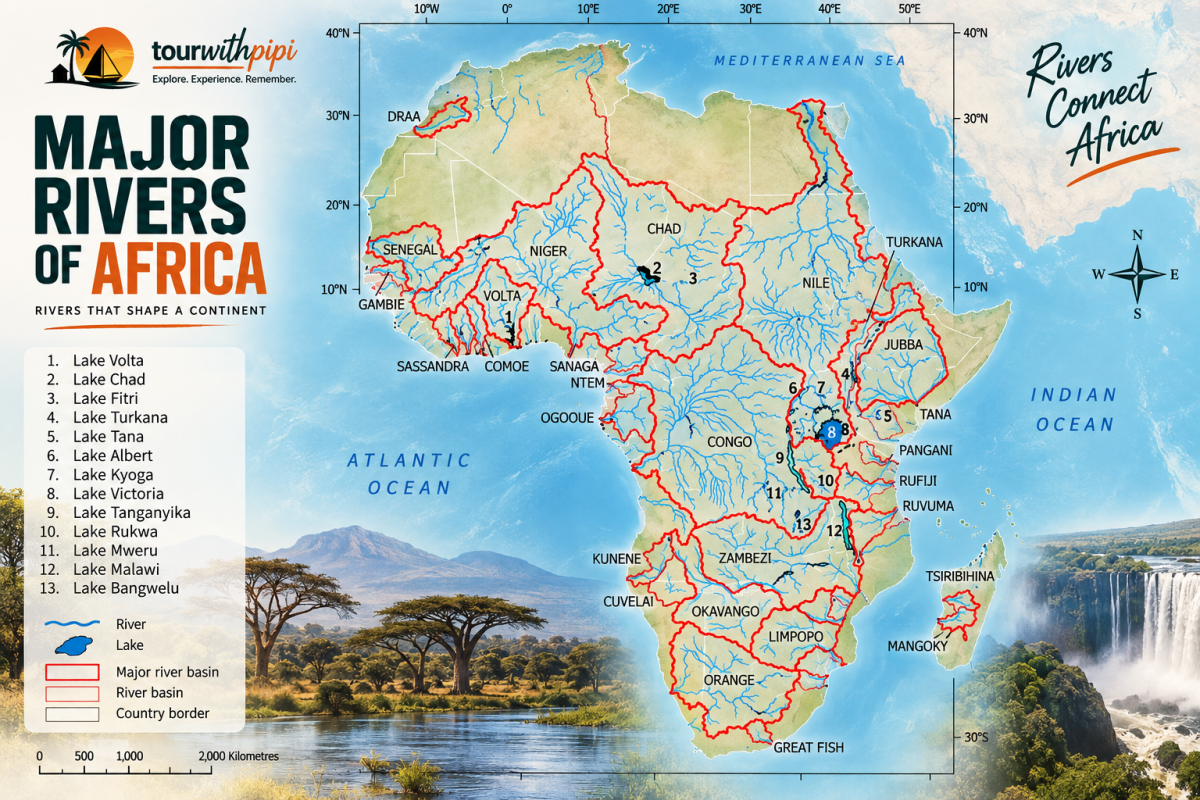
1. The River Nile
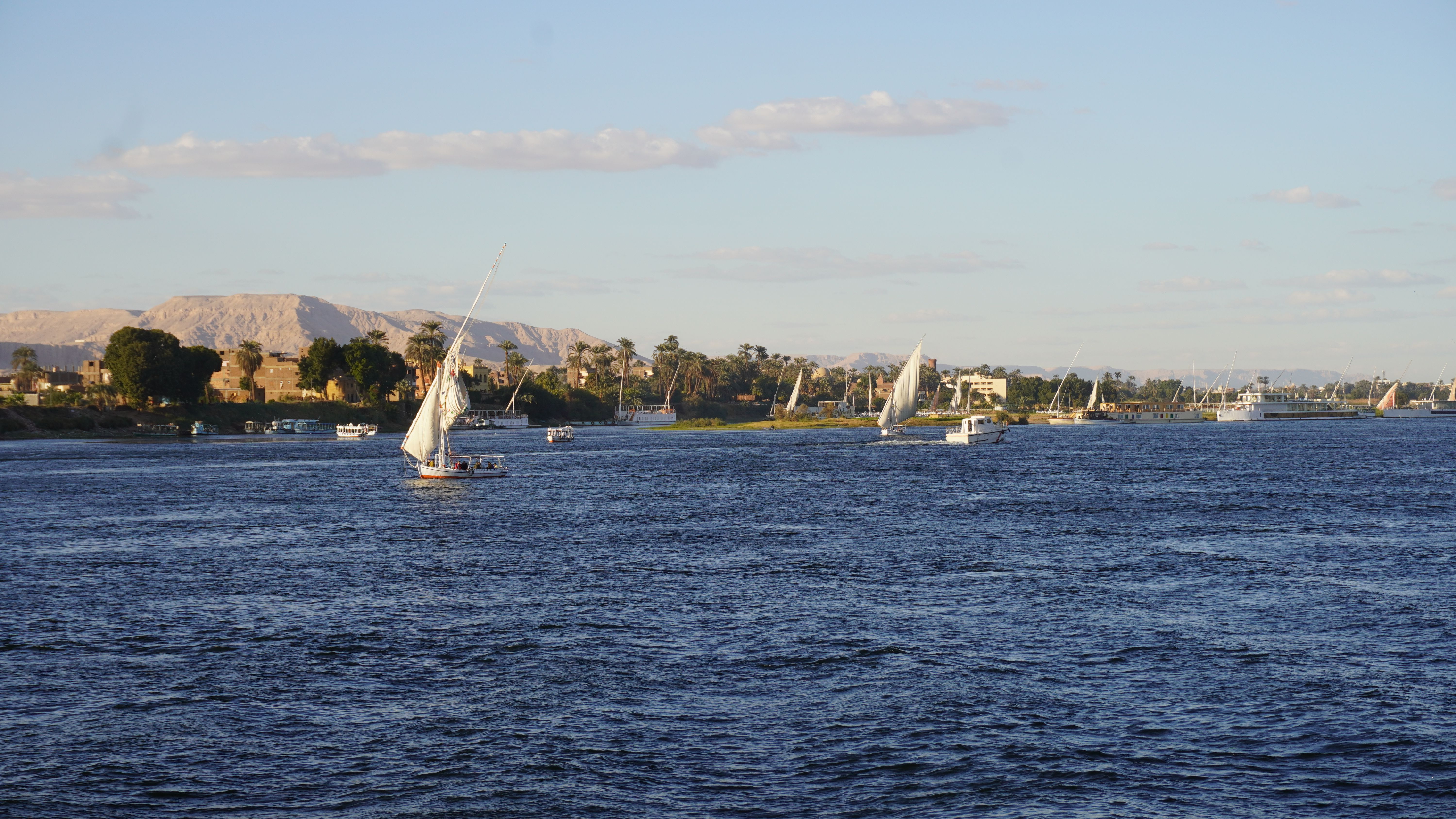
The Nile is the longest river in Africa and has traditionally held the title of the longest river in the world, stretching approximately 6,650 kilometers (4,132 miles) from its furthest headwaters to the Mediterranean Sea. That title isn’t quite settled anymore. New satellite mapping of the Amazon’s source in 2025 put its length at roughly 6,990 kilometers, ahead of the Nile, though Guinness World Records and the Encyclopedia Britannica still credit the Nile as longest pending further verification. A full documentary on the dispute is expected in 2026.
The Nile forms from two main tributaries. The White Nile begins near Lake Victoria, shared by Tanzania, Uganda, and Kenya, while the Blue Nile starts at Ethiopia’s Lake Tana and supplies roughly 80 percent of the Nile’s total water once the two join at Khartoum, Sudan. From there, the river flows north through Sudan and Egypt to its delta on the Mediterranean.
The route in between has more named stretches than most people realize. Leaving Lake Victoria as the Victoria Nile, the river passes through two more equatorial lakes, Kyoga and Albert, picking up runoff from the Rwenzori Mountains and Mount Elgon along the way. It exits Lake Albert as the Albert Nile and continues north to Nimule near the South Sudan border, where it becomes the Bahr el Jebel, meaning “river of the mountains.” From there it crosses the Sudd, one of the world’s largest wetlands, before meeting the Bahr el Ghazal at Lake No and finally the Sobat River, which carries seasonal floodwater down from the Ethiopian Highlands.
- Wildlife and vegetation along the Nile: The river supports Nile perch, which can weigh over 175 pounds, along with tilapia, catfish, and tigerfish. Its banks are lined with papyrus, water lilies, and common reed, and papyrus in particular shaped ancient Egyptian life well beyond food, used historically for paper, sails, cloth, mats, and rope.
- Countries in the Nile basin: Burundi, Rwanda, DR Congo, Tanzania, Kenya, Uganda, South Sudan, Ethiopia, Sudan, and Egypt.
- National parks and highlights: Murchison Falls National Park in Uganda, where the Victoria Nile forces its way through a narrow gorge before opening into a wide river below, and the Blue Nile Falls near Bahir Dar, Ethiopia.
- Activities: Nile river cruises between Luxor and Aswan in Egypt, white water rafting near Jinja, Uganda, at the river’s source, and boat safaris on the Victoria Nile within Murchison Falls National Park.
2. The Congo River
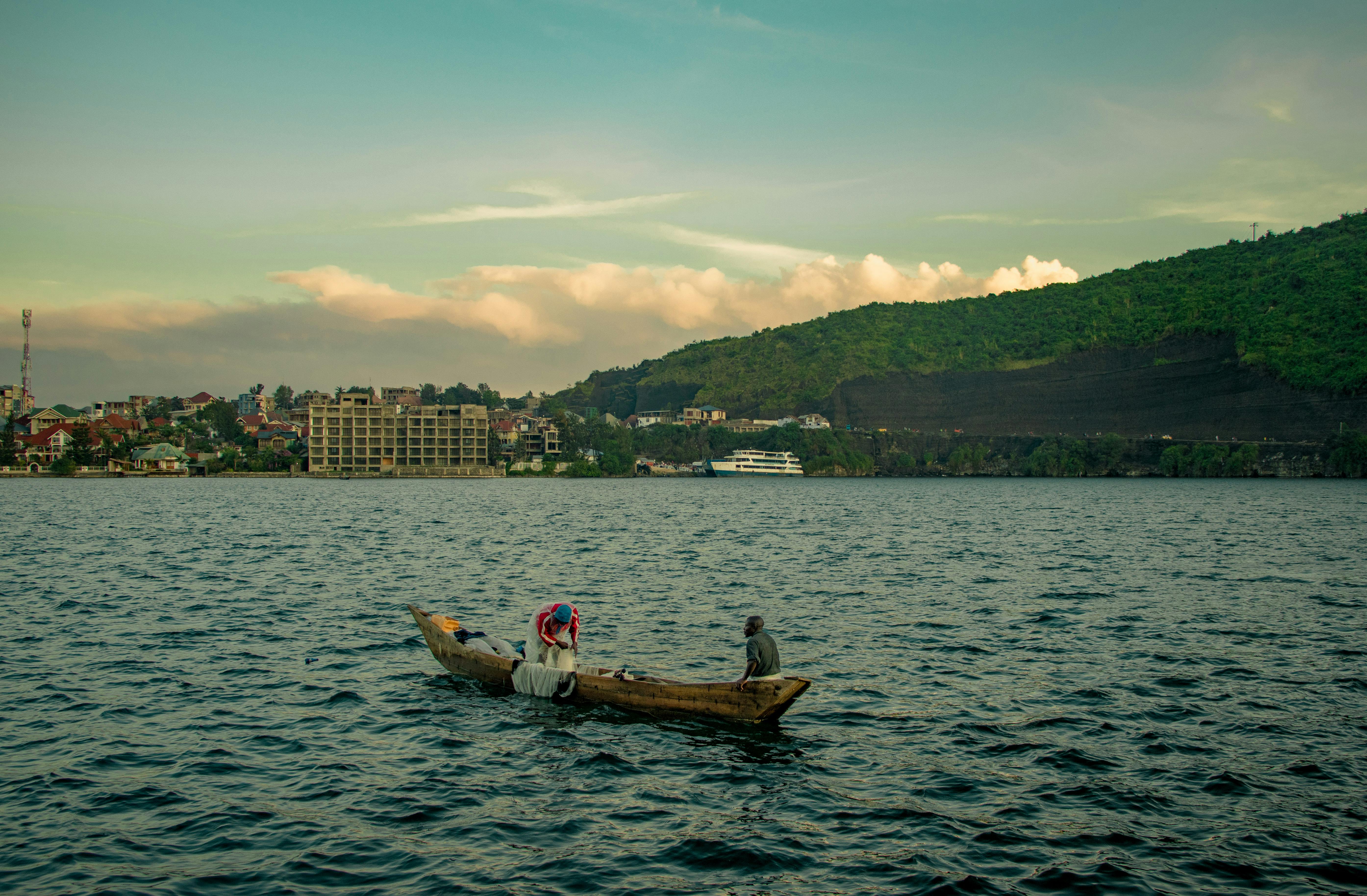
The Congo River runs about 4,700 kilometers (2,920 miles), making it Africa’s second-longest river, but it leads the continent, and much of the world, in other measures. It’s the deepest river on Earth, plunging past 220 meters in places, and it carries more water than any river except the Amazon, averaging roughly 41,000 cubic meters of water per second, and surging past 50,000 cubic meters per second in the rainy season, enough to noticeably freshen the Atlantic Ocean’s surface for miles beyond its mouth.
The Congo is also unusual for crossing the equator twice along its course, which keeps its flow remarkably steady year-round, since one side of its basin is always in a rainy season.
- Countries the Congo flows through: Democratic Republic of Congo, Republic of Congo, Central African Republic, Angola, Zambia, and Cameroon within its wider basin.
- National parks and highlights: Salonga National Park in the DRC, Africa’s largest rainforest reserve, and Odzala-Kokoua National Park in the Republic of Congo, both within the wider Congo Basin rainforest.
- Activities: River travel here is genuinely remote and adventure-oriented rather than a standard tourist activity, typically combined with gorilla or bonobo trekking in the surrounding forest reserves.
3. The Ubangi River
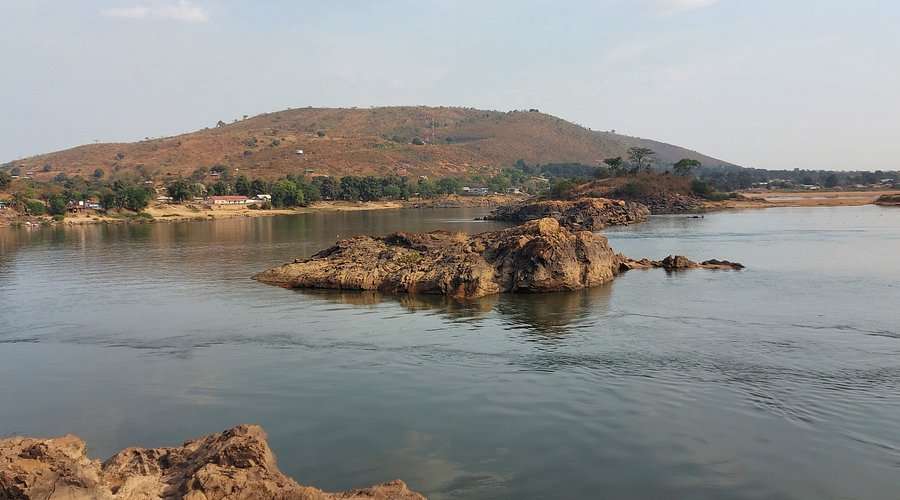
The Ubangi River runs about 1,060 kilometers (660 miles) and is the Congo’s largest right-bank tributary, formed where the Mbomou and Uele Rivers meet. Rather than crossing borders, it defines one, flowing west along the entire boundary between the Central African Republic and the Democratic Republic of the Congo before joining the Congo River itself.
- Countries the Ubangi flows through: Forms the border between the Central African Republic and DR Congo.
- Activities: The river functions primarily as a transport and trade route between the two countries rather than a tourist destination, though it borders some of Central Africa’s most remote forest and savanna landscapes.
4. The Niger River
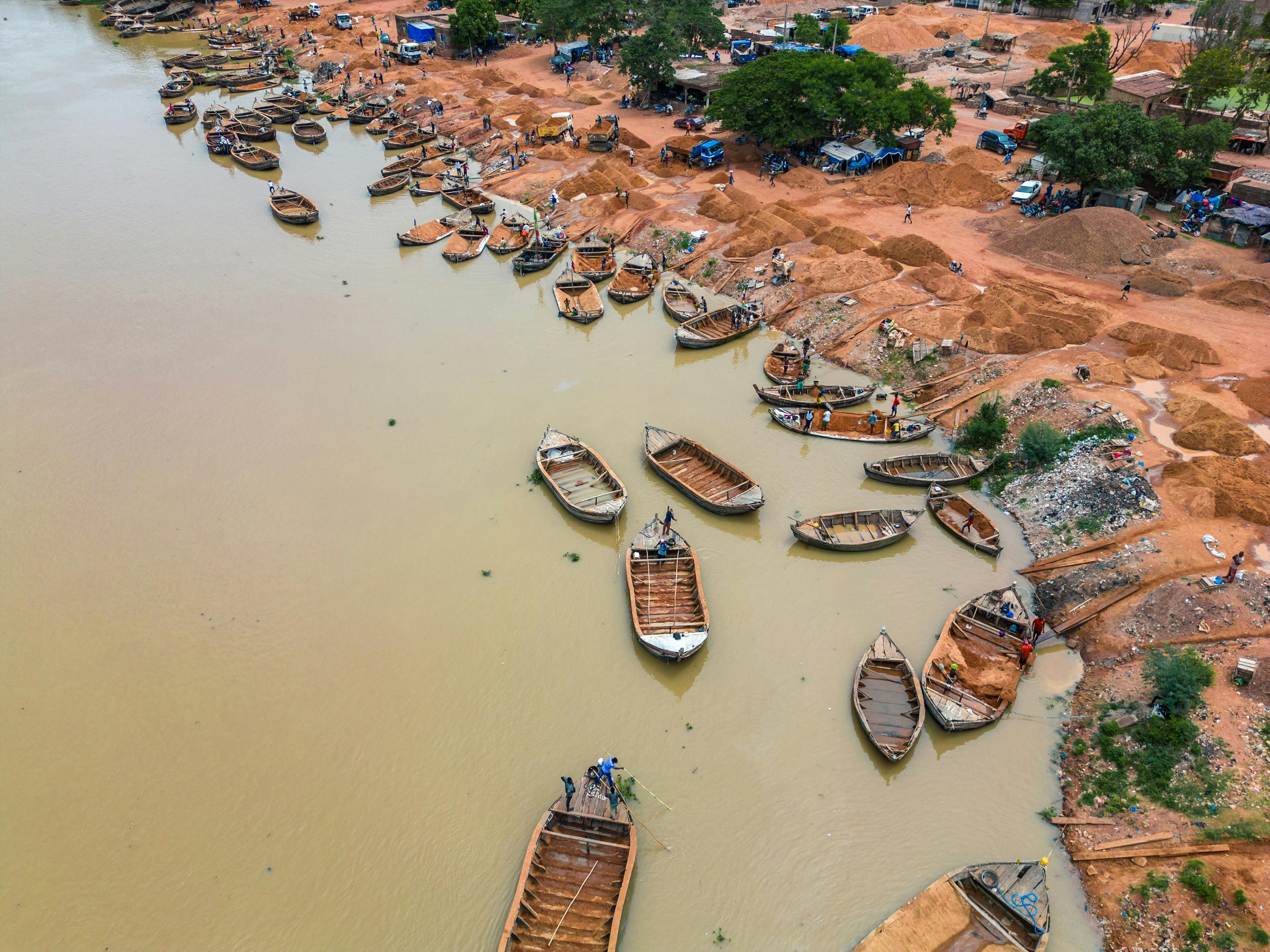
The Niger River runs roughly 4,180 kilometers (2,597 miles) in a distinctive boomerang shape, curving through the Sahara before bending back toward the coast. It’s the principal river of West Africa and the third-longest on the continent.
- Countries the Niger flows through: Guinea, Mali, Niger, Benin, and Nigeria, with a wider basin touching Côte d’Ivoire, Burkina Faso, Cameroon, and Chad.
- National parks and highlights: W National Park, a transboundary UNESCO Biosphere Reserve shared by Niger, Benin, and Burkina Faso, named for the distinctive W-shape the river carves through the park.
- Activities: Boat travel along the river near Mopti and Djenné in Mali, and birdwatching across its extensive inland delta.
5. The Zambezi River
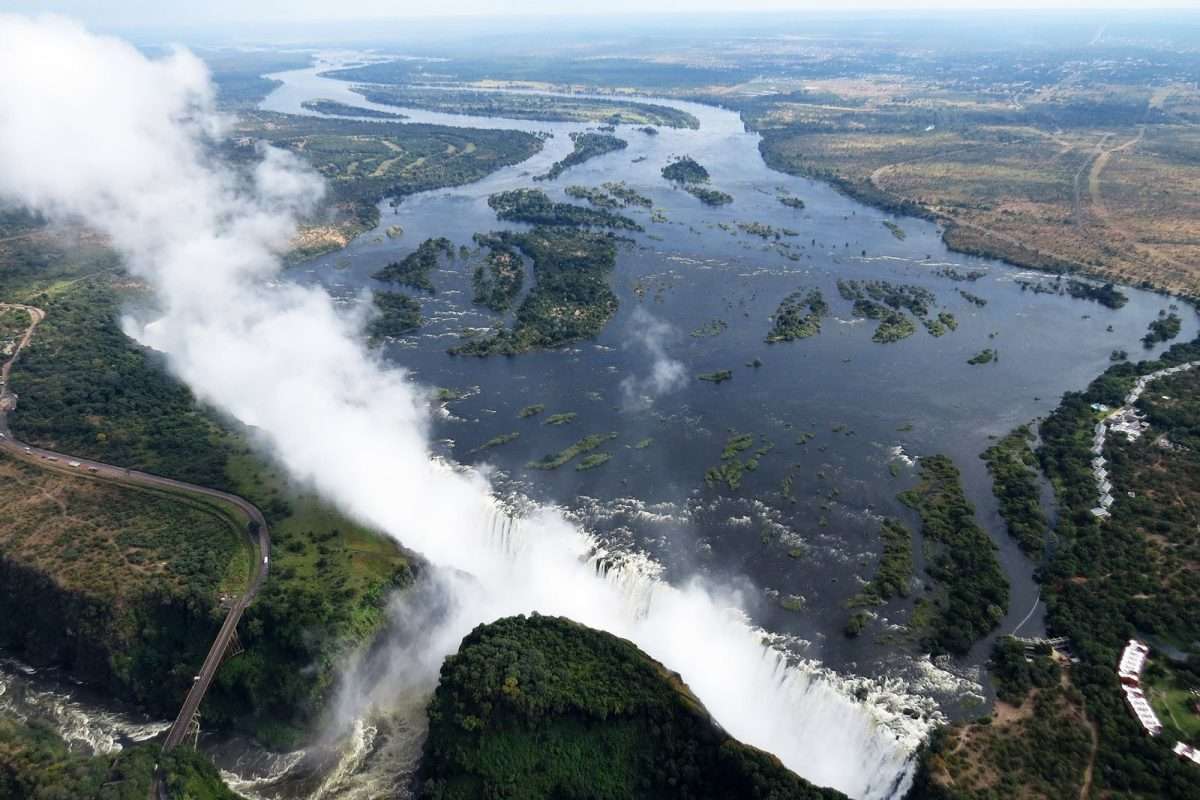
The Zambezi River stretches about 2,700 kilometers (1,678 miles) and is the river most associated with a Southern Africa safari, largely thanks to Victoria Falls, one of the Seven Natural Wonders of the World, where the river drops more than 100 meters into a narrow gorge on the Zambia-Zimbabwe border.
- Countries the Zambezi flows through: Zambia, Angola, Namibia, Botswana, Zimbabwe, and Mozambique, where it empties into the Indian Ocean. Malawi sits within the wider Zambezi basin too, though it connects via the Shire River, a major tributary draining Lake Malawi, rather than the Zambezi’s own mainstem.
- National parks and highlights: Mana Pools National Park in Zimbabwe, a UNESCO World Heritage Site known for walking safaris along the riverbank, and Lower Zambezi National Park in Zambia, directly across the river from Mana Pools.
- Activities: White water rafting and bungee jumping at Victoria Falls, canoe safaris through Mana Pools and Lower Zambezi, sunset river cruises, and tiger fishing.
6. The Orange River
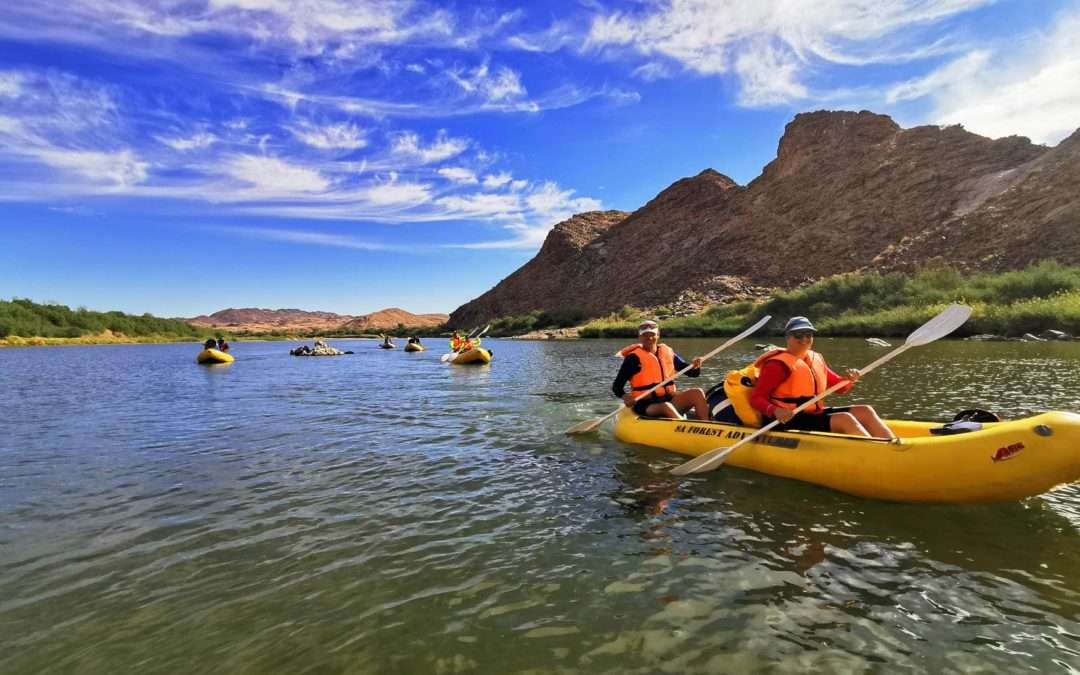
The Orange River runs about 2,200 kilometers (1,367 miles) from its source high in Lesotho’s Drakensberg Mountains to the Atlantic Ocean, and it’s South Africa’s longest river.
- Countries the Orange flows through: Lesotho, South Africa, and along the Namibian border.
- National parks and highlights: Augrabies Falls National Park, where the river plunges through a granite gorge, and the Richtersveld Transfrontier Park near the river’s mouth.
- Activities: Canoeing and multi-day rafting trips, particularly through the Richtersveld’s dramatic desert scenery.
7. The Limpopo River
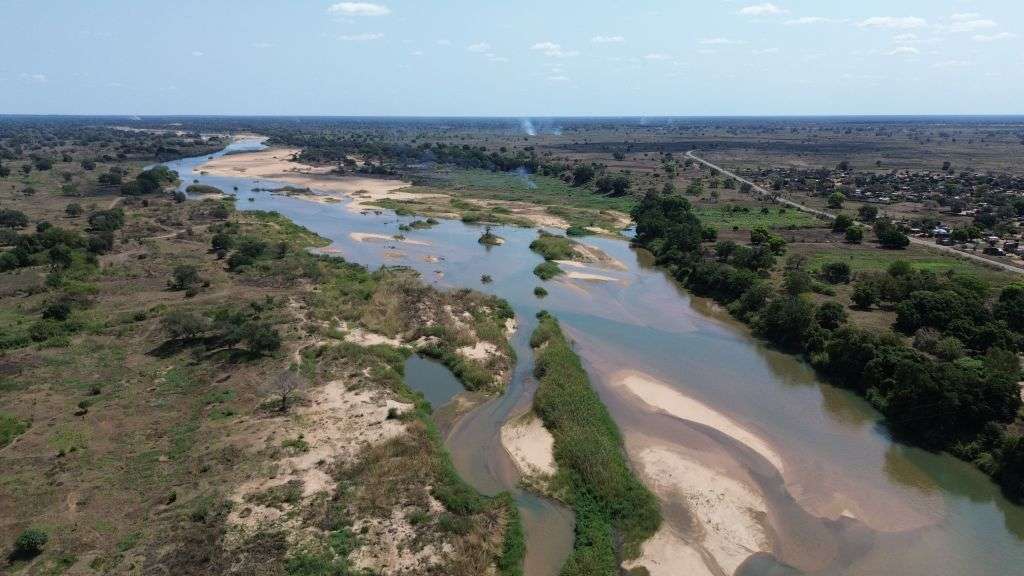
The Limpopo River runs roughly 1,750 kilometers (1,087 miles) and is best known for forming much of the border between South Africa and its neighbors.
- Countries the Limpopo flows through: South Africa, Botswana, Zimbabwe, and Mozambique, where it reaches the Indian Ocean.
- National parks and highlights: The Limpopo forms Kruger National Park’s northern boundary, and Mapungubwe National Park sits where the Limpopo meets the Shashe River, at the tripoint of South Africa, Botswana, and Zimbabwe. Together with Zimbabwe’s Gonarezhou and Mozambique’s Limpopo National Park, it forms the Great Limpopo Transfrontier Park.
- Activities: Game drives through Kruger and Mapungubwe, plus birding along the riverine forest.
8. The Okavango River
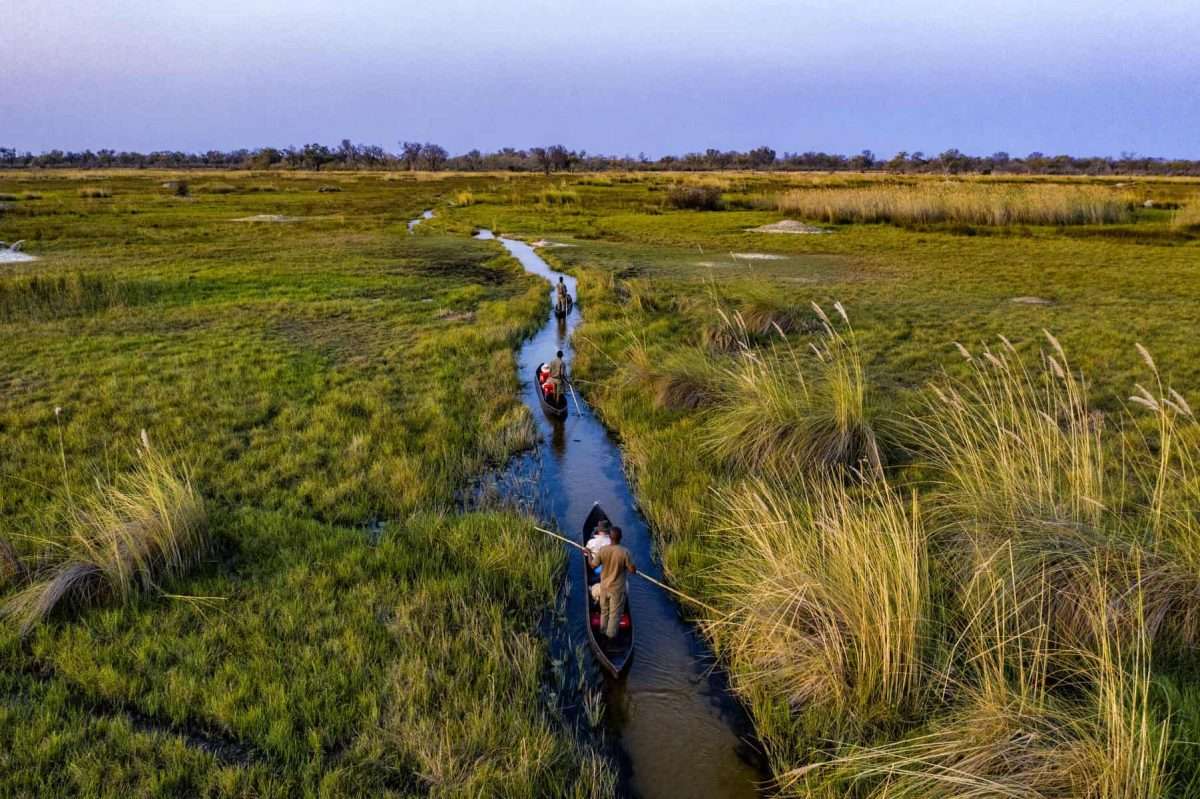
The Okavango is unusual among major African rivers: it never reaches the ocean at all. Running about 1,600 kilometers (994 miles) from its source in Angola’s highlands, it flows into Botswana’s Kalahari Desert and fans out into the Okavango Delta, a vast inland wetland that simply evaporates and soaks into the sand rather than draining to the sea.
- Countries the Okavango flows through: Angola, Namibia, and Botswana.
- National parks and highlights: Moremi Game Reserve, inside the Okavango Delta itself, a UNESCO World Heritage Site since 2014.
- Activities: Mokoro canoe safaris through the delta’s channels, walking safaris on its islands, and boat-based game viewing, all distinct from a typical vehicle-based safari elsewhere in Africa.
Other Major Rivers in Africa
A handful of other rivers don’t quite make a “longest” list but are still significant enough to know about, several with direct safari relevance.
- Senegal River (about 1,790 km): Forms much of the border between Senegal and Mauritania before reaching the Atlantic, and is one of the rivers named in the well-known “seven rivers” rhyme.
- Kagera River (about 690 km): Flows along the Rwanda-Tanzania and Uganda-Tanzania borders into Lake Victoria, and is considered by some geographers to be the Nile’s true ultimate source, further upstream than Lake Victoria itself.
- Rufiji River (about 600 km): East Africa’s largest river by water volume, running entirely through Tanzania and forming the lifeline of the Nyerere National Park and Selous ecosystem, where boat safaris along the river are a signature activity.
- Ruvuma River (about 800 km): Forms the border between Tanzania and Mozambique, reaching the Indian Ocean near the Quirimbas Archipelago.
- Chari River (about 1,400 km): Flows through Central African Republic and Chad into Lake Chad, supplying the majority of that lake’s water.
- Benue River (about 1,400 km): The Niger’s main tributary, flowing through Cameroon and Nigeria before joining the Niger at Lokoja.
- Kasai River (about 2,150 km): The Congo’s largest left-bank tributary, flowing through Angola and the DRC.
- Awash River (about 1,200 km): Ethiopia’s own version of the Okavango. Like the Okavango, it never reaches the ocean, instead disappearing into a chain of salt lakes near the Djibouti border.
Does Africa Only Have 7 Rivers?
No, and this is a genuinely common misconception. Many people grew up with a rhyme or song naming seven rivers, usually the Nile, Niger, Congo, Senegal, Orange, Limpopo, and Zambezi, and the number stuck as if it were a complete list rather than a memory aid.
The real number is far higher. According to UNEP, Africa has 63 transboundary river basins alone, covering 64 percent of the continent’s land area, and that figure doesn’t even count the smaller rivers that stay within a single country’s borders. Nigeria alone is home to over 200 rivers. The “seven rivers” song names some of the continent’s longest and most famous rivers, but it was never meant as an actual count.
The Rivers That Matter Most on Safari

Length isn’t what makes a river matter on safari. A few shorter rivers do more heavy lifting for wildlife viewing than any of the giants above.
- The Mara River, at only around 395 kilometers, is the single most famous river on any African safari. It rises in Kenya’s Mau Escarpment, flows south into Tanzania’s Serengeti, then loops back north through Kenya’s Masai Mara before draining into Lake Victoria. Its crossings, when wildebeest and zebra herds plunge through crocodile-filled water during the Great Migration, are one of the most dramatic wildlife spectacles on Earth, typically from July through October.
- The Chobe River, a tributary that joins the Zambezi near Kazungula, borders Chobe National Park in Botswana and is known for exceptional elephant concentrations along its banks, especially during the dry season when the river becomes one of the only reliable water sources for miles.
- The Grumeti River, in the Serengeti’s western corridor, hosts a smaller, earlier migration crossing than the Mara, typically in May and June, with fewer crowds watching.
- South Africa’s Kruger National Park is built around six rivers of its own, the Sabie, Olifants, Letaba, Luvuvhu, Crocodile, and Shingwedzi, each shaping a different part of the park. The Sabie is known for leopard sightings and flowing year-round, the Crocodile marks Kruger’s southern boundary, and the Luvuvhu supports some of the park’s richest birdlife in the far north.
Plan a Safari Along Africa’s Rivers

The Mara River crossings and the wildlife they draw are one of the best reasons to build a Kenya or Tanzania safari around river country rather than away from it. Explore our Kenya safaris or Tanzania safaris, both built around strong Mara River crossing viewing during the Great Migration. We also arrange Botswana itineraries on request for travelers who want to add the Okavango Delta or Chobe River to their trip.
Frequently Asked Questions
What is the longest river in Africa?
The Nile, at approximately 6,650 kilometers (4,132 miles), running through 11 countries before reaching the Mediterranean Sea in Egypt. Some 2025 satellite measurements suggest the Amazon may now be slightly longer, though Guinness World Records still credits the Nile.
Is it true that Africa only has 7 rivers?
No. That idea comes from a well-known children’s rhyme naming seven famous rivers, the Nile, Niger, Congo, Senegal, Orange, Limpopo, and Zambezi, which was never meant as a full count. According to UNEP, Africa has 63 transboundary river basins alone, and Nigeria by itself is home to over 200 rivers.
What are the most important rivers in Africa?
The Nile, Congo, Niger, and Zambezi are generally considered Africa’s most important rivers, based on length, water volume, and the number of countries and people that depend on them. For safari travel specifically, the Mara, Chobe, and Okavango matter more than their length suggests.
What is the deepest river in Africa?
The Congo River, which plunges past 220 meters deep in places, making it the deepest river anywhere in the world, not just in Africa.
Which African river doesn’t reach the ocean?
The Okavango River. Instead of draining to the sea, it flows into Botswana’s Kalahari Desert and fans out into the Okavango Delta, where the water evaporates and soaks into the sand.
Which rivers are best to see on an African safari?
The Mara River, for the Great Migration’s dramatic crossings in Kenya and Tanzania, and the Chobe River, for consistently large elephant herds in Botswana, are the two most rewarding rivers to build a safari itinerary around.
How many major rivers does Africa have?
Africa has dozens of significant rivers, but the ones most commonly listed as major are the Nile, Congo, Niger, Zambezi, Orange, Volta, Limpopo, Okavango, and Chari, each shaping the geography, economy, or wildlife of the countries it passes through.
Blog Summary
- The Nile is Africa’s longest river at about 6,650 km, though 2025 satellite mapping has reopened the debate over whether the Amazon is now longer.
- The Congo is Africa’s deepest river, plunging past 220 meters, and carries more water than any river on the continent.
- The Niger, Zambezi, Orange, Volta, and Limpopo round out Africa’s other major rivers, each shaping a different region’s geography and wildlife.
- The Okavango is unique among major African rivers for never reaching the ocean, fanning out into the Okavango Delta instead.
- For safari travelers, the Mara River’s Great Migration crossings and the Chobe River’s elephant herds matter more than any river’s total length.
Contact the team on WhatsApp to plan a Kenya or Tanzania safari timed around the Mara River crossings, or a Botswana extension along the Okavango and Chobe.

