
The moment you say “Habari” to your guide and they break into a wide smile, you understand exactly why learning a few Swahili words before your safari matters. Swahili is not just the official language of Kenya and Tanzania — it is the heartbeat of daily life across East Africa. A handful of well-placed words will open doors, earn genuine warmth from locals, and make your time in the bush feel like something more than a tour.
The good news is that Swahili is one of the easiest African languages for English speakers to pick up. Words are pronounced exactly as they are written. Every letter makes the same sound every time. There are no irregular verbs and no gendered nouns to memorize. You can be functional with a few dozen words and phrases, and even one or two will get you further than you expect.
This guide covers the most useful Swahili words and phrases for safari travelers heading to Kenya or Tanzania in 2026, organized by situation so you can find what you need fast.
Written by Khadija Tayabali, Kenya-born physician, Virtuoso-certified safari advisor, and founder of TourwithPipi.
Quick Swahili Facts
- Swahili is the official language of Kenya, Tanzania, Uganda, and the Democratic Republic of Congo
- Over 200 million people speak Swahili across East and Central Africa — it is the most widely spoken language in sub-Saharan Africa
- The word “Swahili” itself comes from Arabic meaning “coastal people”
- In Swahili, the language is called Kiswahili and its speakers call themselves Waswahili
- The word safari is Swahili — it simply means “journey”
- Swahili was born in Zanzibar, developed along the East African coast through centuries of Arab, Portuguese, and Indian Ocean trade, and spread inland from there
- Pronunciation rule: stress falls on the second-to-last syllable in almost every Swahili word
How to Pronounce Swahili Words
Before the word lists, here is the one thing to know about Swahili pronunciation: it is phonetic. What you see is what you say.
Vowels are always the same:
- A = “ah” (like father)
- E = “eh” (like bed)
- I = “ee” (like feet)
- O = “oh” (like go)
- U = “oo” (like food)
The J sounds like the English “J” in joy. The R has a gentle roll — not the hard American R. The G is always hard, like in go, never soft like in gym.
Every syllable in a Swahili word is spoken clearly. There are no silent letters and no letters that swallow each other. If you follow these rules and slow down, you will be understood. Locals are patient, friendly, and genuinely delighted when visitors attempt even a word or two.
Swahili Greetings: Where to Start
In East African culture, the greeting is not optional. It is the foundation of every interaction. Jumping straight into a question or request without first greeting someone properly comes across as rude, no matter how politely it is intended. Your guide, your lodge staff, your driver, the market vendor — everyone expects a greeting first.
The good news is that Swahili greetings are warm, layered, and genuinely enjoyable to use. Locals appreciate any attempt, even a clumsy one.
| Swahili | Pronunciation | English |
|---|---|---|
| Jambo | JAM-boh | Hello (casual, widely used with tourists) |
| Hujambo | hoo-JAM-boh | Hello (more formal) |
| Habari | hah-BAH-ree | Hello / How are you? / What’s the news? |
| Habari gani? | hah-BAH-ree GAH-nee | How are you? / What’s new? |
| Nzuri | n-ZOO-ree | Good / Fine (the standard reply to Habari) |
| Nzuri sana | n-ZOO-ree SAH-nah | Very good / Very fine |
| Sijambo | see-JAM-boh | I’m fine (reply to Hujambo) |
| Karibu | kah-REE-boo | Welcome / Come in |
| Karibuni | kah-ree-BOO-nee | Welcome (to a group) |
| Shikamoo | shee-kah-MOH | Respectful greeting for elders |
| Marahaba | mah-rah-HAH-bah | Reply to Shikamoo |
| Habari za asubuhi | hah-BAH-ree zah ah-soo-BOO-hee | Good morning |
| Habari za mchana | hah-BAH-ree zah m-CHAH-nah | Good afternoon |
| Habari za jioni | hah-BAH-ree zah jee-OH-nee | Good evening |
| Lala salama | LAH-lah sah-LAH-mah | Good night / Sleep well |
| Kwa heri | kwah HEH-ree | Goodbye (to one person) |
| Kwa herini | kwah heh-REE-nee | Goodbye (to a group) |
| Tutaonana | too-tah-oh-NAH-nah | See you later |
| Safari njema | sah-FAH-ree n-JEH-mah | Safe journey / Have a good trip |
TIP: Shikamoo is the respectful greeting for any elder, elder community member, or elder Maasai warrior. If you are visiting a cultural community or meeting older local residents, open with Shikamoo. The reply, Marahaba, means roughly “I am honored.” Using it will earn you enormous respect immediately.
The most important rule of Swahili greetings: Always greet before asking anything. Say Habari before asking for directions. Say Jambo before ordering food. Even just a smile and a Habari before your question changes the entire tone of the interaction.
Essential Swahili Phrases for Daily Situations
These are the words you will reach for most often during your safari. Keep these on your phone or write them on a card in your daypack.
| Swahili | English |
|---|---|
| Asante | Thank you |
| Asante sana | Thank you very much |
| Karibu (in reply to Asante) | You’re welcome |
| Tafadhali | Please |
| Samahani | Excuse me / Sorry |
| Ndiyo | Yes |
| Hapana | No |
| Sawa | OK / Understood / Agreed |
| Pole | Sorry (as in sympathy) / Take it easy |
| Pole pole | Slowly / Take it slow |
| Msaada | Help |
| Sijui | I don’t know |
| Sifahamu | I don’t understand |
| Sema tena | Say that again / Repeat please |
| Ninasema Kiswahili kidogo | I speak a little Swahili |
| Unasema Kiingereza? | Do you speak English? |
| Jina lako nani? | What is your name? |
| Jina langu ni… | My name is… |
| Natoka… | I’m from… |
| Nimefurahi kukutana nawe | Nice to meet you |
How to Say Thank You in Swahili
Swahili has multiple ways to express gratitude, each slightly different in weight and formality. Here are the most useful ones.
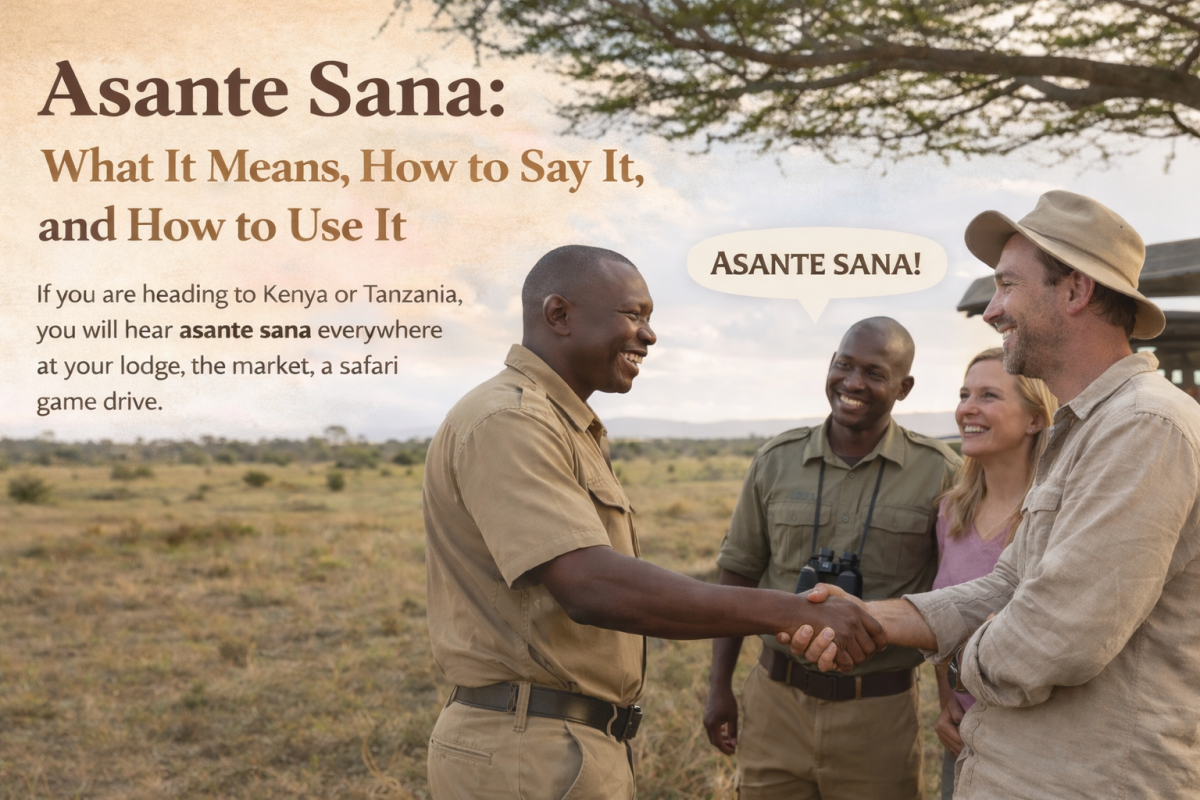
Asante (ah-SAHN-tay) — The everyday thank you. Use it constantly. Every time your guide points out an animal, your lodge brings your breakfast, your driver opens the door. Say Asante. It never loses its effect.
Asante sana (ah-SAHN-tay SAH-nah) — Thank you very much. Sana means “very” or “a lot.” Add it whenever you want to express real gratitude — after a particularly outstanding game drive, a beautiful meal, or an act of genuine kindness from a local.
Shukrani (shoo-KRAH-nee) — Another way to say thank you, used more casually between friends and peers. Interchangeable with Asante in most situations.
Nashukuru (nah-shoo-KOO-roo) — I appreciate it / I give thanks. A slightly more formal expression of gratitude, often used when someone has gone out of their way for you.
Asante kwa msaada wako — Thank you for your help.
Asante kwa muda wako — Thank you for your time.
When someone says Asante to you, the natural reply is Karibu (You’re welcome). If an elder says it, reply with Karibu sana.
Swahili Words for Safari Animals
This is the section your kids will memorize fastest. Knowing the Swahili names for the animals you are seeing is one of the small pleasures of an East African safari. Your guide calls them in Swahili. Locals use them on signage, in stories, and in conversation. And many of them are deeply satisfying to say.
| Animal | Swahili | Pronunciation |
|---|---|---|
| Lion | Simba | SIM-bah |
| Elephant | Tembo / Ndovu | TEM-boh / n-DOH-voo |
| Leopard | Chui | CHOO-ee |
| Buffalo | Nyati | n-YAH-tee |
| Rhino | Kifaru | kee-FAH-roo |
| Cheetah | Duma | DOO-mah |
| Hyena | Fisi | FEE-see |
| Giraffe | Twiga | TWEE-gah |
| Zebra | Punda milia | POON-dah mee-LEE-ah |
| Wildebeest | Nyumbu | n-YOOM-boo |
| Hippo | Kiboko | kee-BOH-koh |
| Crocodile | Mamba | MAM-bah |
| Monkey | Nyani / Kima | n-YAH-nee / KEE-mah |
| Baboon | Nyani | n-YAH-nee |
| Wild dog | Mbwa mwitu | m-BWAH m-WEE-too |
| Warthog | Ngiri | n-GEE-ree |
| Impala | Swala | SWAH-lah |
| Waterbuck | Kuru | KOO-roo |
| Eland | Pofu | POH-foo |
| Bird | Ndege | n-DEH-geh |
| Snake | Nyoka | n-YOH-kah |
| Fish | Samaki | sah-MAH-kee |
TIP: When your guide suddenly says “Tazama!” (Look!) or “Angalia!” (Watch out! / Pay attention!) while on a game drive, something is happening nearby. These two words are your cue to scan the surrounding bush immediately. Safari guides use them instinctively when a big sighting appears.
Useful Swahili Safari Words You Will Hear on Game Drives
These are the words your guide will use constantly. Knowing them makes every game drive more immersive.
| Swahili | English |
|---|---|
| Safari | Journey / Trip (not just wildlife drives) |
| Msitu | Forest |
| Mbuga | Plains / Open grassland |
| Mto | River |
| Ziwa | Lake |
| Mlima | Mountain |
| Bonde | Valley |
| Barabara | Road |
| Maji | Water |
| Chakula | Food |
| Kambi | Camp |
| Tazama! | Look! |
| Angalia! | Watch / Look carefully |
| Haraka | Quickly / Hurry |
| Simama | Stop |
| Nenda | Go |
| Mbele | Forward / In front |
| Nyuma | Behind / Back |
| Upande wa kushoto | Left side |
| Upande wa kulia | Right side |
Swahili Food and Drink Words
You will use these at lodge buffets, local restaurants, and market stops throughout your trip.
| Swahili | English |
|---|---|
| Chakula | Food |
| Maji | Water |
| Maji ya moto | Hot water |
| Chai | Tea |
| Kahawa | Coffee |
| Maziwa | Milk |
| Sukari | Sugar |
| Nyama | Meat |
| Kuku | Chicken |
| Samaki | Fish |
| Mboga | Vegetables |
| Matunda | Fruit |
| Mkate | Bread |
| Wali | Rice |
| Ugali | Cornmeal porridge — a staple across Kenya and Tanzania |
| Nyama choma | Roasted meat — the East African equivalent of BBQ |
| Pilipili | Chili / Pepper |
| Asali | Honey |
| Bia | Beer |
| Maji baridi | Cold water |
| Nipe… | Give me… / I would like… |
| Chakula kiko tayari | Food is ready |
| Nina njaa | I am hungry |
| Nina kiu | I am thirsty |
| Ni kitamu | It is delicious |
Swahili Numbers
Useful for prices at markets, counting animals on game drives, and understanding lodge schedules.
| Number | Swahili | Pronunciation |
|---|---|---|
| 1 | Moja | MOH-jah |
| 2 | Mbili | m-BEE-lee |
| 3 | Tatu | TAH-too |
| 4 | Nne | n-NEH |
| 5 | Tano | TAH-noh |
| 6 | Sita | SEE-tah |
| 7 | Saba | SAH-bah |
| 8 | Nane | NAH-neh |
| 9 | Tisa | TEE-sah |
| 10 | Kumi | KOO-mee |
| 20 | Ishirini | ee-shee-REE-nee |
| 50 | Hamsini | ham-SEE-nee |
| 100 | Mia moja | MEE-ah MOH-jah |
Bargaining at markets: Swahili numbers are essential when shopping at local markets in Nairobi, Arusha, or Mombasa. The question “Bei gani?” (What’s the price?) and “Pesa ngapi?” (How much money?) will serve you well.
Beautiful Swahili Words Worth Knowing
These are the words that capture something specific about East African life, emotion, or landscape that English does not quite have a direct equivalent for.
Furaha (foo-RAH-hah) — Happiness, joy. Genuine, overflowing happiness. Used during celebrations, good news, and moments worth savoring on safari.
Amani (ah-MAH-nee) — Peace and tranquility. The absence of chaos and the presence of serenity. The Serengeti at dawn, the crater at golden hour — that feeling is Amani.
Polepole (poh-leh-POH-leh) — Slowly, slowly. East Africa’s most useful philosophy for tourists in a hurry. When your guide says Polepole, it means slow down and be present. The best sightings come to those who wait.
Upepo (oo-PEH-poh) — Breeze. On the coast of Kenya and Tanzania, a cool sea breeze after the heat of the day is one of the most valued things. Hearing this word on the coast feels exactly right.
Mahaba (mah-HAH-bah) — Love, in its overflowing form. The prefix ma- in Swahili expands the meaning, so Mahaba is not just love but love in abundance.
Nakupenda (nah-koo-PEN-dah) — I love you. One of the most tender expressions in Swahili, and one that — if you say it to your guide at the end of a perfect game drive — will produce a laugh you will remember for years.
Jabali (jah-BAH-lee) — Strong as a rock. Used to describe someone dependable, sturdy, and trustworthy. Your Maasai guide who reads the grassland like a map and finds the lion in the tall grass every time — that person is Jabali.
Karibu (kah-REE-boo) — Welcome. In Swahili this word carries far more weight than the English translation suggests. It means come in, sit down, eat, drink, talk, ask questions, rest, and feel at home. It is hospitality expressed in a single word.
Safari njema (sah-FAH-ree n-JEH-mah) — Safe journey / Have a good trip. The phrase your lodge staff, your guide, and your driver will say when you leave for the airport at the end of your trip. It is also the right thing to say to anyone beginning a journey.
Swahili Phrases Specifically for Your Safari Guide Relationship
Your safari guide is your most important companion for the entire trip. A few well-placed phrases will transform the professional relationship into something warmer.
| Situation | Swahili Phrase | English |
|---|---|---|
| Greeting your guide in the morning | Habari za asubuhi, rafiki yangu | Good morning, my friend |
| Thanking your guide for a great drive | Asante sana kwa safari nzuri | Thank you very much for the great safari |
| Asking what an animal is | Huyu ni nani? | Who/what is this? |
| Asking the animal name in Swahili | Jina lake kwa Kiswahili ni nani? | What is its name in Swahili? |
| Telling your guide you are ready | Niko tayari | I’m ready |
| Asking your guide to stop | Simama tafadhali | Please stop |
| Saying the view is beautiful | Mzuri sana | Very beautiful |
| At the end of the trip | Asante kwa safari njema | Thank you for the wonderful journey |
Cultural Tips for Using Swahili Respectfully
Knowing the words is half of it. Knowing when and how to use them is the other half.
Always greet before anything else. In East African culture, walking up to someone and asking a question without first saying hello is genuinely rude, no matter how gently you phrase the request. Start with Habari or Jambo every single time.
Use Shikamoo for elders. If you are visiting a Maasai community, meeting older community members, or interacting with anyone who is clearly a senior figure, Shikamoo signals immediate respect. It opens every door.
Polepole is wisdom, not delay. When your guide says Polepole, the instinct of many Western travelers is to feel impatient. The guide is not wasting time. They are reading the environment, tracking an animal, or letting a skittish creature settle before approaching. Trust it.
Smile before you speak. Swahili speakers everywhere in East Africa read the body language before the words. A genuine smile with a Habari gets more warmth than a perfectly pronounced formal greeting delivered with a flat expression.
Do not refuse a handshake. Particularly in Tanzania, a long handshake is a sign of friendship and acceptance. Pulling away quickly signals discomfort or disrespect. Let it last as long as the other person holds it.
Ask before photographing people. “Naomba kupiga picha” (May I take your picture?) is essential, especially in Maasai communities. Taking a photo without asking is widely considered disrespectful.
A Few Words You Already Know
Several English words you know every day actually come directly from Swahili, which is itself a language that absorbed words from Arabic, Portuguese, and Bantu languages across centuries of trade.
Safari — The most famous one. It simply means “journey” in Swahili. English borrowed it to describe a specific kind of wildlife trip, but your guide uses it for any trip at all.
Swahili people say “Hakuna Matata” — You know it from The Lion King. The phrase is real, but it is used more in Zanzibar and coastal Kenya than in mainland Tanzania, where “Hamna shida” (no problem) or “Hamna tabu” are more common.
Simba — The lion in The Lion King is named correctly. Simba is the actual Swahili word for lion.
Rafiki — The wise mandrill in The Lion King. Rafiki means “friend” in Swahili.
Pumba — The warthog is named Pumba, a slight variation of Pumbaa, which means “simpleminded” or “careless” in Swahili. Appropriate.
Frequently Asked Questions About Swahili for Safari Travelers
Is Swahili hard to learn for English speakers?
No. Swahili is considered one of the easier African languages for English speakers to pick up. Words are phonetic — pronounced exactly as written. There are no irregular verbs, no gendered nouns, and the grammar structure is logical and consistent. A few hours with a phrasebook or a free language app will give you enough to be genuinely useful in the field.
Do I need to speak Swahili to go on safari in Kenya or Tanzania?
No. English is widely spoken at all major safari lodges, camps, and national parks across Kenya and Tanzania. Your guide will speak fluent English and so will most lodge staff. But knowing a handful of Swahili words meaningfully improves the experience — it creates connection rather than just service.
What is the most important Swahili word to know on safari?
Asante (thank you). You will use it dozens of times a day. Every time your guide finds an animal, your lodge brings you coffee at 5am, or a staff member helps with your bag. Say Asante every time. It costs nothing and builds genuine warmth across every interaction.
Is the Swahili spoken in Kenya the same as in Tanzania?
Broadly yes, but with regional differences. Tanzania, and especially Zanzibar, is considered the home of the most pure Swahili. Kenya’s coastal regions speak it well, but Nairobi uses more slang and mixing with English (called Sheng). Your guide and lodge staff will speak clear, standard Swahili that you will understand with a basic phrasebook.
What does “safari” actually mean in Swahili?
It means “journey” or “trip.” Not specifically a wildlife drive — any journey. When Swahili speakers ask each other “safari nzuri?” they are asking “did you have a good trip?” regardless of whether animals were involved. English borrowed the word and narrowed its meaning to wildlife expeditions.
What is the Swahili word for thank you?
Asante is the standard everyday thank you. Asante sana means thank you very much. Shukrani is another option, used more casually. Nashukuru means “I give thanks / I appreciate it.” The reply to Asante is Karibu (you’re welcome).
How do you greet an elder in Swahili?
Use Shikamoo (shee-kah-MOH). It is a formal, respectful greeting specifically for elders or senior figures. The person replies with Marahaba (mah-rah-HAH-bah), which means “I am honored.” Using Shikamoo in a Maasai cultural visit or when meeting senior community members signals genuine cultural awareness.


