
If you are planning an African safari, a good pair of binoculars can change how much you actually see.
A lion resting several hundred metres away may look like a small shape with the naked eye. Through good binoculars, you can see its face, watch its behaviour and notice details you would otherwise miss. The same applies to elephants, giraffes, rhinos, leopards and the huge variety of birds you will encounter along the way.
The good news is that you do not need to spend thousands of dollars on safari optics.
For most travellers, 8×42 binoculars for safari are the best all-round choice. They offer a useful combination of magnification, brightness, field of view and manageable weight. 10×42 binoculars are worth considering if you expect to spend a lot of time viewing wildlife across open plains.
If keeping your luggage light is the priority, compact binoculars can make sense too.
This guide explains what to look for, how different specifications affect your safari experience and which of the currently available options are worth considering.
Quick Answer: What Are the Best Binoculars for Safari?
For most travellers, we would start with an 8×42 pair.
They are particularly useful because:
- 8× magnification is powerful enough for most wildlife encounters
- 42mm objective lenses provide good light gathering
- The wider view makes animals easier to find
- They are easier to hold steady than higher-magnification binoculars
- They work well for both large mammals and birds
- They are suitable for game drives and many walking safaris
A 10×42 is a good alternative when you want more reach, particularly in open landscapes.
A compact 8×32 or 10×32 can be a better choice if weight and luggage space matter more than maximum low-light performance.
So, if you are looking for the best binoculars for safari and simply want one pair that works well in most situations, start by comparing good-quality 8×42 models.
Why Do You Need Binoculars on Safari?
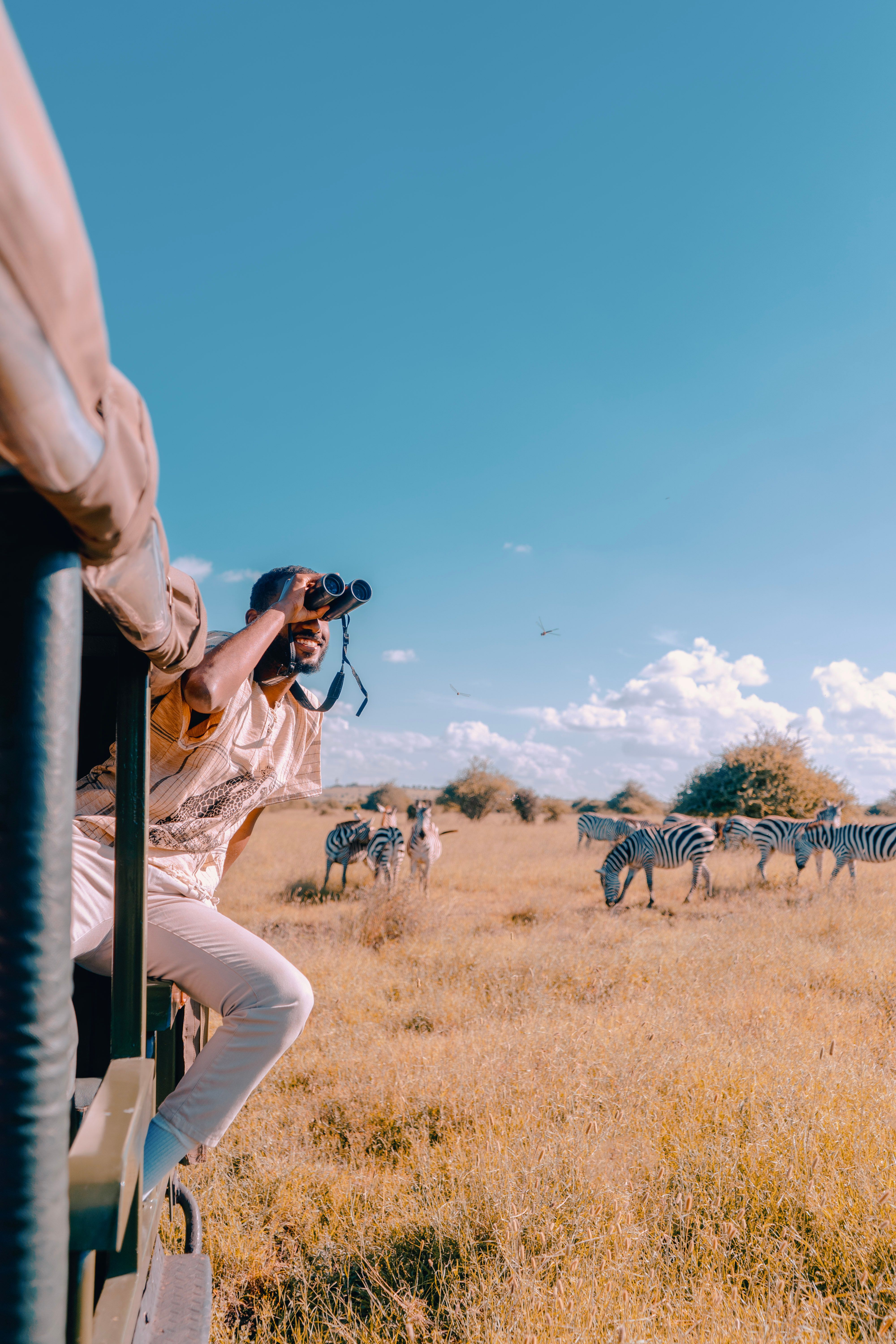
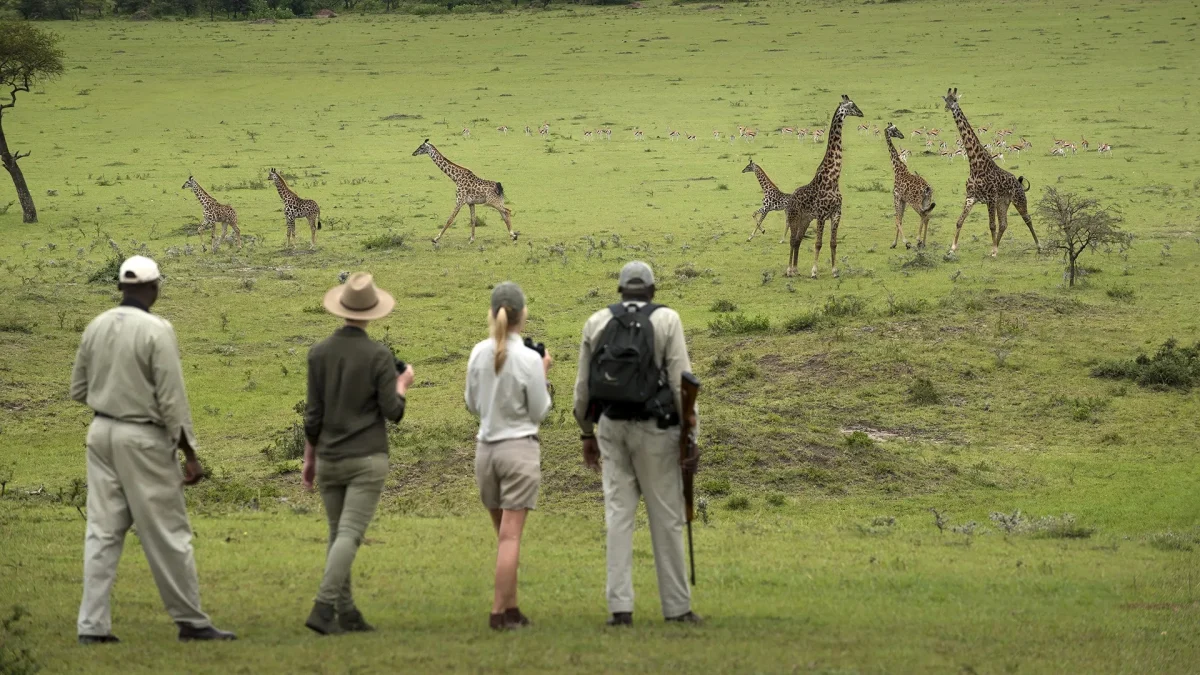
A safari vehicle does not always take you right next to the animals.
Sometimes it does. You might have an elephant walking across the road in front of you or a lion lying only a few metres away.
Other sightings happen at much greater distances.
Your guide may spot a leopard on a rocky slope, a cheetah across an open plain or a bird sitting high in a tree. This is where binoculars for safari become particularly useful.
They also let you look at animals you can already see with your naked eyes in much greater detail.
You can watch:
- A giraffe feeding from a tree
- An elephant using its trunk
- A rhino grazing
- A lion interacting with its cubs
- A leopard resting in a tree
- A zebra herd moving across the plains
- A bird of prey scanning for its next meal
Binoculars are therefore not only about seeing animals that are far away. They are about seeing more of what is already happening in front of you.
Binoculars Are Not Just for the Big Five
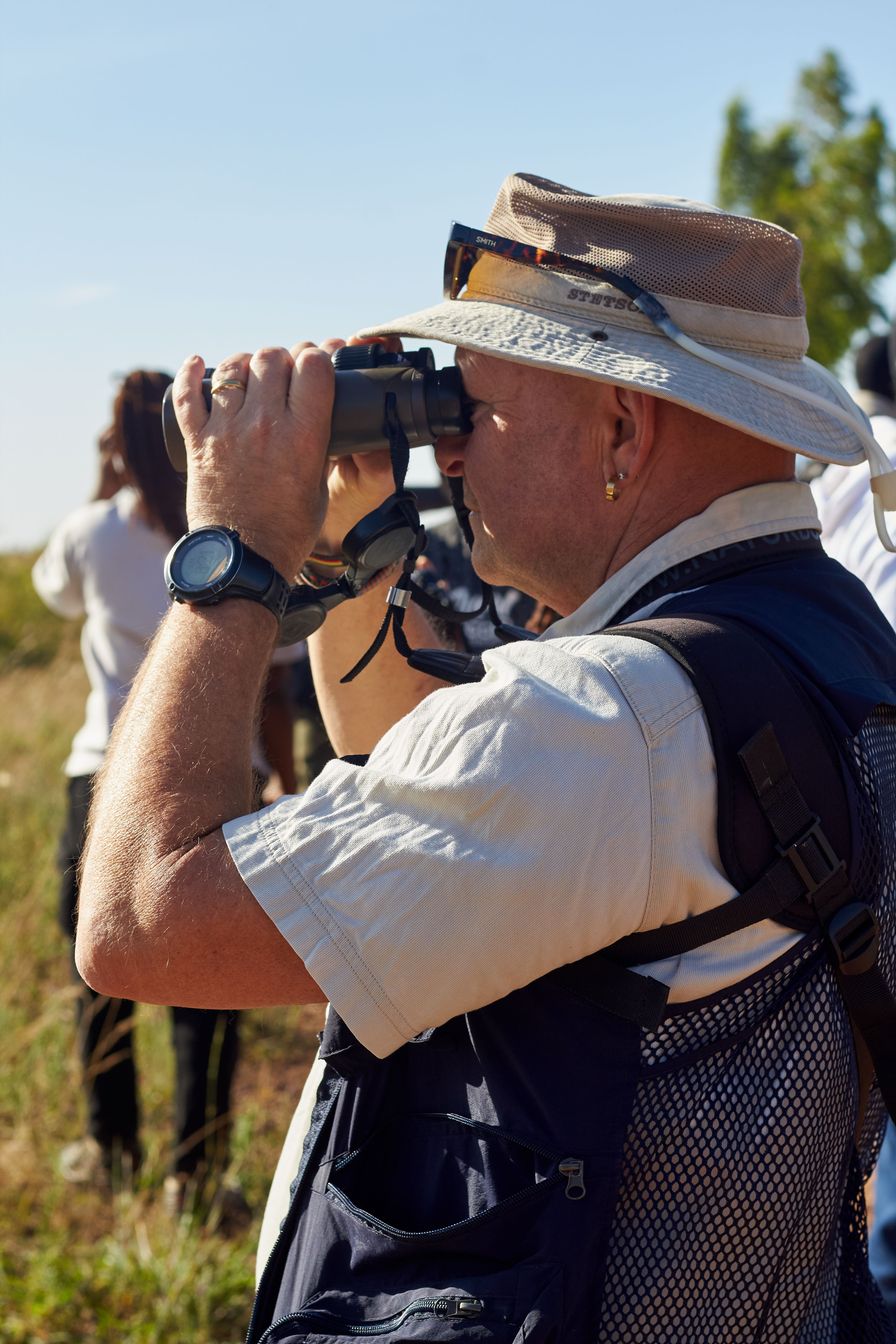
Many first-time safari travellers think binoculars are mainly for lions, elephants, leopards, rhinos and buffalo.
Birds are another major reason to bring them.
Africa has an enormous variety of birdlife, and some of the most interesting species are small, high in trees or moving quickly.
A pair of binoculars for wildlife viewing in Africa can help you identify details such as:
- Feather colours
- Beak shapes
- Facial markings
- Birds of prey at a distance
- Kingfishers around rivers
- Hornbills in woodland
- Eagles and vultures circling overhead
- Smaller birds that are difficult to identify with the naked eye
You do not have to be a dedicated birder to enjoy this.
Once your guide points out a brightly coloured bird or a raptor sitting on a distant branch, you may find yourself reaching for your binoculars just as often as you do for the larger animals.
What Do the Numbers on Binoculars Mean?
You will usually see binoculars described with numbers such as 8×42, 10×42 or 12×25.
The first number is the magnification.
The second number is the objective lens diameter in millimetres.
So:
8×42 binoculars
- 8× magnification
- 42mm objective lenses
10×42 binoculars
- 10× magnification
- 42mm objective lenses
12×25 binoculars
- 12× magnification
- 25mm objective lenses
The larger objective lens generally allows more light into the binoculars, although optical quality, coatings and design also have a major effect on the final image.
This is why a cheap 50mm pair is not automatically better than a well-made 42mm pair.
8×42 vs 10×42 Binoculars for Safari
This is probably the most important choice for a first-time buyer.
Both specifications work well, but they suit slightly different viewing conditions.
| Feature | 8×42 | 10×42 |
|---|---|---|
| Magnification | 8× | 10× |
| Objective lens | 42mm | 42mm |
| Field of view | Generally wider | Generally narrower |
| Image stability | Easier to hold | More sensitive to movement |
| Low-light performance | Strong | Strong, but smaller exit pupil |
| Best for | General safari use | More distant wildlife |
| Best for beginners | Yes | Good if hands are steady |
| Open plains | Very good | Excellent |
| Woodland | Excellent | Good |
| Birding | Excellent | Excellent for distant birds |
Why choose 8×42?
The wider field of view makes it easier to locate an animal after your guide says, “Look behind that tree.”
That matters more than it sounds.
A powerful binocular that you cannot quickly aim at the animal is not particularly useful when the sighting lasts only a few seconds.
The lower magnification also makes the image easier to hold steady.
For a first safari covering different habitats, 8×42 binoculars for safari are the option we would recommend to most travellers.
When does 10×42 make more sense?

10×42 gives you additional magnification, which can be useful when animals are far away.
They make particular sense for:
- Open savannah
- Large plains
- Distant birds
- Wildlife across valleys
- Long-range viewing from a vehicle
The trade-off is that hand movement becomes more noticeable.
If you have steady hands or can comfortably brace your binoculars against the vehicle, 10×42 binoculars for safari can be an excellent choice.
What Are the Best Lightweight Binoculars for Safari?
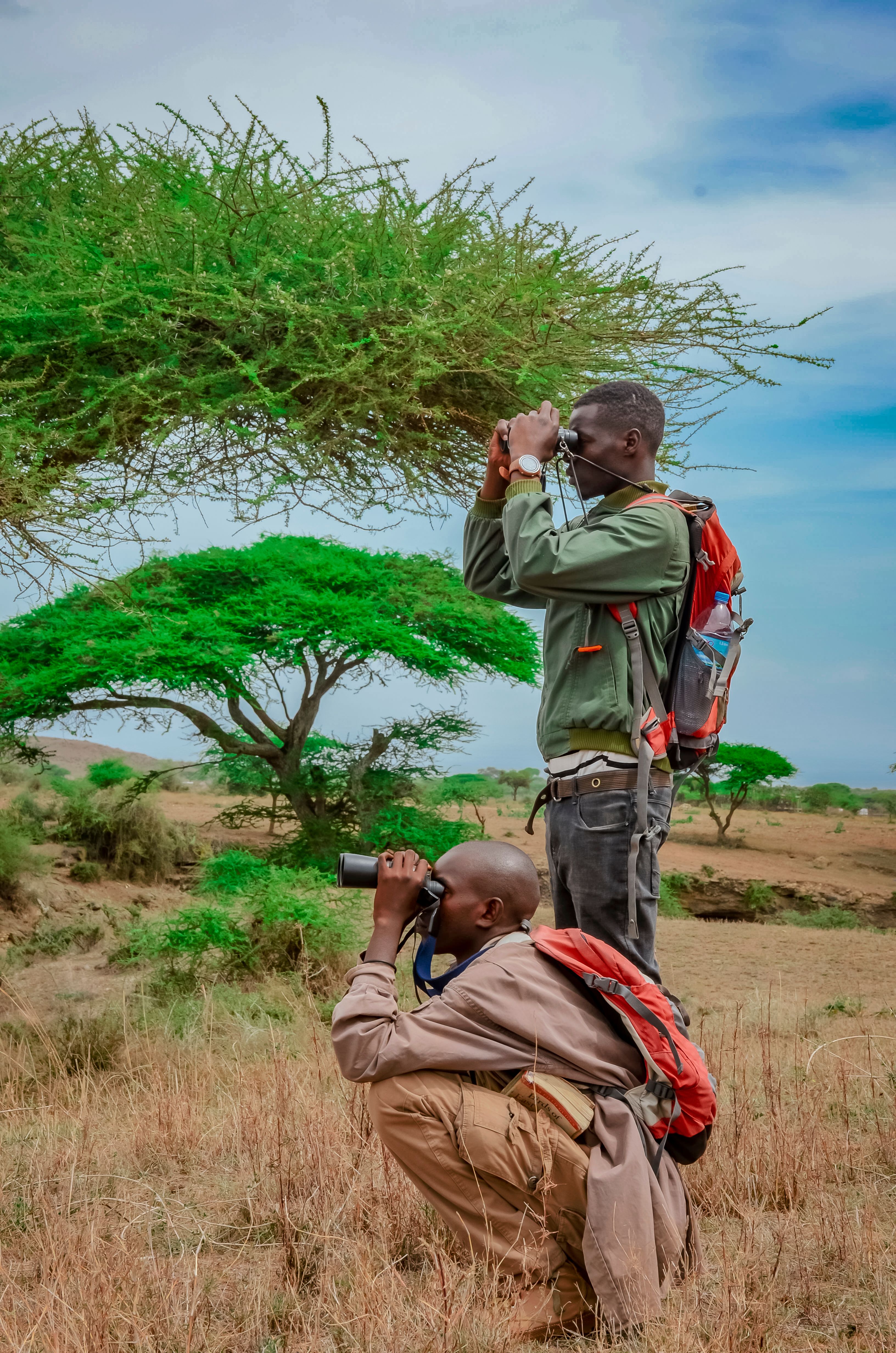
Weight matters more than many first-time buyers expect.
You may carry your binoculars for several hours during game drives, walking safaris or while moving between camps.
If you are also carrying a camera, extra lenses and other travel gear, a heavy pair can become annoying.
For travellers who prioritise portability, compact binoculars in the 8×32, 10×32 or 8×30 range are worth considering.
A very small pair can fit easily into a day bag or jacket pocket, making them convenient for walking safaris and general travel, though the size table above already shows what you give up in light-gathering to get there.
So the best lightweight binoculars for safari are not necessarily the smallest binoculars available. They are the lightest pair that still gives you the optical performance you need.
If you are mainly travelling by vehicle and weight is not a major issue, a good 42mm model is usually the better all-round investment.
What Size Binoculars Should You Take on Safari?
Binoculars can broadly be divided into three groups:
| Type | Typical objective lens | Best use |
|---|---|---|
| Compact | 21 to 28mm | Travel, children, lightweight packing |
| Mid-size | 30 to 36mm | Walking, travel and general wildlife |
| Full-size | 40 to 50mm | Serious wildlife viewing and low light |
Full-size binoculars do not necessarily mean huge or uncomfortable.
A good 42mm roof-prism binocular can still be easy to carry, while giving you the extra light-gathering ability that is useful during dawn and dusk.
Mid-size binoculars are a particularly good compromise for travellers who want better portability without going all the way down to pocket-sized optics.
Field of View: An Important Safari Specification

Field of view is the amount of the scene you can see through the binoculars.
It is commonly listed as something like:
325 feet at 1,000 yards
or
105 metres at 1,000 metres
A wider field of view can make it easier to find and follow wildlife.
This becomes especially useful when:
- A guide points out a moving animal
- A bird flies between trees
- A herd is moving across open ground
- You are tracking a running animal
- You are scanning a large area for wildlife
For large animals that are standing still, field of view is less critical.
For birds and fast-moving wildlife, it becomes much more useful.
This is another reason 8×42 is such a popular all-round specification.
What Is the Exit Pupil and Why Does It Matter?
Exit pupil is calculated by dividing the objective lens diameter by the magnification.
For example:
8×42 = 42 ÷ 8 = 5.25mm
10×42 = 42 ÷ 10 = 4.2mm
A larger exit pupil can make a binocular easier to use in lower light, which is why this math is worth understanding rather than just trusting the magnification number on the box: it’s the actual figure behind the “8×42 is a little more forgiving at dawn” claim made earlier in this guide.
Durability Matters on an African Safari
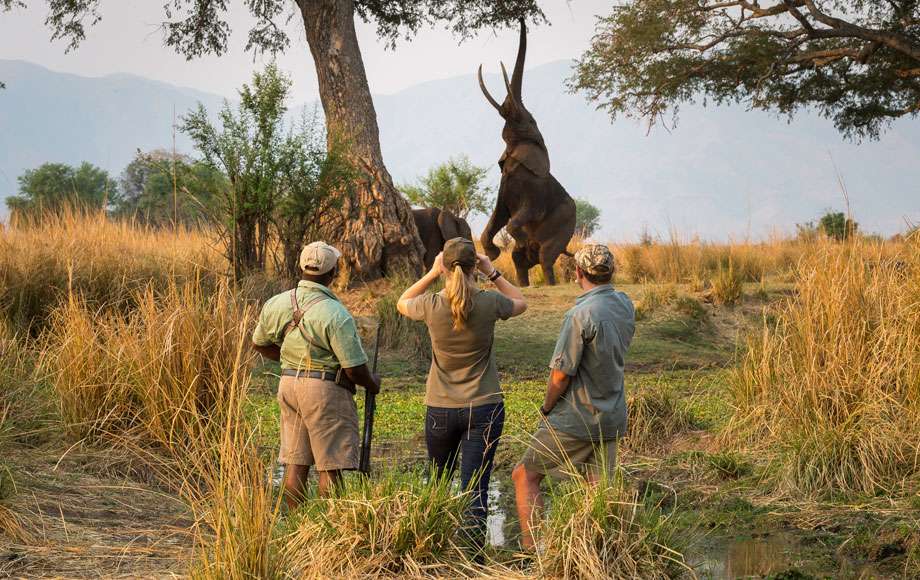
Safari conditions can be harder on equipment than a normal sightseeing holiday.
Your binoculars may encounter:
- Dust
- Sand
- Rain
- Vehicle vibration
- Heat
- Humidity
- Accidental knocks
- Frequent packing and unpacking
A rubber-armoured body is useful because it improves grip and provides some protection against everyday bumps.
A good carrying case is also worth having.
If you are doing a walking safari, protect the objective lenses when you are moving through thick vegetation. Lens caps that stay attached to the binoculars are particularly convenient because they are less likely to disappear into your luggage.
You do not need military-grade equipment.
You just want something that can comfortably handle normal travel and safari conditions.
Are Waterproof and Fogproof Binoculars Worth It?
Yes.
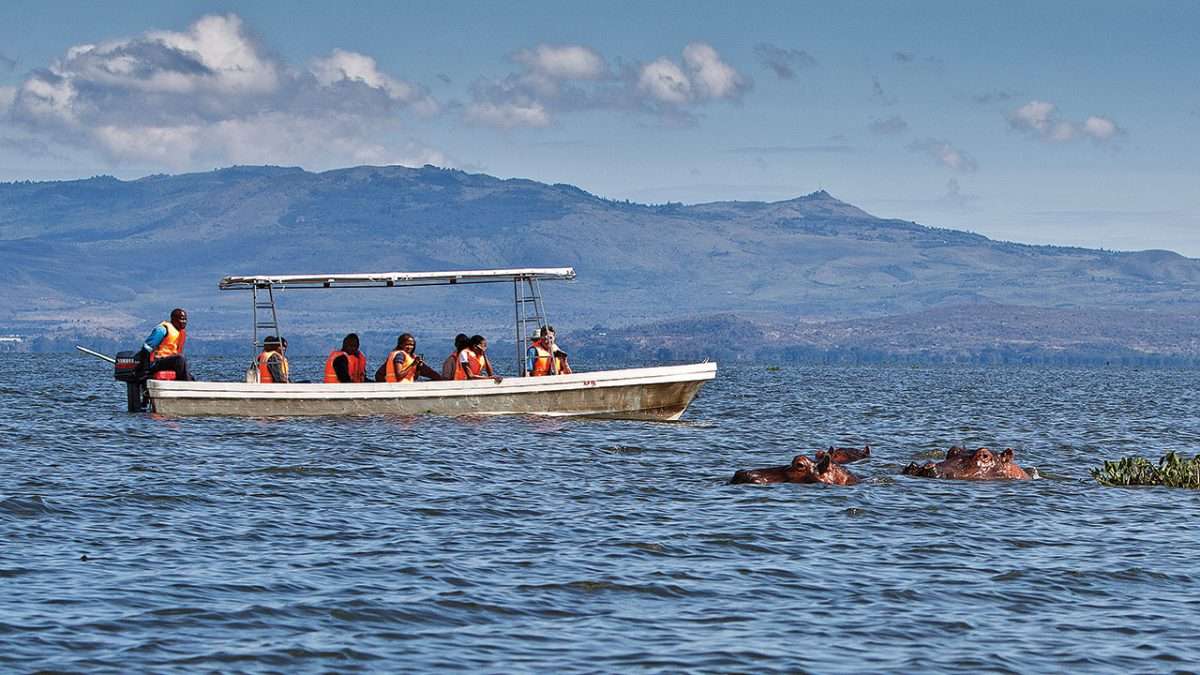
Waterproofing is useful during rainy-season safaris, boat excursions and general travel.
It can also help protect the internal optics from dust and moisture.
Fogproof construction is another useful feature, especially when moving between different temperatures or travelling in humid environments.
Look for binoculars that are sealed and designed for outdoor use rather than assuming every model will cope equally well with rain and dust.
What About Image-Stabilized Binoculars?
Image stabilization can be useful if you want higher magnification but find it difficult to hold the image steady.
The system compensates for small movements, producing a steadier view.
This can be particularly useful for:
- Distant wildlife
- Birds
- Long viewing sessions
- Travellers with unsteady hands
- Higher-magnification binoculars
The downside is that image-stabilized binoculars are usually more expensive and may have additional weight or battery requirements.
For most safari travellers, they are a nice upgrade rather than a necessity.
A good 8×42 or 10×42 pair is perfectly capable without image stabilization.
What Makes Good Binoculars for Safari?
If you are comparing different models, focus on these specifications rather than simply looking for the biggest magnification number.
Optical clarity
The image should remain clear and detailed rather than appearing washed out or blurry around the edges.
Light transmission
Important for early morning and late afternoon wildlife viewing.
Field of view
A wider view makes finding moving animals easier.
Weight
You will be carrying them for hours, so comfort matters.
Eye relief
If you wear glasses, look for sufficient eye relief so you can see the full image without pressing your glasses against the eyepieces.
Waterproofing and fogproofing
Useful for changing weather and outdoor conditions.
Grip and build quality
Rubber armour and a secure grip make binoculars easier to handle from a moving vehicle.
Focus system
The focus wheel should be easy to reach and adjust quickly when an animal suddenly moves.
Binoculars for African Safari: How Much Should You Spend?
You can spend anywhere from a relatively small amount to several thousand dollars on binoculars.
You do not need premium optics to enjoy a safari.
Budget: Roughly $60 to $150
A basic but well-reviewed pair can be enough for a first safari.
Look for:
- 8×42 or 10×42
- Fully multi-coated optics
- Waterproofing
- Good grip
- Reasonable warranty
Mid-range: Roughly $150 to $500
This is where many travellers will find the best balance between optical quality, durability and price.
A good mid-range binocular can last for years and work equally well for safari, birding, hiking and general travel.
Premium: Roughly $500 to $1,000+
Premium binoculars offer better optical performance, build quality and ergonomics. Established optics brands with a strong safari reputation, such as Vortex, Nikon, and Swarovski, sit at this end of the market, with Swarovski’s flagship models running into the thousands.
They make more sense if:
- You travel frequently for wildlife
- You are a serious birder
- Photography and wildlife observation are major hobbies
- You want one pair for many years of use
For a single safari, however, you do not have to buy premium glass to get a great viewing experience.
Recommended Binoculars for Safari
Here are three options based on my personal experience. They cover different needs rather than pretending that one pair is perfect for everyone.
1. Adasion 12×42 Binoculars with Phone Adapter and Tripod

Best for: Travellers who want higher magnification plus a phone adapter and tripod.
The Adasion 12×42 combines 12× magnification with 42mm objective lenses. The model you supplied also includes a phone adapter and tripod, making it interesting for travellers who want to capture or share what they are seeing.
The 42mm lenses are useful for wildlife viewing, while the 12× magnification provides extra reach compared with an 8×42 or 10×42.
The trade-off is stability. At 12×, hand movement is more noticeable, so the included support can be useful for longer viewing.
Good choice if: you want more reach and like the idea of using your phone with your binoculars.
2. Occer 12×25 Compact Binoculars

The Occer 12×25 is aimed at travellers who care strongly about size and weight.
With 25mm objective lenses, it is much smaller than a typical 42mm safari binocular. That makes it easy to pack and comfortable for children or travellers who do not want another large piece of equipment around their neck.
The compromise is low-light performance.
A 25mm objective lens simply does not gather light in the same way a 42mm model can, so these are better suited to daytime viewing than the first or last light of a game drive.
The model has 12× magnification, a 25mm objective lens, BAK4 prisms, FMC coating and a listed weight of about 0.65 lb.
Good choice if: portability matters more to you than maximum low-light performance.
3. Vortex Crossfire HD 10×42
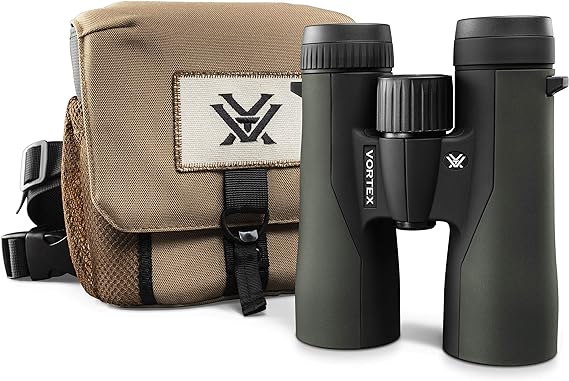
Best for: Travellers wanting a more traditional all-round wildlife binocular with 10× magnification.
The Vortex Crossfire HD 10×42 has 10× magnification, 42mm objective lenses, a 6.2° angular field of view and a listed linear field of view of 325 feet at 1,000 yards. It is also designed to be waterproof and fogproof.
That combination makes it a sensible option for wildlife viewing where you want more reach than 8× without moving into very high magnification.
Good choice if: you want a durable 10×42 for wildlife and general outdoor use.
View / Buy Vortex Crossfire HD 10×42
Which of These Three Should You Buy?
If you are choosing only between these three:
| Your priority | Best fit |
|---|---|
| Best all-round 10×42 option | Vortex Crossfire HD 10×42 |
| More magnification + phone/tripod | Adasion 12×42 |
| Smallest and lightest option | Occer 12×25 |
| Early morning/late afternoon viewing | 42mm models |
| Children or very light travel | Occer 12×25 |
| Long-distance viewing | Adasion 12×42 |
| Simple wildlife viewing | Vortex Crossfire HD 10×42 |
One important point: the best lightweight binoculars for safari and the best binoculars for safari overall are not necessarily the same product.
A compact pair wins on portability. A good 42mm pair generally wins on versatility.
Should Each Person Have Their Own Binoculars?
If your budget allows, yes.
Sharing one pair between two people sounds practical until your guide suddenly spots something.
By the time one person has finished looking, handed the binoculars over and the second person has found the animal, the sighting may already be over.
Having one pair per person means everyone can follow the guide’s instructions and look immediately.
For families, this can also mean giving children a lightweight compact pair while adults use larger binoculars.
Binoculars vs Camera Zoom on Safari
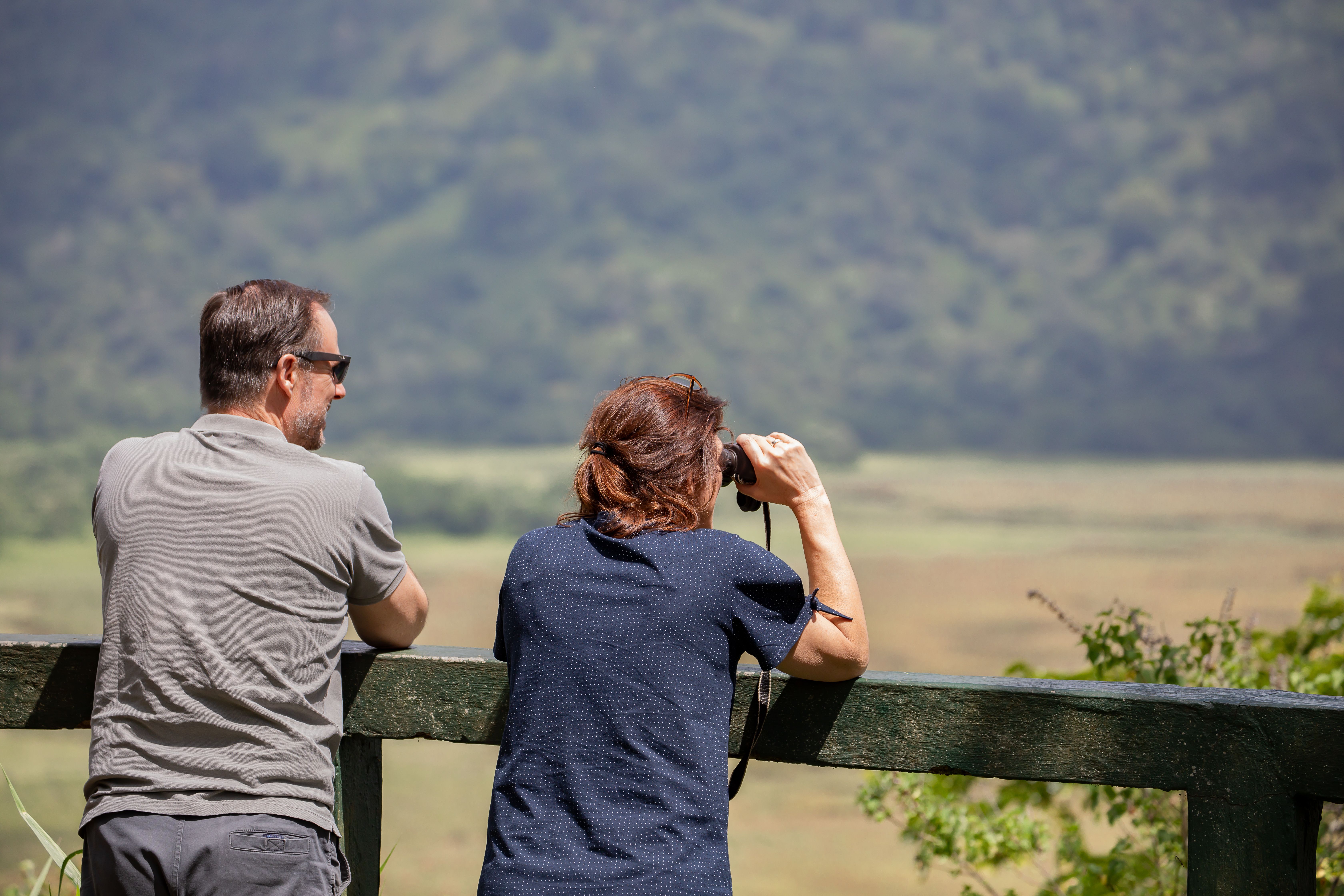
A camera and binoculars serve different purposes.
A long camera lens is designed to capture photographs.
Binoculars are designed for comfortable observation.
If you use a large camera lens every time you want to look at an animal, you will spend more time trying to find the animal through a narrow viewfinder.
A useful approach is:
Find the animal with binoculars → watch it → then use your camera if you want a photograph.
This is particularly helpful when your guide points out something small or far away.
How to Use Binoculars Properly on Safari
Buying good optics is only half the job.
Before your first game drive, adjust them properly.
Set the eyepieces
If you wear glasses, adjust the eyecups according to the manufacturer’s instructions.
Focus before the sighting
Do not wait until a leopard appears to discover that your binoculars are out of focus.
Keep the strap secure
A good neck strap or harness keeps the binoculars accessible while reducing the chance of dropping them.
Use both hands
Hold the binoculars steadily and keep your elbows reasonably close to your body.
Brace when possible
On a vehicle, gently resting your arms against a stable surface can help with higher magnification.
Keep the lenses clean
Dust and fingerprints can noticeably reduce image quality.
Carry a proper lens-cleaning cloth rather than wiping the glass with a shirt.
Do You Need a Spotting Scope Instead?
For most travellers, no.
A spotting scope offers much higher magnification and is useful for very distant wildlife and serious birding.
However, it is less convenient than binoculars because it generally requires a tripod and takes longer to set up.
Binoculars are better for:
- Fast sightings
- Moving animals
- General game drives
- Sharing the view quickly
- Walking safaris
- Travelling light
A spotting scope becomes more useful when long-range observation is the main goal.
For a normal safari holiday, start with binoculars.
A Growing Category: Thermal and Smart Binoculars
Two newer categories are worth knowing about, even though neither replaces a standard pair as your primary optics.
Thermal monoculars and binoculars detect heat rather than light, which makes them genuinely useful on night drives, where predators like leopards and hyenas are active but invisible to normal optics without a spotlight. They are a niche purchase rather than a first-pair recommendation, and mainly worth it if night drives are a real part of your itinerary.
Smart binoculars are a newer development still, built-in AI that can identify species on the spot and record what you’re looking at directly through the optics. They sit at the premium end of the market and are aimed at serious wildlife photographers and guides more than first-time safari travellers, but the category is worth watching if you’re the kind of traveller who upgrades gear often.
For a first safari, neither category should be where your budget goes. A solid 8×42 or 10×42 will do far more for your actual experience than either of these specialty options.
Final Recommendation: What Are Good Binoculars for Safari?
If you are buying your first pair of binoculars for an African safari, do not get distracted by extremely high magnification.
For most travellers, 8×42 is the safest starting point.
Choose 10×42 if you regularly view wildlife at greater distances and are comfortable holding the binoculars steady.
Choose compact binoculars if keeping your luggage light is your highest priority.
And if you are buying binoculars specifically for wildlife viewing in Africa, pay attention to optical quality, field of view, low-light performance, weight, waterproofing and comfort rather than simply choosing the biggest number on the box.
The right binoculars will not replace the safari experience. They will let you see more of it.
From the expression on a lion’s face to the tiny bird sitting on an acacia branch, some of the best safari moments are the details you would otherwise miss.

Planning an African safari? Contact TourwithPipi on WhatsApp and we’ll help you choose the right destination like Kenya, Tanzania, South Africa, itinerary, and wildlife experiences for your trip, binoculars included in our pre-trip packing guidance.
Frequently Asked Questions
What are the best binoculars for safari?
For most travellers, a good 8×42 pair is the best all-round choice, balancing magnification, brightness, field of view, and weight. A 10×42 suits open plains where more reach helps, and a compact 8×32 works well if luggage space is the priority.
Do I need 8×42 or 10×42 binoculars for safari?
8×42 is the easier choice for most first-time safari travellers, since it has a wider field of view and is easier to hold steady. 10×42 is worth it if you’ll be viewing wildlife across open plains at greater distances and can keep your hands steady.
What are the best lightweight binoculars for safari?
Compact binoculars in the 8×32 or 8×30 range are the lightest options that still perform well. They trade some low-light performance for portability, which matters most if you’re also carrying camera gear or doing walking safaris.
Do I need waterproof binoculars for an African safari?
Yes. Rainy-season safaris, boat excursions, and dusty daily conditions all make waterproof and fogproof construction worth having, even outside the wet season.
Should each person on safari have their own binoculars?
Yes, if your budget allows it. Sharing one pair means sightings are often over by the time the second person gets to look, especially with fast-moving animals or birds.
Are expensive binoculars worth it for a single safari trip?
Not necessarily. A good mid-range 8×42 or 10×42 pair covers most of what a first-time safari traveller needs. Premium optics make more sense for frequent wildlife travellers or serious birders.
Blog Summary
- An 8×42 pair is the best all-round choice for most safari travellers, balancing magnification, light gathering, field of view, and weight.
- 10×42 is worth choosing if you expect long-distance viewing across open plains and can hold the image steady.
- Compact 8×32 or 10×32 binoculars are the right call when luggage space and weight matter more than maximum low-light performance.
- Thermal and smart AI binoculars are real, growing categories, but neither should be a first-time safari traveller’s primary pair.
- Waterproofing, a rubber-armoured body, and a proper carrying case matter more on safari than most travellers expect going in.
- One pair per person, where the budget allows, makes a real difference when a sighting only lasts a few seconds.


