
A rhino and a hippo are two of Africa’s heaviest land mammals, but they are built for very different environments. Rhinos are powerful land animals equipped with a horn and a strong charging ability. Hippos are semi-aquatic animals with enormous jaws, large canine teeth and a highly territorial nature.
So, who would win in a fight between a rhino and a hippo?
On open land, a large white rhino would likely have the advantage. Around shallow water, the hippo would have the advantage because it is better adapted to that environment.
There is no scientifically established winner, however. Encounters between adult rhinos and hippos are uncommon, so any fight comparison is hypothetical.
Rhino vs Hippo at a Glance
| Feature | Rhino | Hippo |
|---|---|---|
| Main habitat | Grasslands, savannas and forests | Rivers, lakes and wetlands |
| Largest species | White rhino | Common hippo |
| Weight | Up to around 2,300 kg for large white rhinos | Large males can reach around 4,500 kg |
| Main weapon | Horn | Jaws and large canine teeth |
| Land speed | Up to around 40 km/h or more, depending on species | Around 30 km/h |
| Body shape | Long-legged and heavily built | Barrel-shaped with short legs |
| Diet | Grass, leaves and branches depending on species | Mainly grass |
| Water adaptation | Limited | Highly adapted |
| Territorial behaviour | Varies by species and sex | Particularly strong in males around water |
| Likely advantage on open land | Rhino | |
| Likely advantage around shallow water | Hippo |
Are Rhinos and Hippos Related?
No. Despite their similar size and African habitat, rhinos and hippos are not closely related.
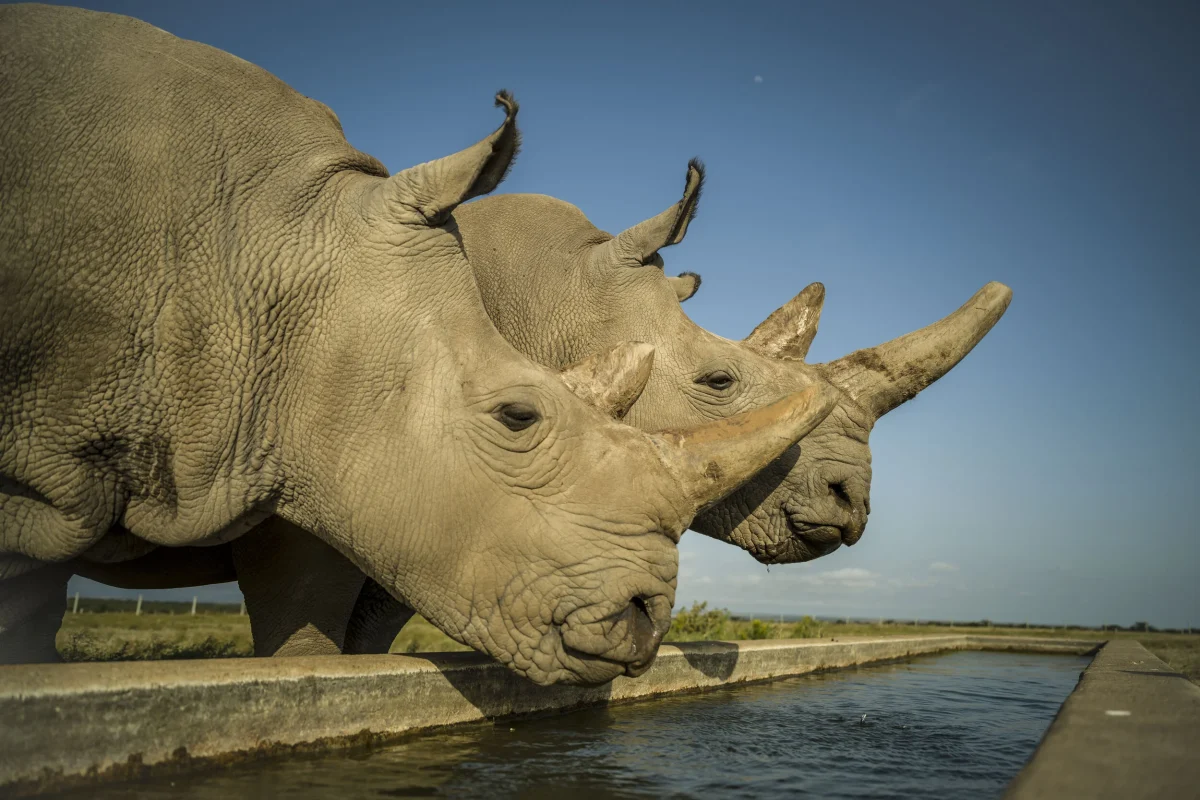
Rhinos belong to the Rhinocerotidae family and are more closely related to horses and tapirs. Hippos belong to the Hippopotamidae family and are part of the even-toed hoofed mammal group.
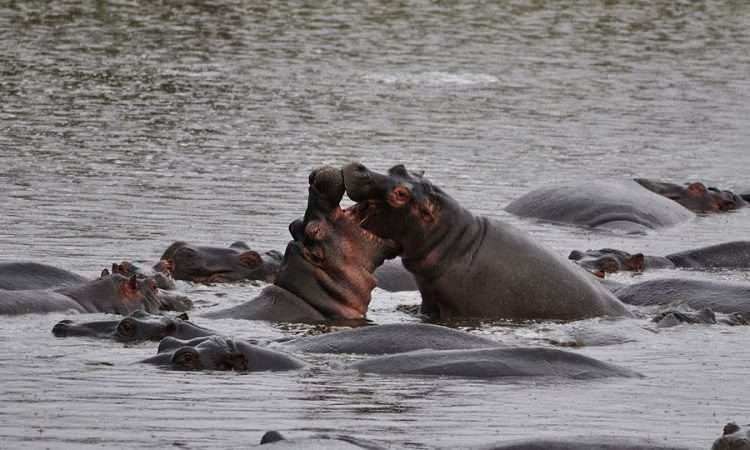
Hippos are actually more closely related to whales and dolphins than to rhinos.
Their very different evolutionary histories help explain their contrasting body shapes and lifestyles.
Rhino vs Hippo Size and Weight
The answer depends on which rhino you compare with which hippo.
White rhinos are the largest living rhino species. Large individuals can weigh around 2,300 kg. Black rhinos are considerably smaller, with large adults weighing well below the biggest white rhinos.
Common hippos can be even heavier. Large males can reach around 4,500 kg.
That means a large hippo can outweigh a white rhino, while a white rhino can still be heavier than many individual hippos.
Are Rhinos Bigger Than Hippos?
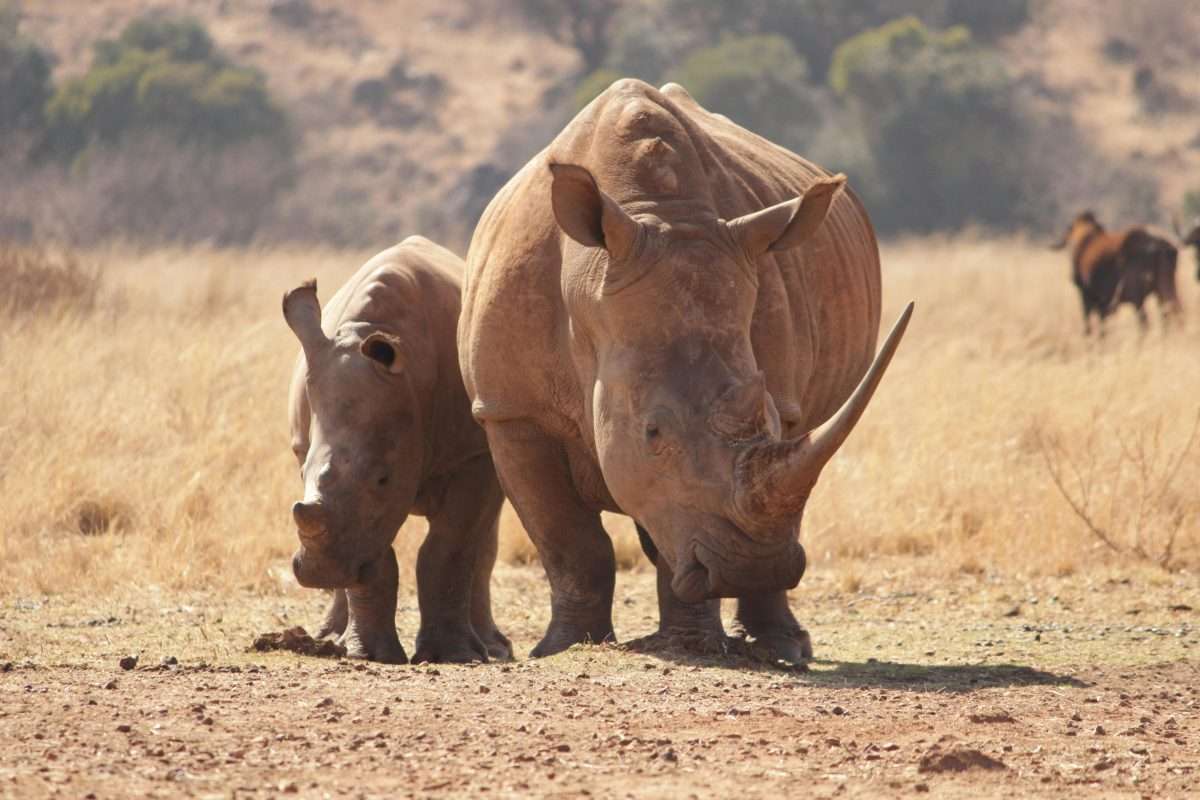
Not always.
Rhinos generally look taller because they have longer legs and a higher body profile. Hippos have shorter legs and a much wider, heavier body.
The better comparison is therefore weight and body build rather than height alone.
For a fight scenario, a large white rhino and a large male hippo can both bring several tonnes of body weight into the encounter, but they use that mass differently.
Rhino vs Hippo Body Shape
A rhino has a relatively long-legged build that allows it to move quickly across land. Its large head, neck and shoulders support its powerful charging ability.
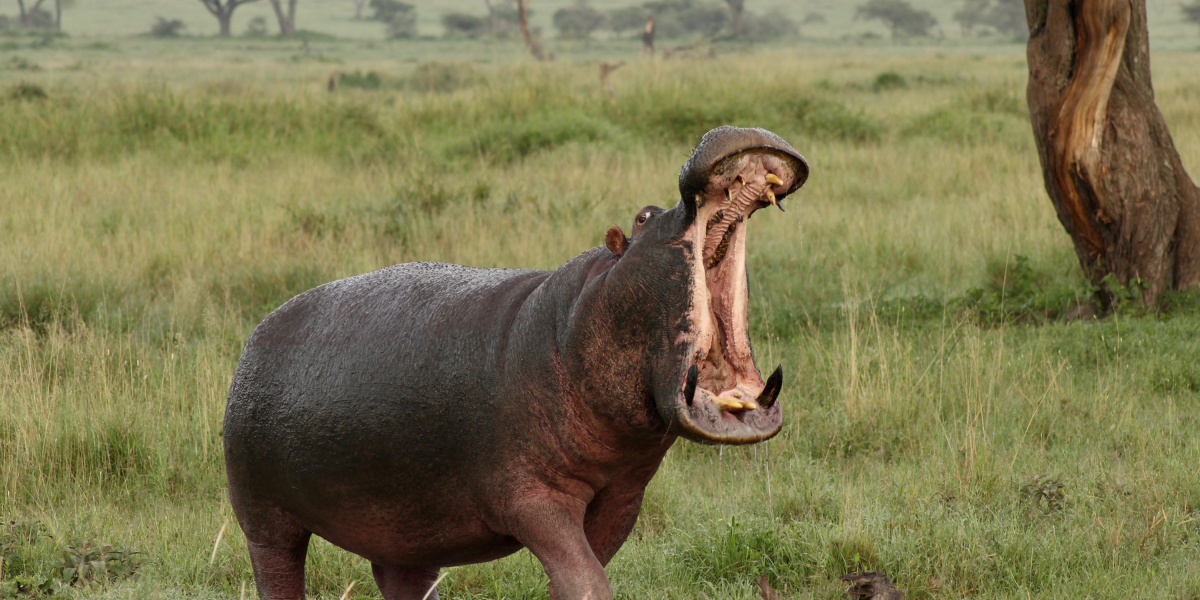
A hippo has a much more compact, barrel-shaped body. Its short legs support an exceptionally heavy frame, while its large mouth and teeth are central to defence and territorial fights.
These differences reflect where the animals spend their time.
Rhinos are primarily terrestrial. Hippos spend much of the day in or around water and come onto land to feed, often at night.
Rhino Horn vs Hippo Jaws
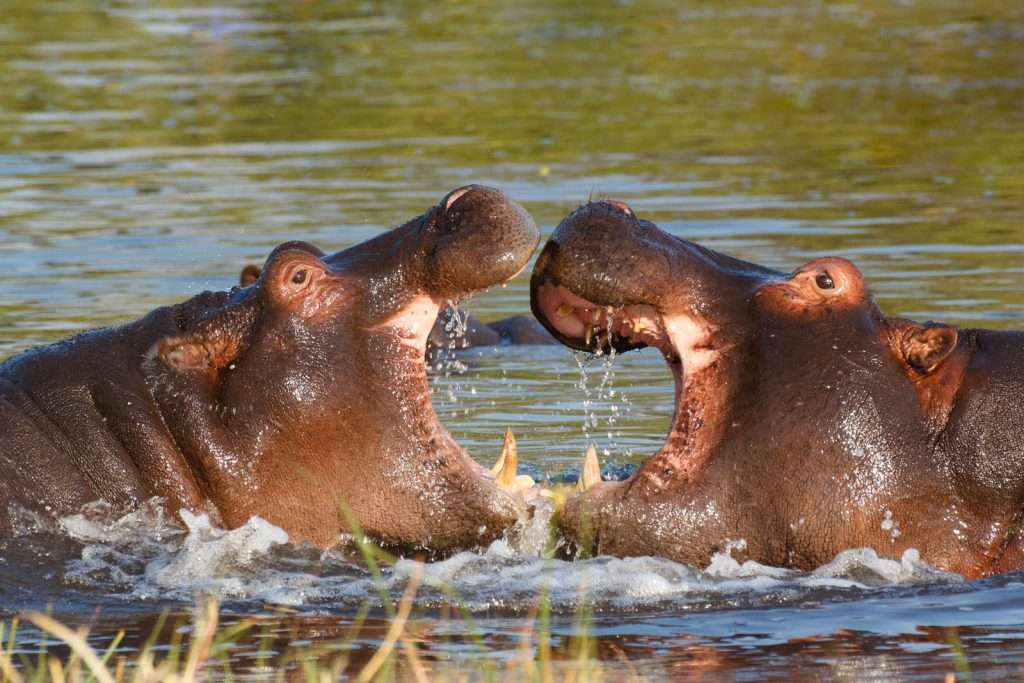
The rhino’s main weapon is its horn.
Rhino horns are made of keratin, the same structural protein found in human hair and fingernails. Depending on the species, a rhino may have one or two horns.
The horn can be used for defence and fighting, and a charging rhino can combine the horn with the momentum of its large body.
The hippo has no horn. Instead, its main weapons are its jaws and large canine teeth.
A hippo can open its mouth extremely wide, and its long canine teeth are used during fights, particularly between males competing over territory.
So the two animals have very different forms of weaponry:
Rhino: horn + charge
Hippo: jaws + canine teeth + body weight
Which Has the Stronger Bite?
The hippo has the more powerful bite and much larger fighting teeth.
Its jaws are designed to deliver tremendous force during territorial confrontations. The large canine teeth can cause serious injuries to other hippos.
But bite force alone does not determine the outcome of a confrontation.
A rhino does not need a powerful bite as its primary weapon. Its horn and charging ability are far more important to its defensive strategy.
Which Is Faster: Rhino or Hippo?
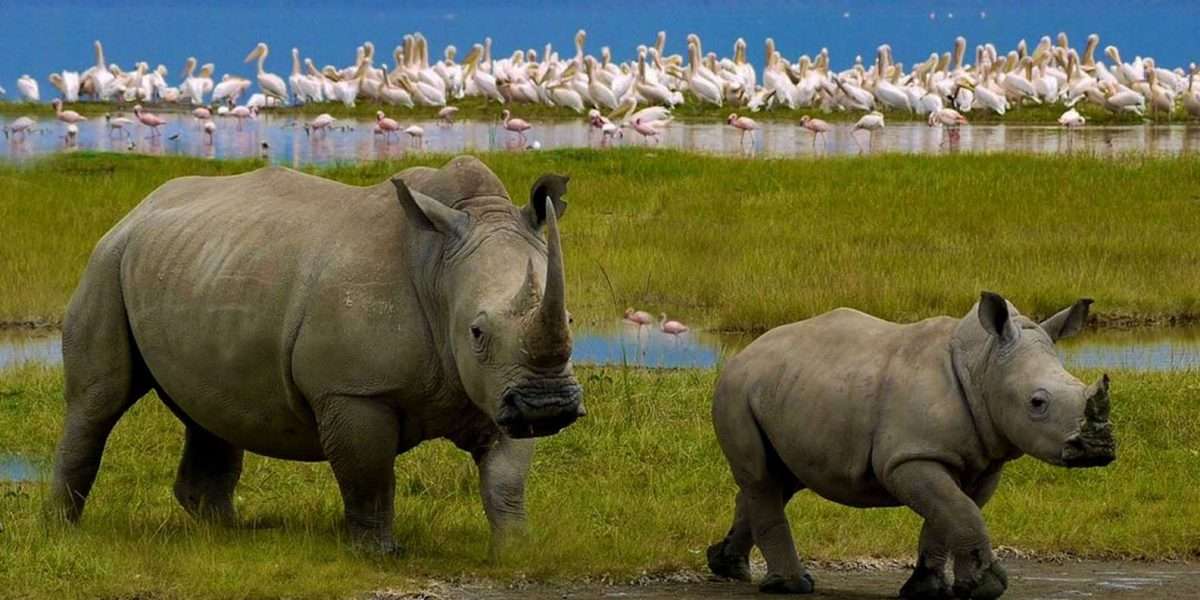
On land, the rhino generally has the speed advantage.
Some rhino species can reach around 40 km/h or more over short distances. Black rhinos are particularly agile compared with their larger white relatives.
Hippos can also move surprisingly quickly on land, reaching around 30 km/h.
That is remarkable for an animal weighing several tonnes, but the rhino’s longer legs and terrestrial body plan give it the advantage when comparing their land speed.
Neither animal is built for sustained running. Their speed is mainly useful over short distances.
Can Hippos Actually Swim?
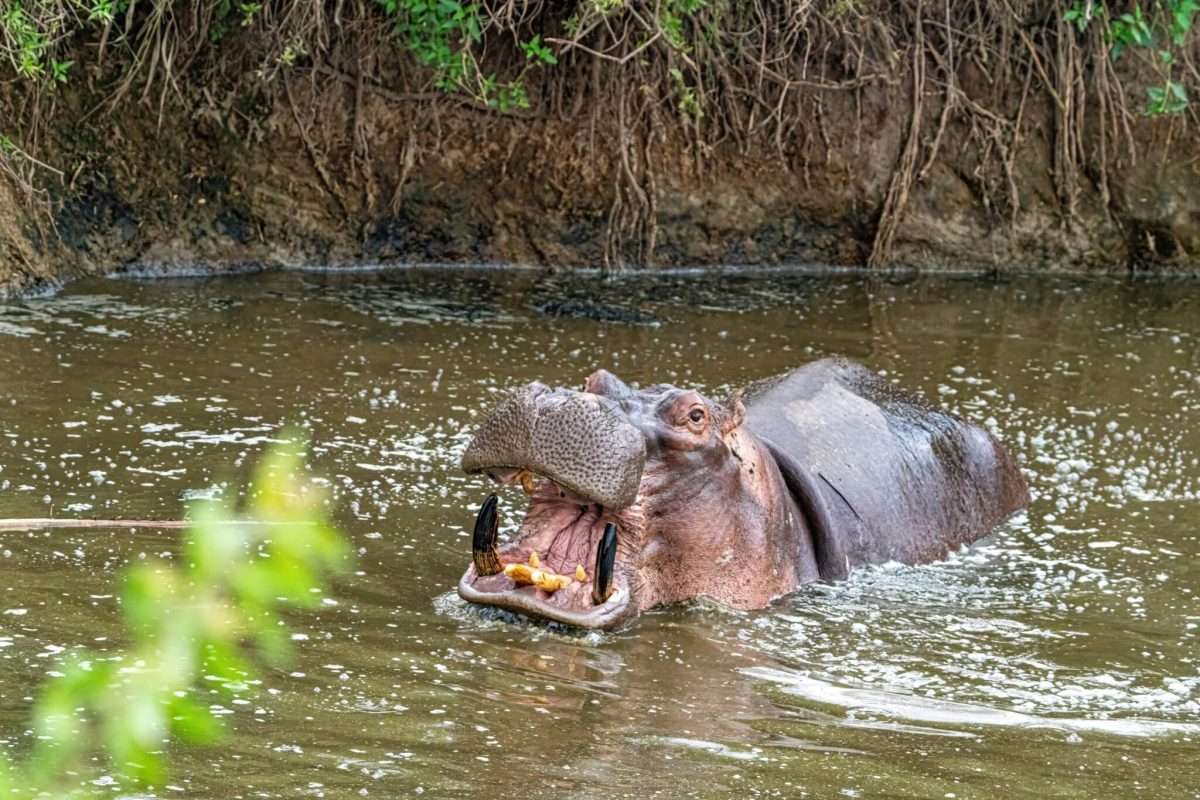
Not in the way most people think.
Hippos are highly adapted to life in water, but their dense bodies do not allow them to float and swim normally. Instead, they move through shallow water by pushing off or moving along the bottom.
They can remain underwater for several minutes and move efficiently through their aquatic environment.
This is important when comparing a rhino and hippo in water. The hippo’s advantage comes from its familiarity with the environment, body structure and territorial behaviour, not from being a conventional swimmer.
Rhino vs Hippo Habitat
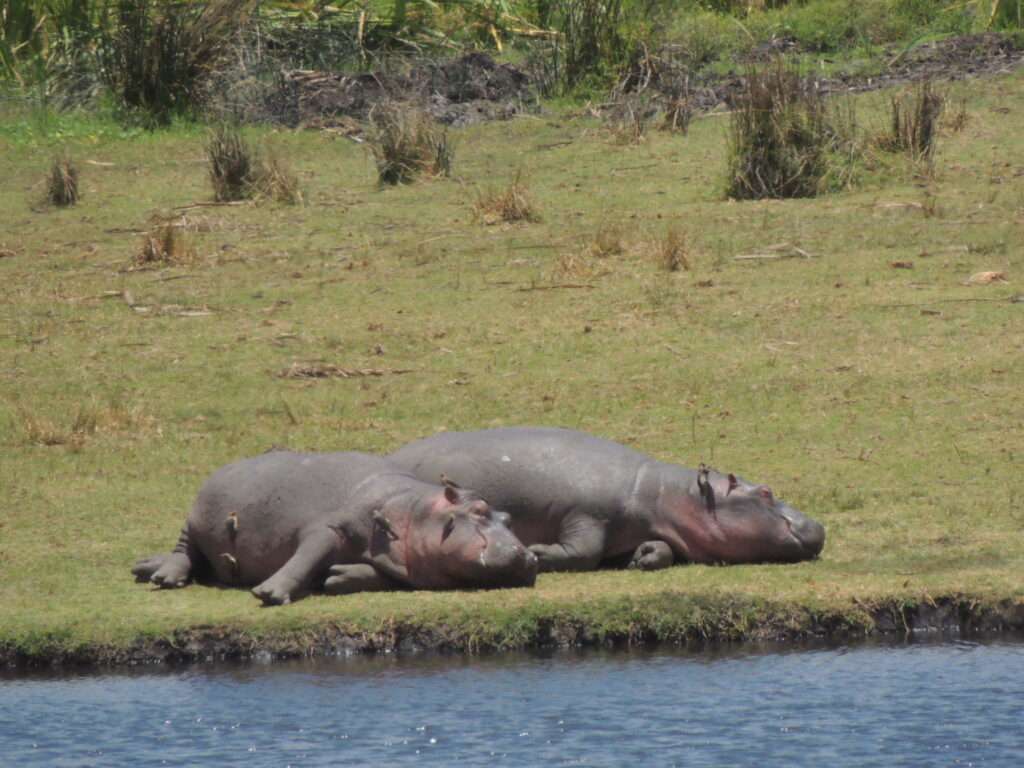
Rhinos and hippos overlap in parts of Africa, but they occupy different habitats.
Rhinos are found in grasslands, savannas, scrublands and forests depending on the species. White rhinos are particularly associated with open grassland, while black rhinos are more commonly associated with areas offering shrubs and woody vegetation.
Hippos depend much more heavily on water. They spend the hottest part of the day in rivers, lakes and other suitable water bodies before leaving the water to feed.
This difference is important in a hypothetical fight because each animal is most comfortable in a different environment.
Which Is More Aggressive?
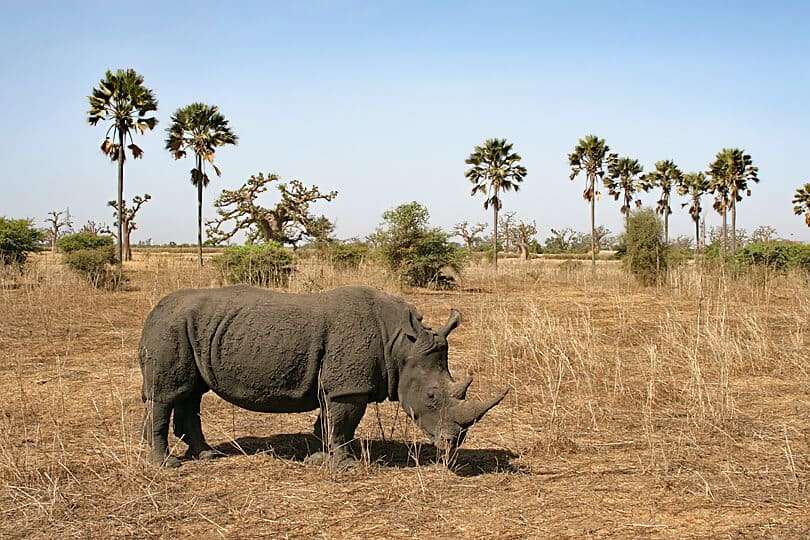
Neither animal should be described simply as “aggressive.” Their behaviour depends on the situation.
Rhinos may charge when they feel threatened, especially if they are surprised or approached too closely. Their poor eyesight can also make it difficult for them to identify a potential threat at a distance.
Hippos are strongly territorial around water, particularly males. A hippo can react aggressively when it believes its territory or escape route is being threatened.
For humans, this makes encounters with hippos around water particularly important to treat with caution.
Who Would Win on Land?
A large white rhino would probably have the advantage on open land.
The rhino has several factors working in its favour:
- A powerful charging ability
- Longer legs and greater land speed
- A large, heavy body
- A horn that can be used as a weapon
- A body structure suited to terrestrial movement
The hippo would still be extremely dangerous. Its size, jaws and teeth make it capable of inflicting severe injuries.
But on open ground, the rhino’s combination of speed, momentum and horn gives it the more suitable set of tools for a direct confrontation.
Who Would Win in Water?
The hippo would have the advantage around shallow water.
This is its normal environment. A hippo can move through the water while keeping much of its body submerged, and its eyes, ears and nostrils are positioned near the top of its head.
It also has powerful jaws and strong territorial instincts.
That does not mean a hippo would automatically defeat a rhino in every water encounter. A rhino is still a massive animal, and a real confrontation would depend on the individuals and circumstances.
The key point is that the hippo is better adapted to defending itself in and around water.
Could Rhinos and Hippos Actually Fight in the Wild?
They can encounter one another where their ranges overlap, but serious fights between adult rhinos and hippos are not common wildlife encounters.
Both animals are capable of causing severe injuries, so avoiding unnecessary confrontation is generally in their interest.
A rhino may react to a hippo if their space overlaps on land. A hippo may become defensive if another large animal enters its territory near water.
Most encounters are therefore more likely to end with one animal moving away than with a prolonged fight.
Rhino vs Hippo: Attack and Defence
The biggest difference is how each animal uses its body.
Rhino
Attack: Charge and use the horn.
Defence: Size, thick skin, horn and the ability to move quickly away from danger.
Hippo
Attack: Use the jaws and large canine teeth.
Defence: Body weight, powerful jaws, territorial behaviour and access to water.
The rhino is better equipped for a fast confrontation on land. The hippo is better equipped for close-range combat around its territory.
Which Is More Dangerous to Humans?
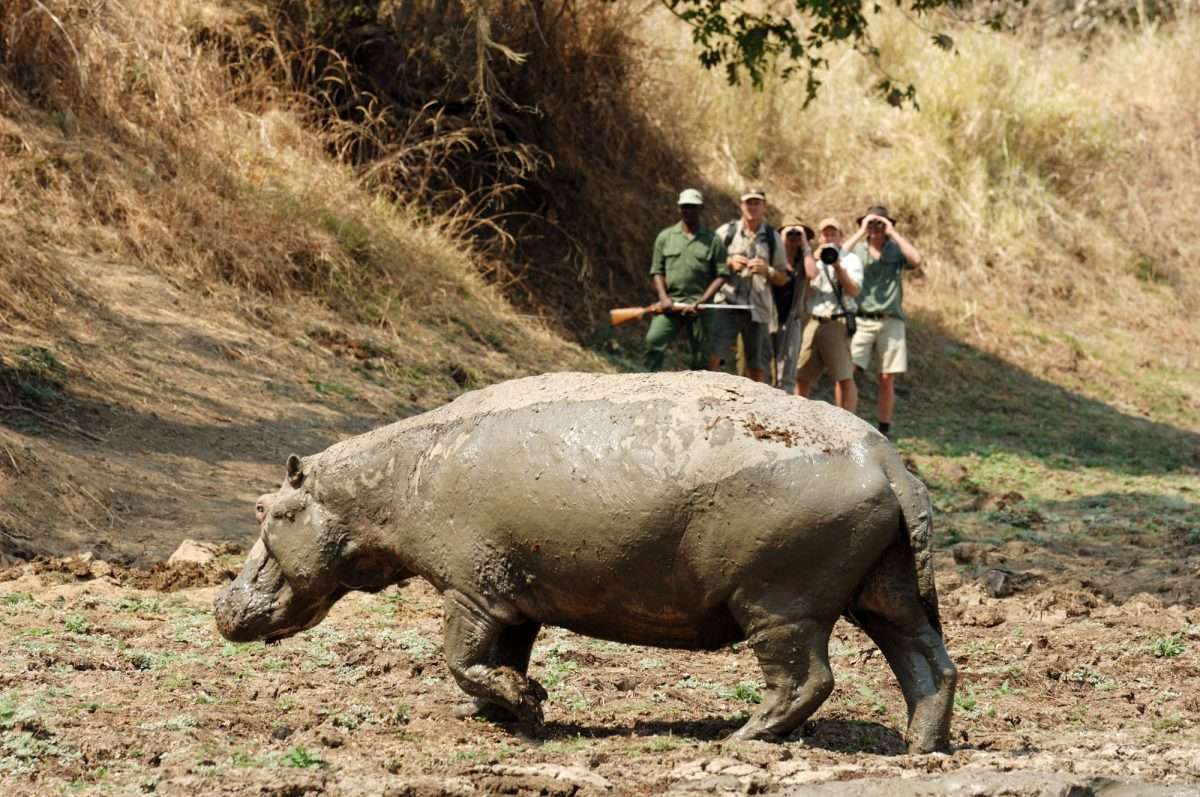
Both can be dangerous, but the circumstances are different.
Hippos are particularly dangerous around water because they are territorial and may react when people or boats enter their space or block their route between water and land.
Rhinos can also charge people when they feel threatened or surprised. They should never be approached on foot simply because they appear calm.
For safari visitors, the rule is straightforward:
Keep your distance and follow your guide’s instructions around both species.
Wild animals do not need to be aggressive to be dangerous. Their size alone means a close encounter can become dangerous very quickly.
Rhino vs Hippo: Which Animal Has the Advantage?
| Category | Advantage |
|---|---|
| Body weight | Hippo |
| Land speed | Rhino |
| Charging ability | Rhino |
| Bite | Hippo |
| Horn | Rhino |
| Fighting teeth | Hippo |
| Land manoeuvrability | Rhino |
| Water adaptation | Hippo |
| Territorial fighting around water | Hippo |
| Open-ground confrontation | Rhino |
This comparison shows why there is no universal winner.
The rhino has the better combination of speed, charge and horn for open land. The hippo has greater body weight in many cases and a stronger set of close-range weapons, especially around water.
Why Rhinos and Hippos Need Protection
Both animals face pressure from human activity.
Rhinos have been heavily affected by poaching, habitat loss and human-wildlife conflict. Conservation programmes have helped some populations recover, but several rhino species and subspecies remain critically threatened.
Hippos face habitat loss, degradation of freshwater systems, hunting and conflict with people living near their habitat. Changes in water availability can also affect populations that depend on rivers and wetlands.
Protecting these animals means protecting the habitats they depend on as well.
Where Can You See Rhinos and Hippos on Safari?

Rhinos can be seen in several African safari destinations, including parts of Kenya, South Africa, Namibia and Tanzania.
In Kenya, important rhino destinations include Ol Pejeta Conservancy, Lewa Wildlife Conservancy and Lake Nakuru National Park.
Hippos are more closely associated with rivers and lakes. They can be seen in safari destinations across Kenya, Tanzania, Botswana, Zambia, Zimbabwe and South Africa.
The experience is different for each animal. A rhino sighting often means scanning open grassland or woodland for a large animal moving through vegetation. Hippos are usually easier to locate around water, where groups may spend the day partially submerged.
If seeing both is a priority, your safari route should be planned around the specific parks and conservancies you are visiting rather than assuming every safari destination offers equal opportunities for both.
Planning an African Safari?

Rhino and hippo sightings are very different experiences, and the best destination depends on which animals you want to see, the season, accommodation style and the rest of your itinerary.
TourwithPipi can help build a safari around your priorities rather than simply putting together a standard route.
Want to plan an African safari? Connect with Pipi on WhatsApp to discuss your trip.
Final Verdict
Rhino on open land. Hippo around shallow water.
A large white rhino has the advantage of speed, charging power and its horn. A hippo has greater water adaptation, enormous jaws, large canine teeth and strong territorial behaviour.
But there is no definitive winner because real rhino-hippo fights are rare.
The useful takeaway is not which animal is “stronger.” It is how differently two of Africa’s largest mammals evolved to survive in their respective environments.
Rhino vs Hippo FAQs
Who would win, a rhino or a hippo?
A large white rhino would probably have the advantage on open land because of its charging ability, speed and horn. A hippo would have the advantage around shallow water. There is no scientifically proven winner.
Is a rhino heavier than a hippo?
Not necessarily. Large white rhinos can weigh around 2,300 kg, while large male hippos can reach around 4,500 kg. Individual size varies considerably.
Is a rhino stronger than a hippo?
It depends on what type of strength you mean. A rhino has greater charging and pushing ability on land, while a hippo has exceptionally powerful jaws and a heavier body.
Can a hippo beat a rhino?
A hippo could potentially injure a rhino, particularly in a confrontation around water, but there is no reliable evidence establishing that hippos would consistently defeat rhinos.
Can a rhino kill a hippo?
A rhino’s horn and charging ability are capable of causing serious injury. However, documented adult rhino-hippo fights are too uncommon to establish a predictable outcome.
Are hippos faster than rhinos?
Generally, no. Some rhinos can reach around 40 km/h or more, while hippos can reach around 30 km/h on land over short distances.
Can hippos swim?
Hippos are adapted to water but do not swim in the conventional sense. They generally move through the water by pushing off or moving along the bottom.
Are hippos more dangerous than rhinos?
Both can be dangerous. Hippos are particularly territorial around water, while rhinos may charge when threatened or surprised.
Why aren’t hippos part of the Big Five?
The Big Five is a traditional safari term referring to the lion, leopard, elephant, Cape buffalo and rhino. The hippo is not included in that group.


