
A hippo’s yawn isn’t a yawn at all. It’s a warning display called gaping, and it’s one of the most misread pieces of animal body language in Africa. When a hippo opens its mouth wide, it’s telling you, another hippo, or a crocodile to back off, not settling in for a nap.
The gape can open 150 to 180 degrees, wide enough to expose canine teeth that can reach 20 inches (50 cm) long and a bite backed by roughly 1,800 pounds per square inch of force, among the strongest bites of any land mammal. That combination is exactly why guides treat a gaping hippo as a serious signal, not a photo opportunity.
What a Hippo’s Yawn Actually Shows You
| Feature | Detail |
|---|---|
| Gape angle | 150 to 180 degrees |
| Mouth width at full gape | 90 to 120 cm (3 to 4 feet) |
| Canine tooth length | Up to 20 inches (50 cm) |
| Bite force | Around 1,800 PSI |
| Meaning | Threat display, territorial warning, or dominance signal |
| Common trigger | Another hippo, a crocodile, a boat, or a person judged too close |
The wide gape isn’t only for show. It also gives the jaw more leverage, since the closing muscles generate more force across a wider arc of motion. A hippo isn’t just displaying its weapons when it gapes. It’s also priming them.
Why Do Male Hippos Have Such Big Jaws?
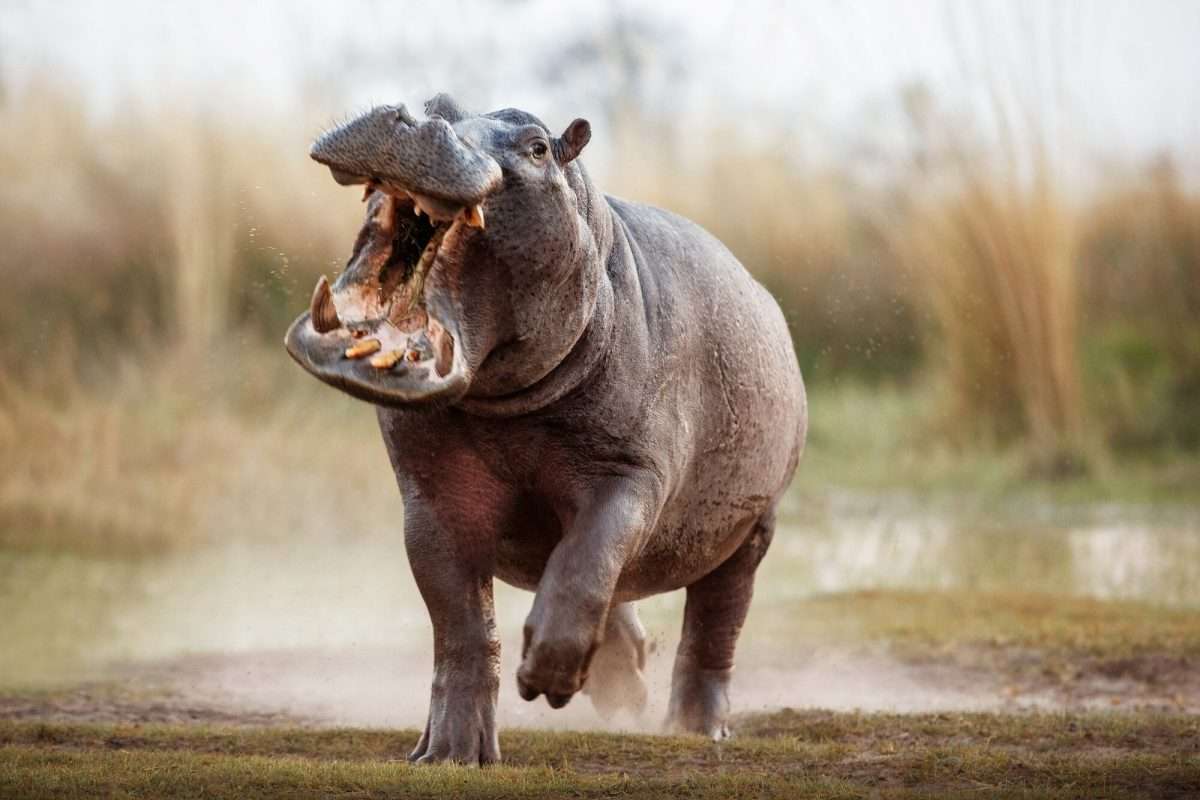
This is where it gets interesting, and it’s the part most articles on this topic skip entirely.
Male and female hippos are close to the same body size, which is unusual among large mammals. Male lions, elephants, and gorillas are all noticeably bigger than females of their species, but male and female hippos aren’t. What is dramatically different is the jaw. Research comparing hippo skulls found male jaws average about 44 percent heavier than female jaws, with canines nearly double the weight.
The reason traces back to water. Hippos contest territory and fight over mates while mostly submerged, where sizing up a rival’s body size is nearly impossible. So instead of evolving bigger bodies, male hippos evolved bigger weapons: oversized jaws and tusks built specifically for the gape display, since that’s the one signal that still reads clearly even when most of the animal is underwater. The bigger and wider the gape, the more convincingly a male can back a rival down without a fight, which is exactly what territorial control and mating access depend on.
Is a Hippo Yawn Ever Actually About Being Tired?
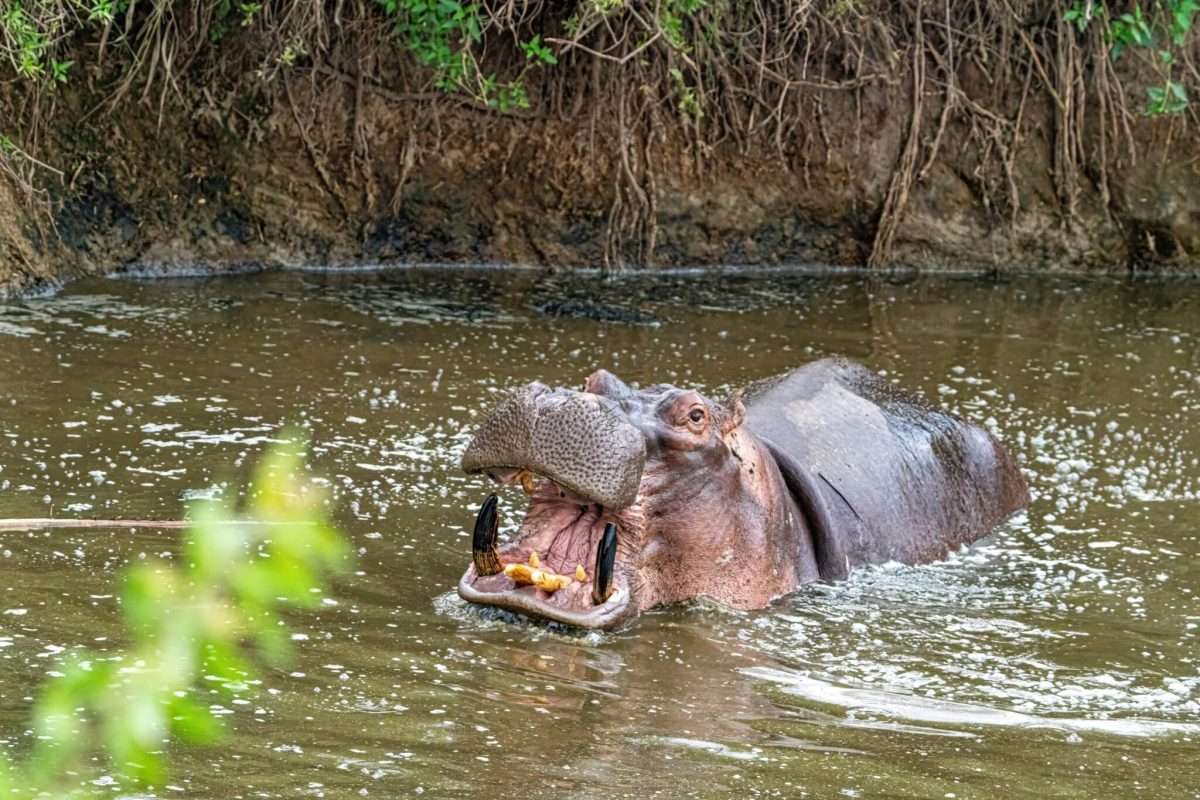
Mostly no, but there’s a real nuance here worth knowing, since it’s backed by actual field data and not just repeated online.
A study of a hippo pod on Zambia’s Luangwa River tracked yawning frequency at two points in the day: right after the hippos returned to their pool in the morning, and right before they left the pool to forage at dusk. Yawning was almost nonexistent in the morning, averaging just 0.03 yawns per hippo. In the evening, that jumped to 1.3 yawns per hippo, a more than fortyfold increase.
That pattern lines up with what’s called the brain-cooling hypothesis: a deep yawn draws in air and increases blood flow to the head, which can help cool the brain before a hippo heads out into the heat to graze. It doesn’t cancel out the threat-display explanation. Both can be true at once, and likely are, depending on context. A hippo yawning alone at dusk before heading out to feed is probably cooling down. A hippo yawning face to face with a rival, a crocodile, or a boat that’s drifted too close is not.
How Hippos Communicate Beyond the Yawn
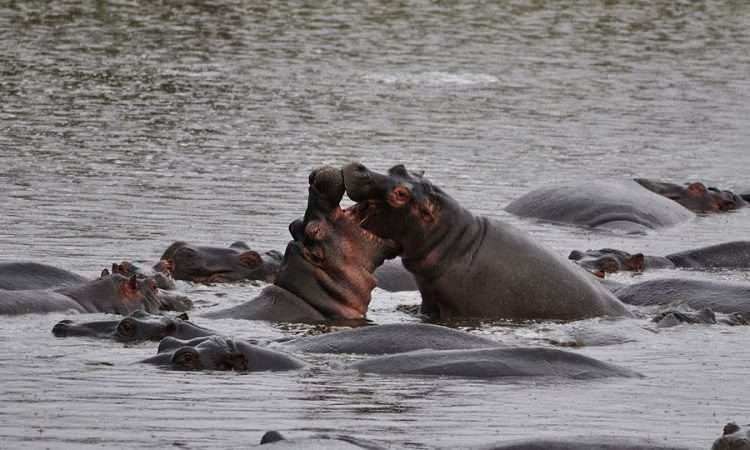
The yawn is the most visible signal, but hippos are constantly talking to each other in ways most visitors never notice.
- Their calls, honks, grunts, and roars carry a long way across water and are used to claim territory and warn off intruders.
- A chorus of hippos honking together can reach roughly 114 to 115 decibels, close to a loud rock concert, and can be heard from over a mile away.
- Part of their communication happens as infrasound, frequencies too low for human ears, which travels efficiently through water and can be picked up through the jawbones of nearby hippos.
- Researchers have found evidence that hippos use vocal recognition to track which individuals belong to which territory or pod, managing relationships between groups without ever making visual contact.
How Aggressive and Dangerous Are Hippos, Really?
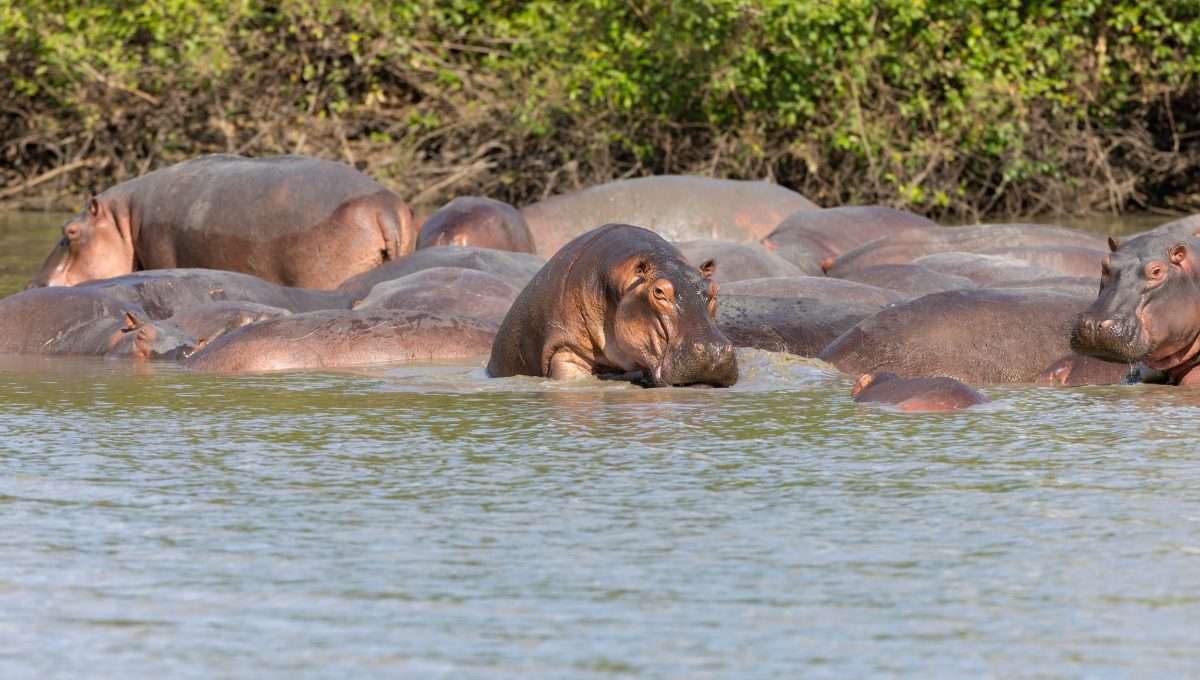
Hippos are widely described as Africa’s most dangerous large land mammal, and that reputation holds up, even if the exact numbers behind it don’t always get checked. You’ll see “500 human deaths a year” repeated across almost every article on this topic. That figure traces back to sources like National Geographic and the BBC, but fact-checkers have found the original research behind it hard to pin down, and some estimates range as high as 1,000 to 3,000 deaths a year. The honest answer is that nobody tracks this precisely, since many incidents happen in remote areas and go unreported. What’s not in dispute is that hippo attacks are unusually lethal when they do happen, and survivors often face severe injuries or amputation.
The aggression comes almost entirely from territory, not hunger. Hippos are herbivores and have no interest in eating people. What triggers an attack is nearly always one of a few situations:
- A person, boat, or vehicle getting between a hippo and its route to water.
- A perceived threat to calves, which mothers defend aggressively.
- A rival hippo, crocodile, or even a lion entering a bull’s territory. Hippos regularly kill crocodiles that stray too close to their pod, and have been documented driving off lions.
- Sudden surprise at close range, especially at dawn or dusk when hippos are out of the water grazing.
Their size and speed make any of these situations dangerous fast. An adult hippo can weigh 1.5 to 3 tons, move at roughly 19 mph over short distances on land, and deliver a bite strong enough to snap a small boat in half. None of that requires the animal to see a person as prey. Simply being in the way is enough.
Planning a Safari to See Hippos: Safety Tips
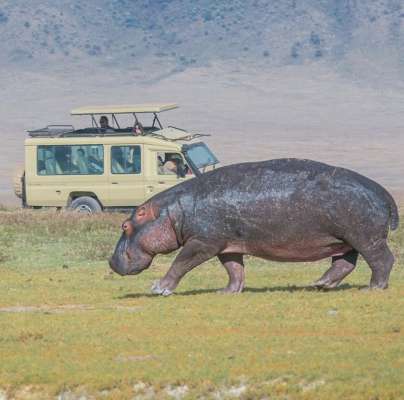
Most hippo incidents happen because someone got between a hippo and its escape route to water. A few rules keep sightings safe rather than dangerous.
- Never approach a hippo on land, even one that looks settled or half asleep. They can run at roughly 19 mph (30 km/h) over short distances, faster than most people expect from an animal that size.
- Keep a minimum distance of 30 meters (about 100 feet) on land, more if the hippo shows any sign of agitation, including gaping.
- Never position yourself between a hippo and open water. That’s the route it will take if it feels threatened, regardless of what, or who, is in the way.
- On a boat safari, let your guide control the approach and distance. Experienced guides read hippo behavior continuously and know when to hold back.
- Treat any gaping hippo as a clear warning to increase distance immediately, not a chance for a closer photo.
- Be especially cautious at dawn and dusk, when hippos leave the water to graze on land and are more likely to be encountered outside the river or pool.
Contact the team on WhatsApp to plan a Kenya or Tanzania safari with experienced guides who know how to read hippo behavior safely.
Frequently Asked Questions
Why do hippos yawn?
A hippo’s yawn, technically called a gape, is mainly a threat display used to show off its teeth, jaw size, and bite strength. It’s a warning to rivals, predators, or anything judged too close, not a sign of drowsiness.
How wide can a hippo open its mouth?
A hippo can open its jaw 150 to 180 degrees, creating a gape roughly 90 to 120 cm (3 to 4 feet) wide at full extension.
How dangerous are hippos to humans?
Very. Hippos are widely considered Africa’s most dangerous large land mammal, though the commonly cited figure of 500 deaths a year is a rough, poorly sourced estimate, with some ranges going as high as 1,000 to 3,000. Attacks are rarely about hunting for food. They almost always happen when a person, boat, or vehicle ends up between a hippo and its water source.
How long are hippo teeth?
A hippo’s canine teeth can grow up to 20 inches (50 cm) long. They’re used purely as weapons, not for eating.
Do hippos yawn because they’re tired?
Occasionally, yes, at least partly. Research on a wild hippo pod found yawning spiked sharply in the evening before hippos left the water to feed, which supports the idea that yawning also helps cool the brain. Most yawns aimed at another animal or a person, though, are still a threat display.
Why do male hippos have bigger jaws than females?
Because hippos contest territory and mates mostly underwater, where visually comparing body size is difficult. Evolution favored bigger jaws and tusks in males instead, since a wide gape display reads clearly even when the rest of the animal is submerged.
How loud are hippo sounds?
A chorus of hippos calling together can reach roughly 114 to 115 decibels, similar to a loud rock concert, and can be heard from more than a mile away. Some of their communication also happens as infrasound, below the range of human hearing.
How close is safe to get to a hippo?
Keep at least 30 meters (about 100 feet) of distance on land, and never position yourself between a hippo and its water source. On a boat safari, always follow your guide’s lead on approach distance.
Blog Summary
- A hippo’s “yawn” is a threat display, called a gape, not a sign of tiredness.
- The gape opens 150 to 180 degrees, exposing canine teeth up to 20 inches long and a bite force of around 1,800 PSI.
- Male hippos evolved oversized jaws and tusks specifically for this display, since body size is hard to judge underwater.
- New research shows some yawning may also help cool the brain, especially in the evening before hippos leave the water to feed, alongside its role as a threat display.
- Hippos communicate through honks, grunts, and infrasound, with choruses reaching up to 115 decibels and carrying over a mile.
- Hippo aggression is almost always territorial, not predatory, triggered by something coming between a hippo and its water, or too close to its calves.
- Hippos are Africa’s most dangerous large land mammal by death toll, so treat any gaping hippo as a serious warning and always keep at least 30 meters of distance.


