
Mount Kilimanjaro is Africa’s tallest mountain at 5896 metres has 3 main peaks: include Kibo at 5895m, Mwenzi 5149 meters, & Shira at 4005 meters (13140 feet).
Standing at 5,895 meters, Mount Kilimanjaro is Africa’s highest mountain and the world’s tallest free-standing peak. Located in Mount Kilimanjaro National Park in Tanzania, it attracts both first-time climbers and experienced trekkers each year.
However, the summit of Mount Kilimanjaro offers more than a sign at the top. Reaching Uhuru Peak means standing on a volcanic summit shaped by ice fields, altitude, and time. It is this combination of height, geology, and accessibility that sets Kilimanjaro apart from other mountains.
So what makes the Mount Kilimanjaro summit unique, and why does it continue to draw climbers from around the world? Below, we explain what truly defines the top of Africa’s highest mountain.
Kilimanjaro Has 3 Main Peaks Volcanic Cones Which Include
1. Kibo Volcano Cone
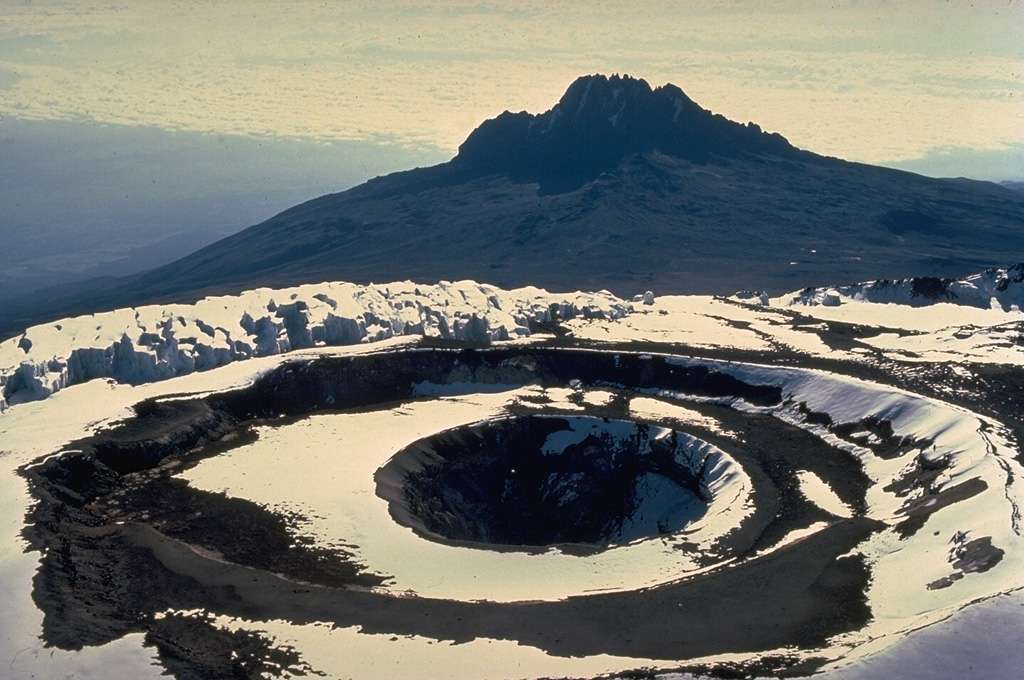
Kibo is the central and highest volcanic cone of Mount Kilimanjaro. Its summit is Uhuru Peak, which stands at 5,895 meters above sea level and makes Kilimanjaro the tallest mountain in Africa.
Kibo is a dormant stratovolcano. Scientists estimate its last major eruptive activity occurred around 200,000 years ago, shaping the broad crater and the near symmetrical cone that climbers see today. Although dormant, Kibo still shows signs of volcanic life.
At the center of the summit crater lies the Reusch Ash Pit, the true core of the volcano. Here, sulfurous gases continue to escape from vents, offering a clear reminder that Kibo is not extinct.
During the last ice age, glaciers once covered the entire summit of Kibo. Over time, rising temperatures reduced this ice cover. Modern photographs show a clear contrast with historical images, revealing how much ice has disappeared.
Even so, the remaining glaciers still define the summit landscape. Large ice walls rise sharply above dark volcanic rock and loose scree, creating one of the most striking features of the Mt Kilimanjaro peaks and the final approach to Uhuru Peak.
2. Mawenzi Volcano Cone
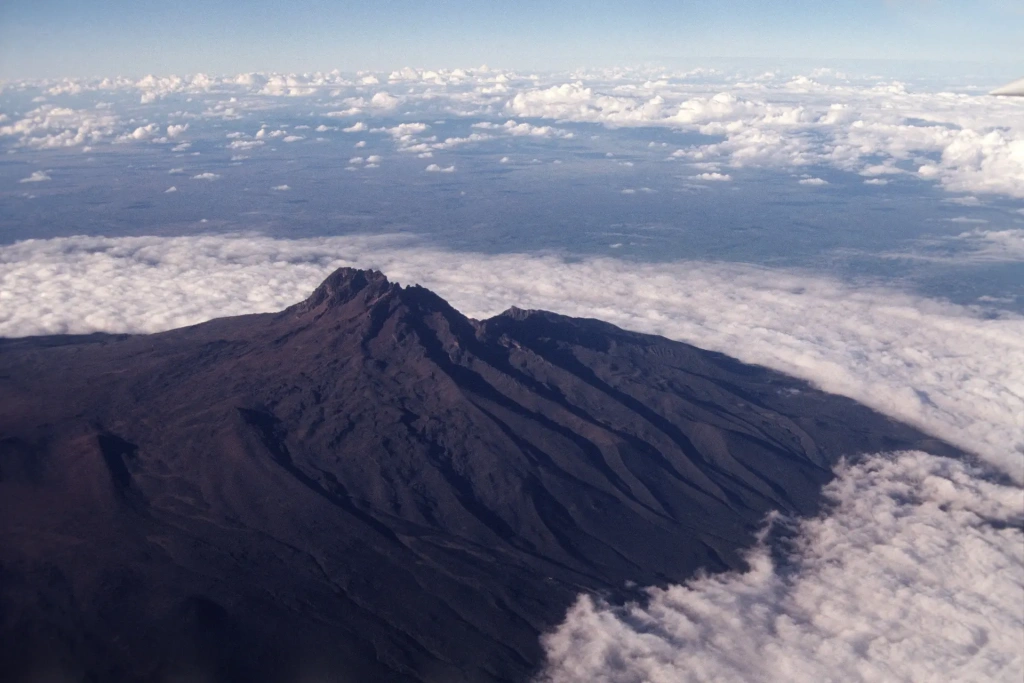
Mawenzi is the second highest Mt Kilimanjaro peak, rising to 5,149 meters above sea level at its highest point, Point Hans Meyer. This rugged cone is an extinct volcano shaped by erosion into sharp ridges and steep pinnacles.
Mawenzi is the most technically demanding of Kilimanjaro’s three peaks. Its jagged terrain and exposed rock faces make it suitable only for experienced climbers, and it is not part of the standard summit routes.
At just 50 meters lower than Mount Kenya, Mawenzi ranks as the third highest peak in Africa, after Mount Kilimanjaro and Mount Kenya, reinforcing its significance among Africa’s great mountains and within the iconic Mt Kilimanjaro peaks.
3. Shira Volcano Cone
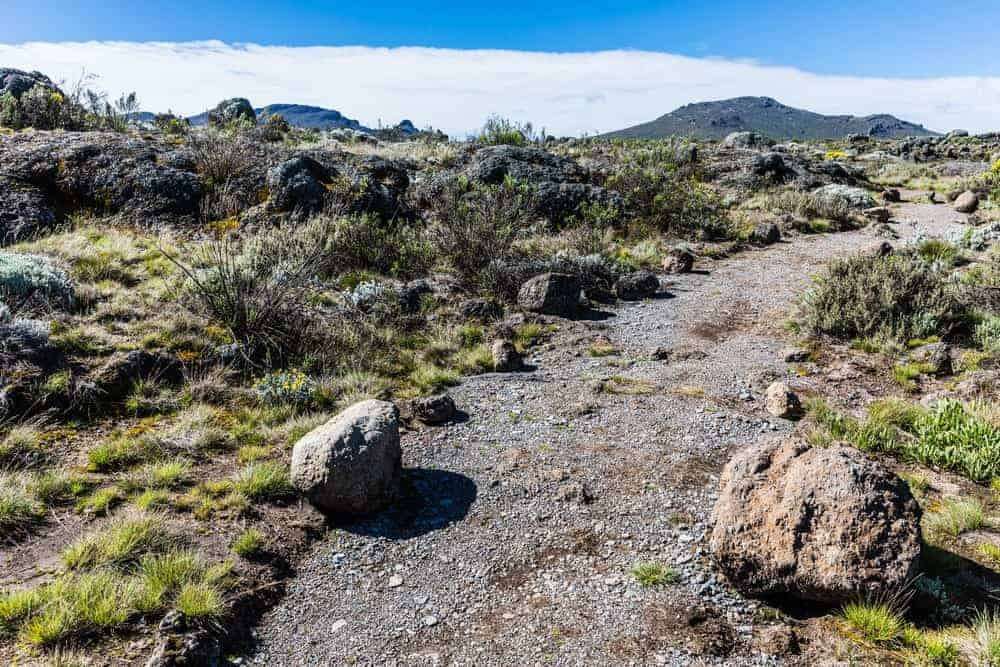
Shira Volcano Cone is the smallest and oldest of the 3 Kilimanjaro peaks. Reaching an elevation of 4,005 meters (13,140 ft). Just like the Mawenzi, Shira is also an extinct volcano. The Johnsell Point standing at 3,962 meters is Shira’s principal summit. The Shira is situated on the Western side of the mountain and is a starting point for some routes to the summit of the mountain. Sometimes referred to as the Shira plateau.
Kibo is located at the center of the mountain, Mawenzi is located in the East and Shira is located on the Western side of Kilimanjaro.
There are several routes on Mt. Kilimanjaro that can lead you to the summit of the mountain in 6-9 days. The best time to visit/climb Kilimanjaro is January to early March and June to October.
Camping in the Crater
Crater Camp the highest camp in Africa is 18,700 feet above sea level. From the crater rim, hikers descend into the caldera, and camp, below the summit, on the dry, rocky scree, with only the glaciers for company. It’s bitterly cold, the sun is harsh, and the air is thin.
The occasional cracking sound as a giant wall of ice moves ever-so-slightly is the only sound, apart from the whistling wind. Nothing grows here, no animal life and the only plant life is ancient lichens that form very slowly on the black volcanic rocks. It’s not a place you want to spend too much time.
But it’s spectacular! For well-acclimatized climbers, the chance to spend a night in the crater is not to be missed. It’s tough here, with the glaciers for company, the thin air, and bitter cold makes sleeping difficult, and the faint smell of rotten eggs reminds you that you’re in a volcano.
If you wanted to spend a night in the crater, you’d have to arrange it in advance with your Kilimanjaro tour company, as most climbs don’t include this as standard.
How Were the Mt Kilimanjaro Peaks Formed?
The Mt Kilimanjaro peaks were formed through powerful volcanic activity that unfolded over millions of years along the East African Rift system. This geological movement allowed magma from deep within the Earth’s mantle to rise to the surface through fractures in the crust, creating repeated eruptions that slowly built the mountain.
Rather than forming in a single event, Kilimanjaro developed in stages. Lava flows, ash deposits, and volcanic gases cooled and hardened layer by layer, shaping three distinct volcanic cones now known as Shira, Mawenzi, and Kibo. Each cone reflects a different phase of volcanic activity, which explains their contrasting shapes, elevations, and conditions today.
Kilimanjaro is classified as a stratovolcano because its structure is made up of alternating layers of hardened lava and volcanic ash. Over time, erosion, shifting tectonic plates, and changes in eruption intensity refined the mountain into the iconic silhouette seen today.
Characteristics of the Three Mt Kilimanjaro Peaks
Each of the Mt Kilimanjaro peaks has its own geological identity and role in the mountain’s formation.
Kibo, the youngest and highest cone, dominates the landscape. It remains dormant and holds the summit of Mount Kilimanjaro at Uhuru Peak. Its broad slopes and crater rim are remnants of massive eruptions that occurred roughly 200,000 years ago. Due to its altitude, Kibo supports glaciers and ice fields, though these are steadily retreating.
Mawenzi is an extinct volcano and far more rugged in appearance. Sharp ridges, steep rock faces, and eroded pinnacles define this cone. Mawenzi no longer shows volcanic activity and is rarely climbed due to its technical difficulty, making it the most challenging of the Kilimanjaro peaks.
Shira is the oldest of the three cones. Its original summit collapsed long ago, leaving behind a wide plateau rather than a pointed peak. Today, the Shira Plateau forms part of several popular climbing routes and offers expansive views across the mountain.
Key Differences Between the Volcanic Cones
The differences between the Mt Kilimanjaro peaks lie in their age, structure, and volcanic status.
Kibo is the tallest and most intact cone, shaped by relatively recent volcanic activity and still classified as dormant. Mawenzi, slightly lower in elevation, shows advanced erosion and dramatic terrain, marking it as fully extinct. Shira, the lowest and oldest cone, has transformed from a volcano into a high-altitude plateau after its caldera collapsed.
Together, Kibo, Mawenzi, and Shira create the layered geography that makes Mount Kilimanjaro unique. Their combined history explains why the mountain offers such varied landscapes, from gentle plains and volcanic plateaus to jagged ridges and icy summits.
What Are the Dangers of Hiking on the Mt Kilimanjaro Peaks?
Hiking across the Mt Kilimanjaro peaks is a rewarding experience, but it comes with real risks that every climber must understand before setting foot on the mountain. The main challenges include altitude sickness, extreme weather, and the geological nature of a high volcanic massif.
While Mount Kilimanjaro is classified as dormant, its elevation and rapidly changing conditions make preparation, pacing, and professional guidance essential for a safe ascent.
Altitude Sickness
Altitude sickness is the most common risk faced by climbers on the Mt Kilimanjaro peaks. As elevation increases, oxygen levels drop sharply, placing stress on the body. Symptoms often begin above 3,000 meters and may include headaches, nausea, dizziness, loss of appetite, and fatigue.
If ignored, altitude sickness can progress into serious conditions such as high altitude pulmonary edema or high altitude cerebral edema, both of which require immediate descent. Gradual acclimatization, slow ascent rates, proper hydration, and rest days are the most effective ways to reduce this risk. Listening to your guide and your body is critical at every stage of the climb.
Volcanic Activity
Mount Kilimanjaro is a stratovolcano with three cones, and while Kibo remains dormant, there is no record of recent eruptions. However, geothermal features such as fumaroles near the summit crater remind climbers of the mountain’s volcanic origin.
The risk of active eruptions is extremely low, but the volcanic terrain itself presents hazards. Loose scree, unstable ash, and steep crater edges demand careful footing, especially near the summit and inside the crater area. This is why access to certain zones is restricted and guided climbs are strongly recommended.
Harsh and Unpredictable Weather
Weather on the Mt Kilimanjaro peaks can change rapidly, even within a single day. Climbers may experience intense sun, freezing temperatures, strong winds, rain, and snow during the same ascent.
Cold-related injuries such as hypothermia and frostbite are real risks, particularly during summit night when temperatures can drop well below freezing. Climate change has also altered weather patterns on the mountain, increasing unpredictability. Proper layering, quality gear, and experienced guides who monitor conditions closely are essential for managing these challenges.
Understanding these risks does not diminish the experience. Instead, it allows climbers to prepare properly and approach Kilimanjaro with respect, awareness, and the confidence needed to reach the summit safely.
The Ash Pit on Mt Kilimanjaro
Most climbers end their ascent at the summit sign on Kibo, take photos, and begin the descent. However, climbers who camp inside the crater can continue deeper into the heart of the mountain and reach the Ash Pit, one of the most hidden features of the Mt Kilimanjaro peaks.
From Crater Camp, a steep 30 to 40 minute hike leads to the center of the volcano. Here, a near perfectly circular cone drops sharply into the earth. The Ash Pit measures roughly 400 feet wide and is made of loose scree, shale, and large volcanic boulders. Fumaroles at the base release sulfur gas and steam, filling the air with a strong sulfur scent and reminding climbers that Kibo remains a dormant volcano.
Descending into the Ash Pit is not permitted. Temperatures at the fumarole vents are estimated to reach boiling point, making the area extremely dangerous.
The Ash Pit is officially known as the Reusch Crater, named after Richard Reusch, a Lutheran missionary based in Marangu who climbed Mount Kilimanjaro multiple times. He was among the earliest recorded European climbers and played a role in documenting Kilimanjaro’s volcanic core.
Reaching the Ash Pit offers a rare perspective of Kilimanjaro beyond the summit sign and reveals the true geological power behind Africa’s highest mountain.
Uhuru Peak
Uhuru peak (which isn’t a peak, as mentioned earlier) is the highest point on the crater rim that encircles the inner caldera. It stands at 19,340 feet above sea level and is the official summit of Mt. Kilimanjaro.
Formerly known as Kaiser Wilhelm Spitze, it was named by Hans Meyer, a German geologist and the first European to summit. At independence, in 1961, the Tanzanian government renamed it Uhuru Peak, the word “uhuru” meaning “freedom” in Swahili.
Around the crater rim are other notable place names, Stella Point is the first stop on the rim for climbers coming up from Barafu camp, and it is named after Stella Latham, the wife of a member of the South African Mountain Club, Kingsley Latham. In 1925, they reached this point together. For some reason, the name has stuck. To end up in the Barafu camp you use the following routes : Machame route, Lemosho route and Umbwer route
For climbers on the Marangu route, coming via School Hut, the first point reached on the rim is Gilman’s Point. This is named after one of the founders of the East African Mountain Club (set up in 1926, arguably the first ‘tour operator’), Clement Gilman.
On the western side of the crater rim, is where the leopard was apparently found, and it’s colloquially known as “Leopard Point”, though there isn’t a signboard.
Getting to the Kilimanjaro Summit – Uhuru peak
Depending on how long your chosen route has taken you, you’ll end up at one of three main ‘basecamps’ on Mt Kilimanjaro. School Hut and Kibo hut take you up to the rim from the east via Gilman’s Point, Arrow Glacier Camp means you’ll be scaling the Western Breach, and lastly, the most-used route is via Barafu Camp in the south east.
From Barafu, it’s mostly a night-time climb, leaving camp at around midnight, and reaching the crater rim by dawn. This allows for spectacular views of the sunrise and allows enough time to descend in time for lunch. For those planning to camp in the crater, a daytime summit attempt is possible.
The trek to Kilimanjaro summit is tough. Bitterly cold, there’s very little oxygen in the air, and the trail is comprised mostly of volcanic scree. It’s a tough, 7-9 hour hike, the biggest challenge is the thin air. Which makes it all the more worth it when you do make it to the top!
FAQs About Mt Kilimanjaro Peaks
What are the three peaks of Kilimanjaro?
Mt Kilimanjaro peaks consist of three volcanic cones: Kibo, Mawenzi, and Shira.
Kibo is the central and highest cone and holds the summit of Mount Kilimanjaro.
Mawenzi is the second-highest cone, known for its sharp ridges and technical terrain.
Shira is the oldest and lowest cone, now forming a broad plateau on the western side.
How many peaks does Kilimanjaro have?
Mount Kilimanjaro has three volcanic peaks. Rising to 5,895 meters above sea level, it is the highest free-standing mountain in the world and is not part of any mountain range.
What are the summits of Mount Kilimanjaro?
The main summits on Mount Kilimanjaro are located on the rim of the Kibo crater:
Gilman’s Point at 5,685 meters (18,652 ft)
Stella Point at 5,756 meters (18,885 ft)
Uhuru Peak at 5,895 meters (19,341 ft), the highest point in Africa and the official summit.
What are the different volcanic cones found on Mount Kilimanjaro?
The volcanic cones of Mount Kilimanjaro are Kibo, Mawenzi, and Shira. Kibo is the tallest and most dominant, Mawenzi is rugged and steep, and Shira is heavily eroded due to its age.
How were the volcanic cones of Mount Kilimanjaro formed?
The Mt Kilimanjaro peaks formed through repeated volcanic eruptions over millions of years. Lava, ash, and gases built up layer by layer. The most recent significant volcanic activity occurred around 360,000 years ago, mainly affecting Kibo and Mawenzi.
Are the volcanic cones on Mount Kilimanjaro still active?
All three volcanic cones are classified as dormant. While there has been no recorded eruption for over 200 years, geothermal activity near Kibo’s crater shows that the volcano is not extinct.
What makes the volcanic cones on Mount Kilimanjaro unique?
The Mt Kilimanjaro peaks are unique because they rise near the equator yet support glaciers, ice fields, and alpine deserts. Their volcanic origins create diverse ecosystems ranging from rainforest to arctic conditions within a single climb.
Can tourists visit the volcanic cones on Mount Kilimanjaro?
Yes, climbers can visit the volcanic cones by trekking Mount Kilimanjaro via approved routes. Access to sensitive areas is regulated, and climbing with a licensed guide is strongly recommended for safety and conservation.
Which Kilimanjaro peak is climbed to reach the summit?
All summit routes lead to Kibo, where Uhuru Peak is located. Mawenzi and Shira are not summit goals for standard trekking routes.
How long does it take to climb Mount Kilimanjaro to reach the peaks?
Most climbs to the summit of Kibo take 6 to 9 days, depending on the route chosen and the pace needed for proper acclimatization.
Final Thought
Understanding the Mt Kilimanjaro peaks gives you a deeper connection to the mountain before you ever set foot on the trail. Kibo, Mawenzi, and Shira are not just volcanic cones. They shape the routes you climb, the landscapes you cross, and the experience you carry home. From the ice fields on Kibo to the rugged spires of Mawenzi and the wide Shira Plateau, Kilimanjaro is a journey through geology, altitude, and history. Reaching Uhuru Peak is not about the signboard. It is about earning your place on Africa’s highest ground with the right preparation, pace, and support.
Plan Your Kilimanjaro Climb with TourwithPipi
Climbing Mount Kilimanjaro is a serious adventure, and choosing the right team matters. At TourwithPipi, we design climbs that focus on safety, acclimatization, and real on-ground expertise. Every itinerary is built to give you the best chance of reaching Uhuru Peak while enjoying the full experience of Kilimanjaro’s peaks and landscapes.


